When to use this letter
Use this letter when a client was fired or forced out and the records suggest the reason was unlawful or breached an agreement. Typical cases:
- Termination soon after the employee complained, reported a safety or legal problem, or took protected leave.
- Termination in breach of an employment contract, or of a for-cause standard in an agreement.
- A constructive discharge, where working conditions changed so much that the employee resigned.
- Severance negotiations, where the client was offered a release and wants better terms.
- A stated reason that conflicts with the employee's reviews, discipline history or treatment of coworkers.
Many termination claims require an agency charge before suit, and the deadlines and prerequisites vary by state and by claim. The draft does not calculate them. Calendar them before negotiations start, since a demand letter generally does not stop the clock.
What to upload
Upload up to 5 PDFs, 500 pages in total. The draft can only tell the story the documents tell, so include the whole employment file you have.
- Offer letter and agreement
- The offer letter, employment contract and any handbook pages on discipline, termination or severance.
- Performance history
- Performance reviews, awards, write-ups and improvement plans, to compare with the stated reason for the firing.
- Complaints and protected activity
- HR complaints, reports of wrongdoing, leave requests and approvals, with the dates they were made.
- Termination documents
- The termination letter or email, meeting notes, and any separation agreement or release offered.
- Pay and benefits records
- Final pay stubs, W-2s and benefits summaries, so the draft can state the pay rate and lost benefits.
What the draft includes
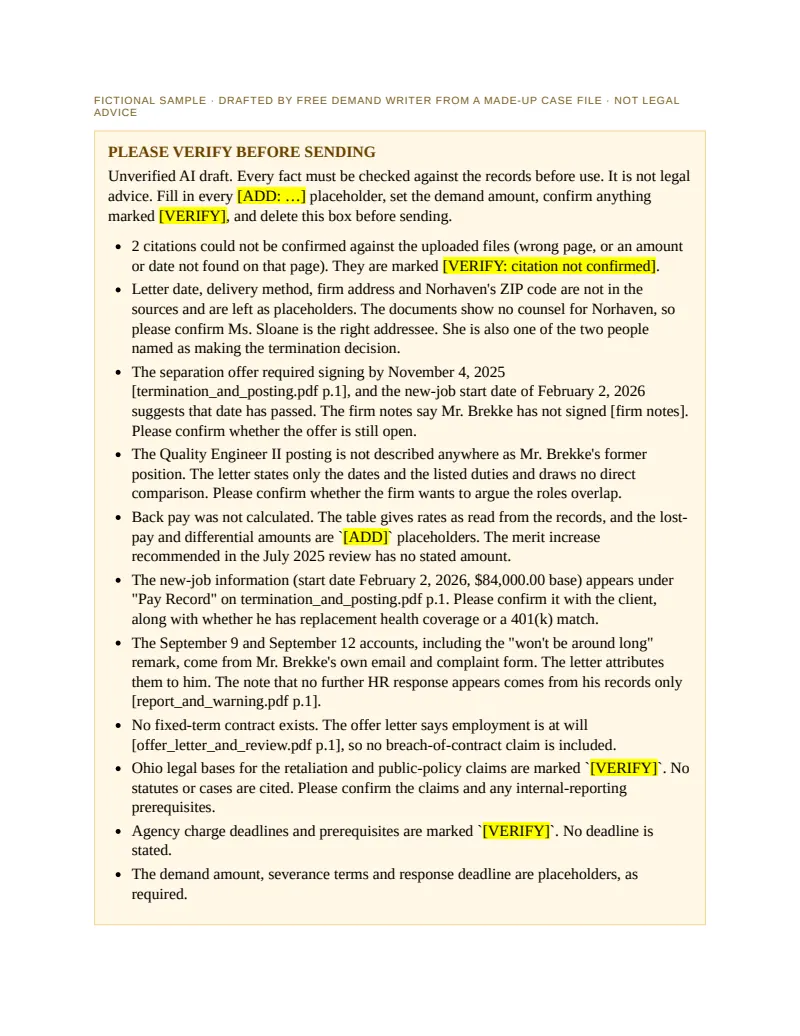
An editable Word letter built only from what your documents say. Missing facts become [ADD: …] placeholders, never guesses, and any law cited is marked [VERIFY].
- Please verify box. A short notice at the top reminding the reviewer that this is an unverified AI draft.
- Employment summary. Employer, position, dates of employment, pay and reporting line, from the records.
- Timeline. Hiring, reviews, complaints, leave, discipline and termination in date order, each cited to the page.
- The stated reason. The reason the employer gave, quoted from its own documents, set against the record.
- Basis for the claim. The facts tied to each theory your attorney may pursue, with any law named marked [VERIFY].
- Losses. Pay rate, lost benefits and time out of work the documents support, with [ADD: …] for mitigation facts.
- The demand. The amount, any severance terms and the response deadline are placeholders for you to set.
Before you send it
The result is an unverified AI draft for attorney review, not legal advice.
- Check each date and quote in the timeline against the page cited.
- Confirm which claims apply and any agency charge deadlines and prerequisites.
- Review any release, arbitration or non-disparagement terms in the agreements.
- Set the amount and deadline, and remove the Please verify box.
Common mistakes
Termination demands are read closely by employment defense counsel. These are the problems that weaken them.
- Calling the firing wrongful without a theory Where employment is at will, an unfair firing is not always an unlawful one. Tie the facts to a specific basis your attorney can support, such as retaliation, a protected trait or a contract term.
- A timeline with gaps Retaliation claims often turn on timing and on who knew what. Show the protected activity, the decision maker's knowledge of it and the adverse action in one clear sequence.
- Ignoring the stated reason The employer will rely on its documented reason. Address it directly with reviews, comparators or inconsistencies from the records, not with general denials.
- Leaving out mitigation Back pay claims usually face the question of whether the employee looked for work. Note the job search and any new income, or leave a placeholder to add them.
- Signing away rights in the reply If a severance agreement was offered, review its release, deadline and confidentiality terms before the letter accepts or rejects anything.
Free wrongful termination / severance demand letter template
Prefer to write it yourself? Download a plain Word template with fields to fill in. No AI, no email needed. Sample template, not legal advice.
Questions
Is the wrongful termination demand letter free?
Yes. No account and no payment.
Can I use it to negotiate a better severance package?
Yes. Upload the separation agreement you were offered. The draft summarizes its terms from the document and leaves the counteroffer as a placeholder for your attorney.
Will it calculate back pay?
It states the pay rate, benefits and dates the records show. The amount demanded is always left to your attorney.
Does it file an agency charge for me?
No. It drafts a letter to the employer only. Any charge, and its deadline, is for your firm to handle.
What happens to the documents I upload?
They are deleted as soon as the draft is generated. The Word file is deleted after 48 hours or 3 downloads.