When to use this letter
Use this letter when goods were delivered or services performed, the invoices are past due, and informal reminders have not worked. Typical cases:
- Unpaid invoices for goods delivered or services performed between businesses.
- Open accounts and credit accounts with a running balance, such as a supplier or distributor account.
- Overdue professional service accounts, such as consulting, engineering, agency or medical practice fees.
- Retainers, subscriptions or service contracts where the customer kept using the service but stopped paying.
Consumer debts carry extra rules. If your firm regularly collects consumer debts, federal and state debt collection laws may require specific disclosures and wording. The draft leaves a [VERIFY] placeholder for them; it does not add them for you. For a loan or a returned check, the promissory note or bounced check letter fits better.
What to upload
Upload up to 5 PDFs, 500 pages in total. A clean account history leads to an accurate balance and fewer placeholders.
- The agreement
- The signed contract, purchase order, credit application, or terms and conditions that set the price and payment terms.
- Invoices and statements
- Each unpaid invoice, plus any account statement that shows the running balance.
- Payment history
- A ledger or aging report showing payments, credits and partial payments, so the draft can show how the balance was reached.
- Proof of delivery or performance
- Signed delivery receipts, bills of lading, completion sign-offs or emails confirming the work was done.
- Personal guarantee
- If an owner signed a guarantee on the credit application, include it so the letter can address the guarantor.
- Prior reminders and replies
- Past-due notices, emails or letters, including any dispute the debtor raised.
What the draft includes
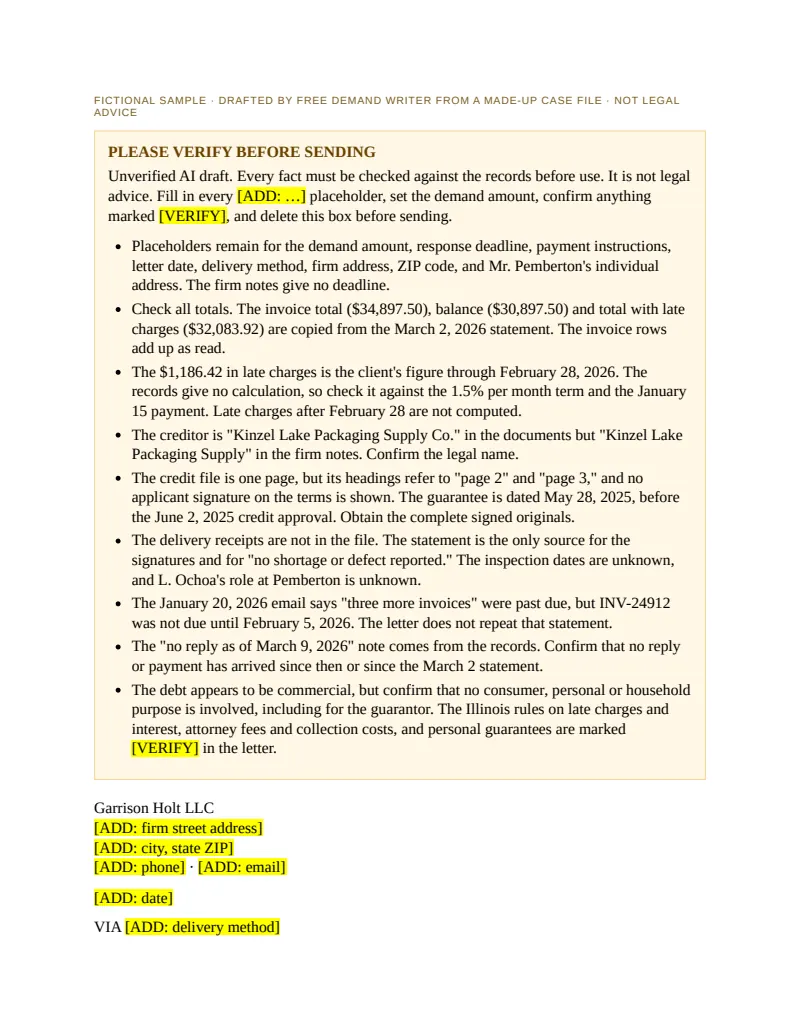
An editable Word letter built only from what your documents say. Missing facts become [ADD: …] placeholders, never guesses, and any law cited is marked [VERIFY].
- Please verify box. A short notice at the top reminding the reviewer that this is an unverified AI draft.
- Parties and account details. Creditor, debtor, account or invoice numbers and the governing agreement, as the documents show them.
- Basis of the debt. What was agreed, what was delivered, and the payment terms, cited to the file and page.
- Account summary. A table of invoices, payments and credits in date order, with a balance for you to confirm.
- Interest, fees and costs. Included only where the agreement provides for them, with the clause cited. Otherwise left as a placeholder.
- The demand. The amount to pay and the deadline are placeholders for you to set, plus how payment can be made.
- Next steps. A neutral statement of the action the client may take if the debt is not paid, for you to tailor.
Before you send it
The result is an unverified AI draft for attorney review, not legal advice.
- Reconcile the balance against the ledger. Look for credits or partial payments the draft may have missed.
- Confirm any interest rate, late fee or attorney fee clause actually applies and is part of the signed terms.
- For consumer debts, add any disclosures your jurisdiction requires and check the tone against debt collection rules.
- Set the amount and deadline, and remove the Please verify box.
Common mistakes
Invoice demands look simple, but small errors can stall payment or create exposure for the creditor and the firm.
- A balance you can't trace If the demanded amount does not match the ledger, the debtor has an easy reason to dispute it. Show how the balance was reached: invoices, payments, credits and any charges.
- Fees from terms nobody signed Late fees and interest printed only on the back of an invoice may not be part of the agreement. Point to the signed contract or credit terms, or leave the charge out.
- Overlooking consumer debt rules When a law firm regularly collects consumer debts for others, the federal Fair Debt Collection Practices Act may apply, along with state collection laws. Those rules can affect the content, tone and timing of the letter.
- Writing to the wrong entity Invoices often go to a trade name, while the contract names a company or an individual. Address the legal entity that owes the debt, and any guarantor, by their correct names.
- Ignoring a prior dispute If the debtor already disputed the bill or the quality of the work, a letter that acts as if it did not looks careless. Address the dispute with documents, or pause and review before sending.
Free unpaid invoice / collections demand letter template
Prefer to write it yourself? Download a plain Word template with fields to fill in. No AI, no email needed. Sample template, not legal advice.
Questions
Is the unpaid invoice demand letter free?
Yes. No account and no payment.
Will it add interest and late fees automatically?
Only if the uploaded agreement provides for them, and the clause is cited so you can check it. The tool never assumes a rate.
Can I use it for consumer debts?
You can, but consumer debt collection is heavily regulated. The draft flags where required disclosures may go; your firm must decide what is required and add it.
What happens to the documents I upload?
They are used only to draft the letter and deleted as soon as the draft is generated. The Word file is deleted after 48 hours or 3 downloads.