Skip to content
Free Demand Writer
Menu
Free Demand Writer

Free Civil Theft / Conversion Demand Letter

A civil theft or conversion demand letter asks a person or business to return money or property they took or kept without right, or pay its value. In some states a written demand is a required first step before a civil theft claim that can carry multiple damages and attorney fees. In others the claim is ordinary conversion and the letter is simply the last chance to resolve it before suit.

Free Demand Writer reads the bank records, receipts, ledgers and messages you upload and drafts the letter in Word. It lists each payment or item with its date, amount and source page, sets out what happened in date order, and leaves the amount, deadline and every state-specific requirement for you to confirm.

Required form. This letter often has a legally required form, content and notice period that vary by state. Check your state's rules before sending; the draft lists them to verify.

New to this kind of letter? Our guide explains what goes into a demand letter, when to send one and what happens next.

  • Free
  • No sign-up
  • Editable Word (.docx)
  • Files deleted after drafting

When to use this letter

Use this letter when your client's money or property was taken or kept by someone with no right to it. Typical cases:

  • A bookkeeper or employee moved company funds into personal accounts.
  • A business partner took client payments, inventory or equipment after a falling out.
  • A contractor or agent took a deposit or funds held for a purpose and kept them.
  • A caretaker or relative used an elderly person's money or cards without permission.
  • A buyer took goods and never paid, or a former tenant removed fixtures or equipment.

This letter often has a legally required form, content and notice period that vary by state, and it must be checked before sending. Some states require a written pre-suit demand for a set amount before a civil theft claim, and the rules on multiple damages and fees differ. The draft flags these points instead of stating them.

What to upload

Upload up to 5 PDFs, 500 pages in total. Records that trace the money or property matter most.

Proof of ownership
Receipts, titles, invoices, account statements or other records showing the money or property belonged to your client.
Financial records
Bank and card statements, ledgers, canceled checks and transfer records that show where the money went.
Agreements
Any employment, partnership, escrow or service agreement that explains why the recipient had access.
Correspondence
Emails, texts and letters asking for return, and anything the recipient said in reply.
Investigation records
Internal audit findings, accountant reports or inventory counts, if your client has them.

What the draft includes

An editable Word letter built only from what your documents say. Missing facts become [ADD: …] placeholders, never guesses, and any law cited is marked [VERIFY].

  1. Please verify box. A short notice at the top reminding the reviewer that this is an unverified AI draft.
  2. Money or property table. Each payment or item with its date, amount or value and the page it comes from.
  3. Proof of ownership. The records showing your client's right to the money or property, cited.
  4. What happened. How the recipient came to hold it and what was done with it, in date order, from the documents only.
  5. Earlier requests. Any prior demands for return and the responses.
  6. The demand. Return or payment by a deadline, with the amount and deadline as placeholders.
  7. Required form and notice. [VERIFY] points for the state's pre-suit demand rules, multiple damages and fees.

Before you send it

The result is an unverified AI draft for attorney review, not legal advice.

  • Confirm whether the state has a civil theft statute and what form, content, amount and delivery method a pre-suit demand needs.
  • Trace every listed payment or item to the cited record, and check the total.
  • Make sure the letter describes conduct, not motive, unless the records show intent.
  • Set the amount and deadline, and remove the Please verify box.
  • Confirm the letter contains no threat of criminal prosecution.

Common mistakes

Civil theft demands draw close scrutiny. These are the errors most worth fixing before the letter goes out.

  • Threatening criminal charges Linking payment to a police report or prosecution can create ethics and extortion problems. Keep the letter to civil remedies.
  • Missing a pre-suit requirement Where a state requires a written demand before a civil theft claim, the wrong form, amount or timing can cost the enhanced remedy. Check the rule before sending.
  • Stating a multiplier from memory Whether multiple damages are available, and how they are counted, varies by state. Confirm it rather than quoting a figure.
  • Overstating the evidence Calling someone a thief without proof invites a defamation claim. Describe what the records show and let the facts carry the letter.
  • Ignoring a contract dispute If the recipient has a plausible claim to the money under an agreement, a theft claim may not fit. Consider a breach of contract or accounting demand instead.

Free civil theft / conversion demand letter template

Prefer to write it yourself? Download a plain Word template with fields to fill in. No AI, no email needed. Sample template, not legal advice.

Questions

Is the civil theft demand letter free?

Yes. No account and no payment.

Does it state the damages multiplier for my state?

No. Whether multiple damages are available, and how they are calculated, varies by state. The draft marks the point [VERIFY] for you to confirm.

Can it be used as a statutory pre-suit demand?

It can be the starting point, but your attorney must check the required form, content, amount, response period and delivery method before it is sent.

Will the letter mention police or criminal charges?

No. The draft is written to seek civil remedies only and never threatens criminal prosecution.

What if the recipient says the money was a loan or a gift?

Upload the messages and records that bear on it. The draft reports what they show and flags any conflict in the Please verify box.

What happens to the documents I upload?

They are deleted as soon as the draft is generated. The Word file is deleted after 48 hours or 3 downloads.
Fictional sample

See a sample draft

We made up a case file and ran it through Free Demand Writer, the same way your documents would be. This is the unedited draft. Everything in it is fictional: the people, the companies and the facts. A Connecticut cabinet shop found that its former part-time bookkeeper wrote company checks to herself and paid her own credit card from the business account.

Fictional case file: bookkeeper_engagement_letter.pdf, accountant_review_findings.pdf, bank_records_excerpt.pdf · State: Connecticut

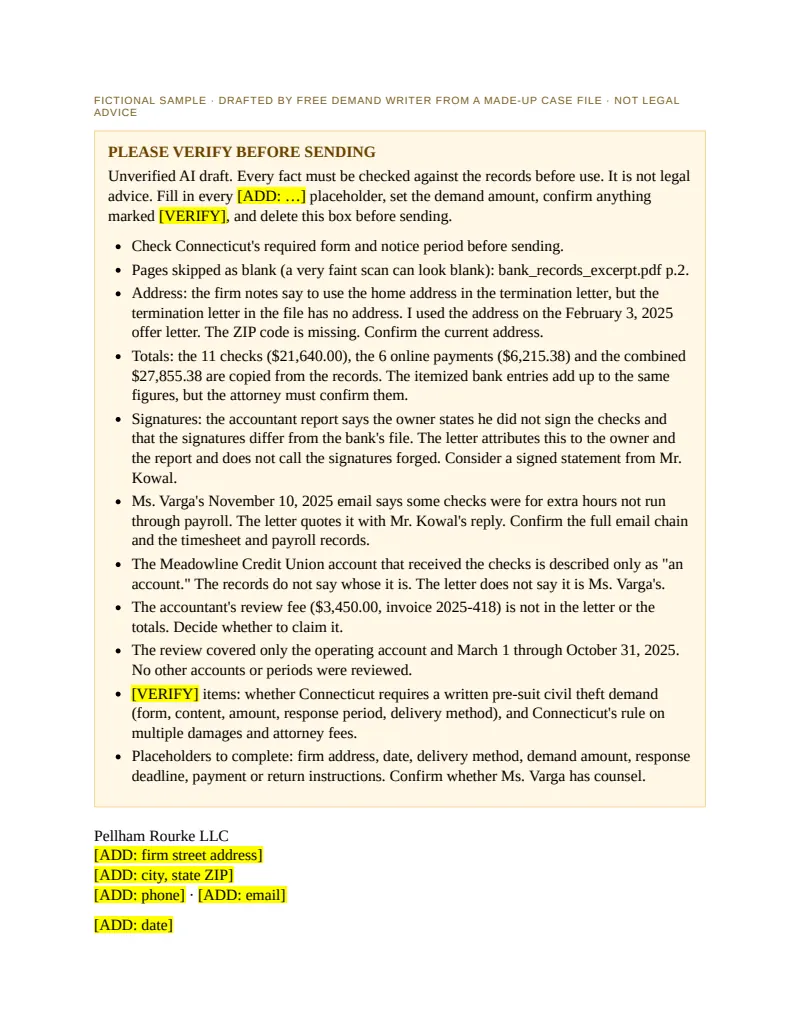
Page 1 of a fictional sample civil theft / conversion demand letter drafted by Free Demand Writer Download sample PDF

Fictional sample. Not legal advice. Your draft is built from your own documents.

Fictional sample · letter text

PLEASE VERIFY BEFORE SENDING

Unverified AI draft. Every fact must be checked against the records before use. It is not legal advice. Fill in every [ADD: …] placeholder, set the demand amount, confirm anything marked [VERIFY], and delete this box before sending.

  • Check Connecticut's required form and notice period before sending.
  • Pages skipped as blank (a very faint scan can look blank): bank_records_excerpt.pdf p.2.
  • Address: the firm notes say to use the home address in the termination letter, but the termination letter in the file has no address. I used the address on the February 3, 2025 offer letter. The ZIP code is missing. Confirm the current address.
  • Totals: the 11 checks ($21,640.00), the 6 online payments ($6,215.38) and the combined $27,855.38 are copied from the records. The itemized bank entries add up to the same figures, but the attorney must confirm them.
  • Signatures: the accountant report says the owner states he did not sign the checks and that the signatures differ from the bank's file. The letter attributes this to the owner and the report and does not call the signatures forged. Consider a signed statement from Mr. Kowal.
  • Ms. Varga's November 10, 2025 email says some checks were for extra hours not run through payroll. The letter quotes it with Mr. Kowal's reply. Confirm the full email chain and the timesheet and payroll records.
  • The Meadowline Credit Union account that received the checks is described only as "an account." The records do not say whose it is. The letter does not say it is Ms. Varga's.
  • The accountant's review fee ($3,450.00, invoice 2025-418) is not in the letter or the totals. Decide whether to claim it.
  • The review covered only the operating account and March 1 through October 31, 2025. No other accounts or periods were reviewed.
  • [VERIFY] items: whether Connecticut requires a written pre-suit civil theft demand (form, content, amount, response period, delivery method), and Connecticut's rule on multiple damages and attorney fees.
  • Placeholders to complete: firm address, date, delivery method, demand amount, response deadline, payment or return instructions. Confirm whether Ms. Varga has counsel.

Pellham Rourke LLC
[ADD: firm street address]
[ADD: city, state ZIP]
[ADD: phone] · [ADD: email]

[ADD: date]

VIA [ADD: delivery method]

Celia Varga
27 Wren Hollow Drive
Elmstead, Connecticut [ADD: ZIP]

Re: Demand for Return of Northfork Millwork LLC Funds. Client: Northfork Millwork LLC. Payments made April 11, 2025 through October 30, 2025

Dear Ms. Varga:

Introduction

This firm represents Northfork Millwork LLC ("Northfork") [firm notes]. We write about company money paid to you, or to a credit card account in your name, from Northfork's operating account at Granite Harbor Savings Bank between April 11, 2025 and October 30, 2025. Northfork did not approve these payments. Please direct all further communication about this matter to us.

The money or property

Northfork's outside accountants, Bayliss & Cho CPAs, reviewed the disbursements from the operating account for March 1, 2025 through October 31, 2025. They identified 11 checks payable to "Celia Varga" or "C. Varga" and 6 online payments to a credit card account in your name [accountant_review_findings.pdf p.1]. The bank's records show the following items [bank_records_excerpt.pdf p.1]:

ItemDate paidAmountSource
Check 4108, payable to Celia VargaApril 11, 2025$1,480.00[bank_records_excerpt.pdf p.1]
Check 4131, payable to Celia VargaMay 2, 2025$1,725.00[bank_records_excerpt.pdf p.1]
Online payment, card account, C. VargaMay 20, 2025$842.17[bank_records_excerpt.pdf p.1]
Check 4157, payable to C. VargaJune 6, 2025$2,150.00[bank_records_excerpt.pdf p.1]
Check 4170, payable to Celia VargaJune 24, 2025$1,960.00[bank_records_excerpt.pdf p.1]
Online payment, card account, C. VargaJuly 3, 2025$1,105.40[bank_records_excerpt.pdf p.1]
Check 4192, payable to Celia VargaJuly 18, 2025$2,040.00[bank_records_excerpt.pdf p.1]
Check 4203, payable to C. VargaAugust 1, 2025$1,890.00[bank_records_excerpt.pdf p.1]
Online payment, card account, C. VargaAugust 15, 2025$978.65[bank_records_excerpt.pdf p.1]
Check 4221, payable to Celia VargaAugust 29, 2025$2,310.00[bank_records_excerpt.pdf p.1]
Online payment, card account, C. VargaSeptember 5, 2025$1,264.90[bank_records_excerpt.pdf p.1]
Check 4236, payable to Celia VargaSeptember 12, 2025$2,085.00[bank_records_excerpt.pdf p.1]
Check 4244, payable to C. VargaSeptember 26, 2025$1,995.00[bank_records_excerpt.pdf p.1]
Online payment, card account, C. VargaOctober 3, 2025$1,036.26[bank_records_excerpt.pdf p.1]
Check 4259, payable to Celia VargaOctober 10, 2025$2,140.00[bank_records_excerpt.pdf p.1]
Check 4268, payable to Celia VargaOctober 24, 2025$1,865.00[bank_records_excerpt.pdf p.1]
Online payment, card account, C. VargaOctober 30, 2025$988.00[bank_records_excerpt.pdf p.1]

The 11 checks total $21,640.00. The 6 online payments total $6,215.38 [bank_records_excerpt.pdf p.1; accountant_review_findings.pdf p.1].

Total (as read from the bank records): $27,855.38 [accountant_review_findings.pdf p.1]

The funds came from the business checking account of Northfork Millwork LLC at Granite Harbor Savings Bank [bank_records_excerpt.pdf p.1]. Northfork's owner, Martin Kowal, is the only authorized signer on that account [bookkeeper_engagement_letter.pdf p.1].

What happened

Northfork offered you the part-time position of Bookkeeper by letter dated February 3, 2025, at $26.00 per hour. You accepted on February 5, 2025, and your start date was February 17, 2025 [bookkeeper_engagement_letter.pdf p.1]. The letter set out your duties. They included preparing checks for the owner's approval, running payroll through the company's payroll service, and reconciling the operating account each month and giving the reconciliation to the owner [bookkeeper_engagement_letter.pdf p.1].

The letter also stated that you could prepare checks but could not sign them. It stated that you were not authorized to pay any personal expense of any person from company funds, and that your pay was processed only through the payroll service [bookkeeper_engagement_letter.pdf p.1].

On February 17, 2025, you signed a company policy acknowledgment. It states: "I understand that company funds may be used only for approved company expenses, and that any check, transfer or payment to an employee outside payroll requires the owner's written approval." [bookkeeper_engagement_letter.pdf p.1]

The accountants' review found the following:

  • None of the 11 checks payable to you was recorded in the payroll service [accountant_review_findings.pdf p.1].
  • In Northfork's accounting software, each check was entered as a payment to a lumber vendor, Stillwater Hardwoods [accountant_review_findings.pdf p.1].
  • Mr. Kowal states that he did not sign any of the checks, and the signatures differ from his signature on file with the bank [accountant_review_findings.pdf p.1].
  • All of the checks were endorsed "Celia Varga" and deposited to an account at Meadowline Credit Union [bank_records_excerpt.pdf p.1].
  • The 6 online payments went to a credit card account in your name between May 2025 and October 2025. They were recorded in the software as "shop supplies" [accountant_review_findings.pdf p.1].
  • The monthly reconciliations you gave Mr. Kowal for April through September 2025 omitted these items, although the bank statements show them [accountant_review_findings.pdf p.1].

On November 4, 2025, Mr. Kowal noticed a check to "C. Varga" that he did not remember signing, and he asked the accountants to review the account [accountant_review_findings.pdf p.1]. Northfork ended your employment on November 6, 2025, by a letter delivered to you by hand [bank_records_excerpt.pdf p.1]. The accountants issued their report on December 8, 2025 [accountant_review_findings.pdf p.1].

Requests and response

The November 6, 2025 termination letter told you that Northfork had found company checks payable to you and payments to your personal credit card that were not approved [bank_records_excerpt.pdf p.1].

On November 10, 2025, you wrote to Mr. Kowal: "I covered a lot of extra hours this year that never went through payroll. Some of those checks were for that. I'm willing to talk but I don't think I owe the whole amount." [bank_records_excerpt.pdf p.1]

On November 12, 2025, Mr. Kowal replied that you never reported any extra hours and that payroll paid every hour on your timesheets. He asked you to repay the full amount [bank_records_excerpt.pdf p.1]. Your email did not address the 6 online payments to the credit card account in your name. We have no record that any amount has been repaid [ADD: confirm with client whether any repayment has been made].

Demand

On behalf of Northfork, we demand that you return the funds described above, or pay Northfork [ADD: demand amount], by [ADD: response deadline]. Payment or return should be made as follows: [ADD: payment or return instructions].

Required form and notice

[VERIFY: whether Connecticut requires a written pre-suit civil theft demand, and its required form, content, amount, response period and delivery method]

[VERIFY: Connecticut rule on multiple damages and attorney fees for civil theft or conversion]

If the funds are not returned or paid as demanded, Northfork may seek all damages and fees the law allows.

Sincerely,

Caroline M. Pellham
Pellham Rourke LLC