When to use this letter
Use this letter when a former client's lawyer made an error that caused a measurable loss, and you want to open talks with the lawyer or their carrier before or alongside suit. Typical cases:
- A missed statute of limitations or filing deadline that ended a valid claim.
- A missed court date, discovery deadline or appeal deadline that led to dismissal, default or sanctions.
- A settlement entered without the client's authority, or advice to settle that the record shows was unsound.
- A transactional error, such as a contract, deed or estate plan that failed to do what the client asked.
Legal malpractice claims often need expert support on the standard of care, and some states require it at an early stage. Filing deadlines vary by state and may start running when the client learns of the error. The draft marks these points [VERIFY] for your attorney to check.
What to upload
Upload up to 5 PDFs, 500 pages in total. The engagement letter and the parts of the underlying file that show the error matter most.
- The engagement letter
- The retainer or fee agreement that sets the scope of the representation, plus any later scope changes.
- The underlying file
- Pleadings, dockets, court orders and rulings, or the transaction documents, that show what was at stake and what went wrong.
- Correspondence
- Emails and letters between the client and the attorney about the matter, the deadline or the error.
- Proof of the lost outcome
- Offers, verdicts in similar claims, damages evidence from the underlying case, or a successor attorney's assessment.
- Fees and costs
- Invoices paid to the attorney and to successor counsel to fix the error.
- Expert opinion
- A written opinion from an attorney expert on the standard of care, if you have one and choose to rely on it.
What the draft includes
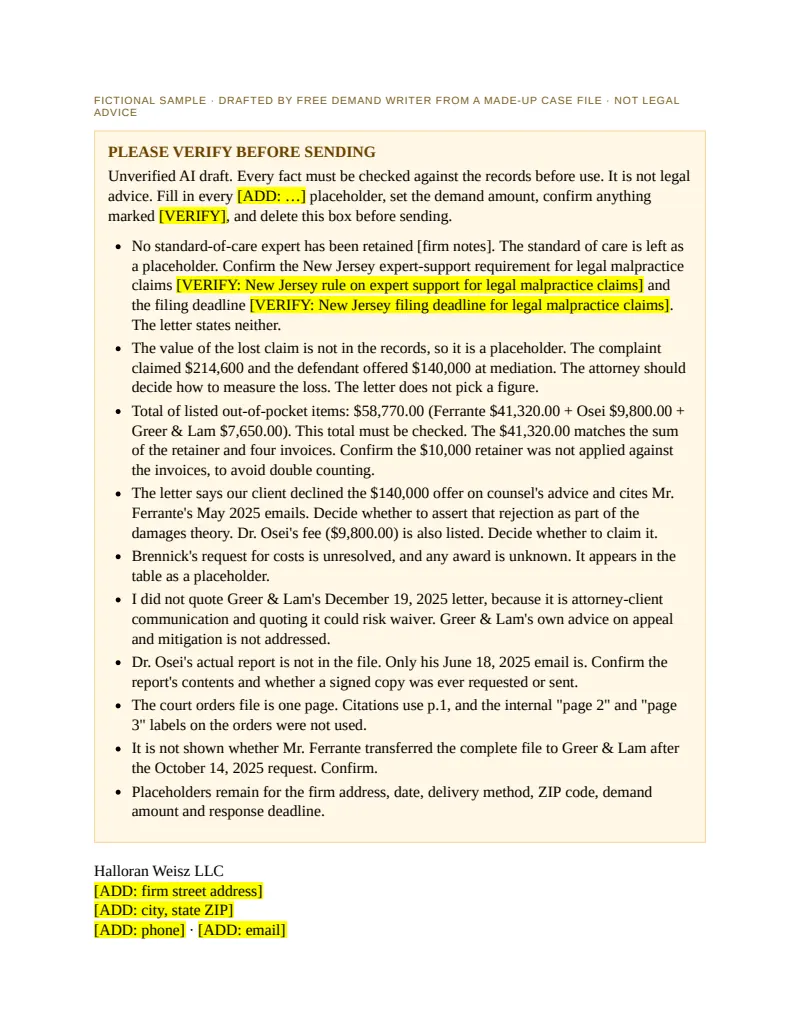
An editable Word letter built only from what your documents say. Missing facts become [ADD: …] placeholders, never guesses, and any law cited is marked [VERIFY].
- Please verify box. A short notice at the top reminding the reviewer that this is an unverified AI draft.
- The engagement. When the representation began, its scope and fee terms, cited to the engagement letter.
- The underlying matter. What the case or transaction was about, drawn only from the file.
- The error. What the attorney did or failed to do, in date order, cited to dockets, orders and correspondence.
- The case within a case. What the record shows the outcome would have been but for the error, with placeholders where proof is missing.
- Damages table. Lost recovery, fees paid and costs to fix the error, each tied to a source document.
- The demand. The amount and response deadline are always placeholders for you to set.
Before you send it
The result is an unverified AI draft for attorney review, not legal advice.
- Confirm the standard of care statements with a qualified attorney expert.
- Test the case within a case: would the underlying claim have succeeded, and could the judgment have been collected?
- Check your state's filing deadline for legal malpractice and when it began to run.
- Match every date and ruling to the cited page in the file.
- Set the amount and deadline, and remove the Please verify box.
Common mistakes
Malpractice carriers defend these claims with experienced counsel. These are the gaps they look for first.
- Proving the error but not the loss A missed deadline is not enough on its own. The letter must show that the underlying claim had value and that the client would likely have recovered it.
- Ignoring collectibility If the underlying defendant had no assets or insurance, the carrier will argue the lost judgment was worth little. Address it with documents where you can.
- Relying on hindsight A strategy call that turned out badly is not always negligence. Tie the claim to a clear departure from what a careful attorney would have done.
- Missing the engagement scope The attorney may argue the task was outside the engagement. Quote the engagement letter and any emails that expanded the scope.
- Waiting too long Filing deadlines may start when the client discovers the error, not when it happened. Calendar the deadline before sending the letter.
Free legal malpractice demand letter template
Prefer to write it yourself? Download a plain Word template with fields to fill in. No AI, no email needed. Sample template, not legal advice.
Questions
Is the legal malpractice demand letter free?
Yes. No account and no payment.
What is the case within a case?
It is the part of the claim that shows what the client would have won or saved in the original matter if the attorney had not made the error. The draft builds it only from the records you upload and leaves gaps as placeholders.
Does the draft give a standard of care opinion?
No. It uses an expert's written opinion if you upload one, and otherwise leaves a placeholder. Some states require expert support for these claims; the draft marks this [VERIFY].
What happens to the documents I upload?
They are deleted as soon as the draft is generated. The Word file is deleted after 48 hours or 3 downloads.