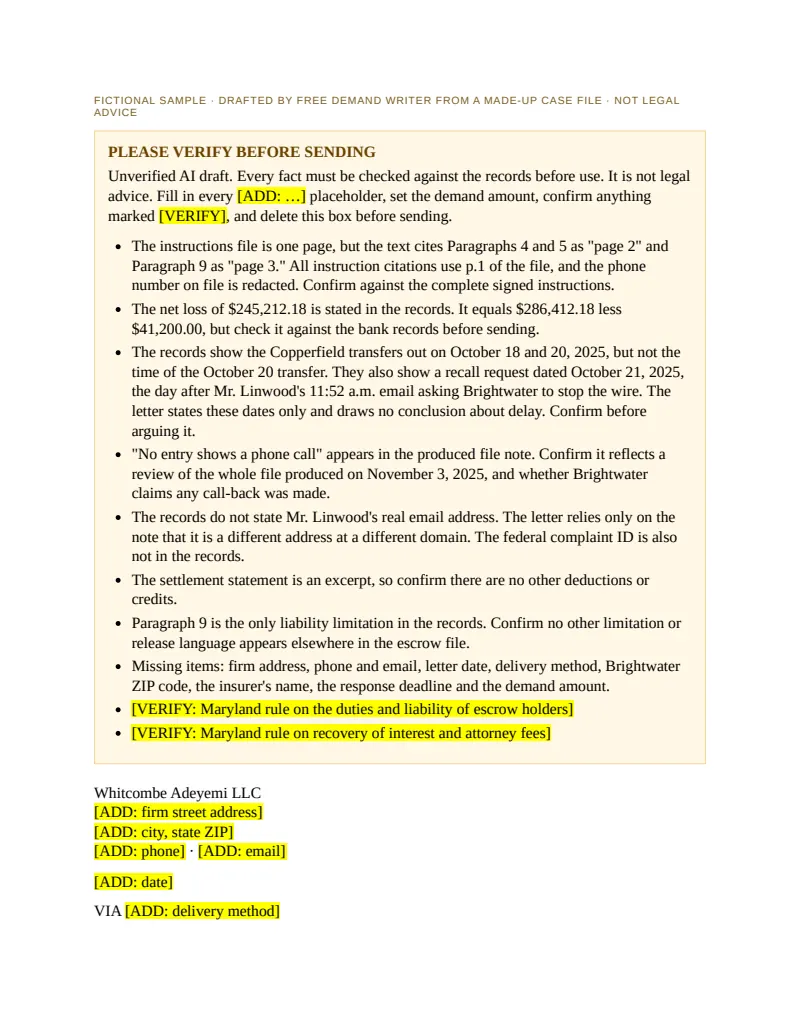
PLEASE VERIFY BEFORE SENDING
Unverified AI draft. Every fact must be checked against the records before use. It is not legal advice. Fill in every [ADD: …] placeholder, set the demand amount, confirm anything marked [VERIFY], and delete this box before sending.
- The instructions file is one page, but the text cites Paragraphs 4 and 5 as "page 2" and Paragraph 9 as "page 3." All instruction citations use p.1 of the file, and the phone number on file is redacted. Confirm against the complete signed instructions.
- The net loss of $245,212.18 is stated in the records. It equals $286,412.18 less $41,200.00, but check it against the bank records before sending.
- The records show the Copperfield transfers out on October 18 and 20, 2025, but not the time of the October 20 transfer. They also show a recall request dated October 21, 2025, the day after Mr. Linwood's 11:52 a.m. email asking Brightwater to stop the wire. The letter states these dates only and draws no conclusion about delay. Confirm before arguing it.
- "No entry shows a phone call" appears in the produced file note. Confirm it reflects a review of the whole file produced on November 3, 2025, and whether Brightwater claims any call-back was made.
- The records do not state Mr. Linwood's real email address. The letter relies only on the note that it is a different address at a different domain. The federal complaint ID is also not in the records.
- The settlement statement is an excerpt, so confirm there are no other deductions or credits.
- Paragraph 9 is the only liability limitation in the records. Confirm no other limitation or release language appears elsewhere in the escrow file.
- Missing items: firm address, phone and email, letter date, delivery method, Brightwater ZIP code, the insurer's name, the response deadline and the demand amount.
- [VERIFY: Maryland rule on the duties and liability of escrow holders]
- [VERIFY: Maryland rule on recovery of interest and attorney fees]
Whitcombe Adeyemi LLC
[ADD: firm street address]
[ADD: city, state ZIP]
[ADD: phone] · [ADD: email]
[ADD: date]
VIA [ADD: delivery method]
Janelle Corbin, Escrow Officer
Neil Ashdown, President
Brightwater Title & Escrow LLC
1200 Harbor Gate Boulevard, Suite 210
Anselm Point, Maryland [ADD: ZIP]
Re: Demand for repayment of misdirected seller proceeds. Arthur Linwood, Brightwater File No. BTE-25-3817, 46 Heron Marsh Road, Calder Creek, Maryland. Settlement and wire date: October 17, 2025
Dear Janelle Corbin and Neil Ashdown:
Introduction
This firm represents Arthur Linwood [firm notes]. We write about Brightwater Title & Escrow LLC ("Brightwater") escrow no. BTE-25-3817 for the sale of 46 Heron Marsh Road, Calder Creek, Maryland [seller_escrow_instructions.pdf p.1]. Brightwater wired Mr. Linwood's sale proceeds of $286,412.18 to an account he does not own, on the strength of an email from a look-alike address. Brightwater did not make the confirmation call that its own written instructions required. Mr. Linwood has recovered only $41,200.00. We demand that Brightwater repay the unrecovered proceeds, as set out below. We also ask that Brightwater notify its errors and omissions insurer of this claim immediately [firm notes].
The transaction and escrow instructions
Mr. Linwood sold the property to Rohan and Elise Matthers for $465,000.00, with settlement scheduled for October 17, 2025. Janelle Corbin was the escrow officer [seller_escrow_instructions.pdf p.1]. The seller-side settlement statement for that date shows the following [settlement_statement_and_wire.pdf p.1]:
- Payoff of first mortgage, Larkfield Home Loans: $158,206.44
- Real estate commission: $23,250.00
- Seller share of transfer and recording taxes: $4,882.50
- Settlement and title fees: $1,385.00
- Credit to seller for prepaid county taxes: $9,136.12
- Cash to seller: $286,412.18
On September 26, 2025, Mr. Linwood signed, and Ms. Corbin accepted for Brightwater, Seller's Escrow and Disbursement Instructions [seller_escrow_instructions.pdf p.1]. Several provisions matter here:
- Paragraph 3 directs that Mr. Linwood's net proceeds "will be sent by wire" to an account at Tidewater Commonwealth Bank, account holder Arthur Linwood, account ending 4410. Mr. Linwood gave these details in person at the title office on September 26, 2025 [seller_escrow_instructions.pdf p.1].
- Paragraph 4 states: "Brightwater will not change any wire instructions based on an email, fax or text alone. Any change must be confirmed by Brightwater by a telephone call placed to Seller at the phone number listed in this file on the date these instructions were signed, and documented in the file before funds are sent." [seller_escrow_instructions.pdf p.1]
- Paragraph 5 warns: "Criminals target real estate closings." [seller_escrow_instructions.pdf p.1]
- Paragraph 9 states: "Brightwater's liability is limited to the exercise of reasonable care in carrying out these instructions." [seller_escrow_instructions.pdf p.1]
What went wrong
The records show the following sequence.
- October 16, 2025, 3:58 p.m. Ms. Corbin received an email in Mr. Linwood's name from arthur.linwood.home@mailbox-secure.net. It asked her to send his "closing money to my new account at Copperfield National Bank, account ending 7759," and said "Please do not call, I'm in meetings all day." [emails_and_police_report.pdf p.1] The email address Brightwater's file holds for Mr. Linwood, and had used for every earlier message, is a different address at a different domain [emails_and_police_report.pdf p.1].
- October 16, 2025, 4:10 p.m. Ms. Corbin replied to the new address: "Got it, Arthur. I've updated your wire instructions for tomorrow." [emails_and_police_report.pdf p.1]
- October 16, 2025, 4:12 p.m. Brightwater's file note reads: "Seller emailed updated wire info, new bank. Updated in system. JC." [settlement_statement_and_wire.pdf p.1] No entry in the file shows a telephone call to Mr. Linwood about the change [settlement_statement_and_wire.pdf p.1]. Brightwater produced this file to Mr. Linwood on November 3, 2025 [settlement_statement_and_wire.pdf p.1].
- October 17, 2025, 2:48 p.m. Brightwater wired $286,412.18, referenced "BTE-25-3817 seller proceeds," to Copperfield National Bank, account ending 7759. The wire was authorized by J. Corbin [settlement_statement_and_wire.pdf p.1]. Mr. Linwood's Tidewater Commonwealth Bank statement for the account ending 4410 shows no incoming wire from Brightwater in October or November 2025 [settlement_statement_and_wire.pdf p.1].
- October 20, 2025. At 9:14 a.m., Mr. Linwood emailed Ms. Corbin from his real address to say his proceeds had not arrived at Tidewater [emails_and_police_report.pdf p.1]. At 11:40 a.m., Ms. Corbin answered: "we sent it to the new account you gave us on the 16th. Did you not send that email?" [emails_and_police_report.pdf p.1] At 11:52 a.m., Mr. Linwood replied that he never changed his bank and never sent that email, and asked Brightwater to stop the wire [emails_and_police_report.pdf p.1]. The same day he filed a Federal Internet Crime Complaint [emails_and_police_report.pdf p.1].
- October 21, 2025. Mr. Linwood reported the loss to the Calder Creek County Police Department, Incident Report 25-118842, which was referred to the financial crimes unit [emails_and_police_report.pdf p.1]. Brightwater's recall request to Copperfield National Bank is also dated October 21, 2025 [settlement_statement_and_wire.pdf p.1].
- November 12, 2025. Copperfield National Bank wrote to Brightwater that it had returned $41,200.00, "the balance remaining in the receiving account." It stated that the remaining funds "were transferred out on October 18 and October 20, 2025 and are not available." [settlement_statement_and_wire.pdf p.1]
- November 18, 2025. Brightwater issued Mr. Linwood a check for $41,200.00 (recalled funds) [settlement_statement_and_wire.pdf p.1].
- December 9, 2025. Mr. Ashdown wrote to Mr. Linwood that Brightwater "followed the instructions it received from what appeared to be your email" and does "not accept responsibility for the loss." [emails_and_police_report.pdf p.1]
Brightwater's own Paragraph 4 provides that no wire instruction would be changed "based on an email, fax or text alone." It required a telephone call to Mr. Linwood at the number in the file, documented before funds were sent. The file shows an email from an address that was not Mr. Linwood's, a same-day change in the system, and a wire the next afternoon. It shows no call. The email's request that Brightwater not call was itself a warning sign, not a reason to skip the step Brightwater had promised.
The agent's duty
An escrow holder is generally obligated to follow the instructions it has accepted and to act with reasonable care in carrying them out. [VERIFY: Maryland rule on the duties and liability of escrow holders] Brightwater's own instructions adopt that standard in Paragraph 9, which limits its liability to "the exercise of reasonable care in carrying out these instructions" [seller_escrow_instructions.pdf p.1]. Brightwater did not carry out Paragraph 3, which directed the proceeds to Mr. Linwood's Tidewater Commonwealth Bank account. It also did not follow the Paragraph 4 procedure for changing those instructions. Mr. Ashdown's statement that Brightwater "followed the instructions" it received does not answer this. The instruction Brightwater acted on was not a valid change under the terms Brightwater itself wrote and accepted.
Losses
| Item | Date | Amount | Source |
|---|
| Seller's net proceeds wired to the account ending 7759 | October 17, 2025 | $286,412.18 | [settlement_statement_and_wire.pdf p.1] |
| Less: funds recalled and paid to Mr. Linwood by Brightwater check | November 18, 2025 | ($41,200.00) | [settlement_statement_and_wire.pdf p.1] |
| Net loss to seller (as stated in the records) | | $245,212.18 | [settlement_statement_and_wire.pdf p.1] |
Demand
Mr. Linwood demands that Brightwater repay [ADD: demand amount] by [ADD: response deadline]. Please send payment to this office, and we will provide payment instructions on request: [ADD: payment instructions].
Please also take the following steps now:
- Preserve the complete escrow file for BTE-25-3817. This includes the wire instruction records and system change history for the October 16, 2025 update, the email and metadata for the October 16, 2025 messages, and all telephone and call records for that period. It also includes all communications with Copperfield National Bank and Tidewater Commonwealth Bank, including the October 21, 2025 recall request, and all communications with Mr. Linwood.
- Notify Brightwater's errors and omissions insurer of this claim, and provide us with the insurer's name, the policy number and the claim contact: [ADD: insurer name, policy number, claim contact].
Mr. Linwood reserves all rights and remedies, including the right to seek interest and attorney fees. [VERIFY: Maryland rule on recovery of interest and attorney fees] Nothing in this letter waives any right, claim or remedy, all of which are reserved.
Please direct all communications about this matter to me.
Sincerely,
Fiona D. Whitcombe
Whitcombe Adeyemi LLC
cc: [ADD: errors and omissions insurer, if known]