Skip to content
Free Demand Writer
Menu
Free Demand Writer

Free Bank Unauthorized Wire / Forged Check (UCC) Demand Letter

When a forged check clears, an ACH debit hits an account without permission, or a wire goes out on instructions the customer never gave, the account holder usually has to press the bank to put the money back. A demand letter sets out each unauthorized transaction, shows when and how the loss was reported, and asks the bank to recredit the account and explain its decision in writing.

Free Demand Writer reads the statements, check images, wire records and fraud claim papers you upload and drafts the letter in Word for the account holder. It lists the transactions in a table with page citations, builds the reporting timeline from the documents, and refers to the account agreement and the governing law in general terms, with every rule that could decide the claim marked to verify.

New to this kind of letter? Our guide explains what goes into a demand letter, when to send one and what happens next.

  • Free
  • No sign-up
  • Editable Word (.docx)
  • Files deleted after drafting

When to use this letter

Use this letter when a bank has paid out a customer's money without valid authorization and has not made the customer whole. Typical cases:

  • A check with a forged signature or altered payee or amount was paid from the account.
  • A business email compromise led to a wire sent on fake instructions.
  • Unauthorized ACH debits were taken from a business or personal account.
  • The bank denied a fraud claim or has not decided it after the customer reported the loss.
  • A deposited check was later charged back after the funds were already sent on.

Claims like these often turn on how quickly the customer reviewed statements and reported the loss, and on the security procedures in the account agreement. Those rules vary by state and by account type, so your attorney must check them before sending.

What to upload

Upload up to 5 PDFs, 500 pages in total. The statements showing each transaction and the record of when the loss was reported matter most.

Account statements
Statements covering each unauthorized transaction and the period around it.
Transaction records
Check images (front and back), wire confirmations, ACH details and any instructions the bank says it received.
Fraud claim papers
Claim forms, affidavits, the bank's letters and any denial, with dates.
Account agreement
The deposit or treasury services agreement, including any security procedure or funds transfer terms.
Police or agency reports
Any police report or report to a federal agency about the fraud.

What the draft includes

An editable Word letter built only from what your documents say. Missing facts become [ADD: …] placeholders, never guesses, and any law cited is marked [VERIFY].

  1. Please verify box. A short notice at the top reminding the reviewer that this is an unverified AI draft.
  2. Transaction table. Date, type, amount, payee or beneficiary and source for each unauthorized item, with the total as read.
  3. Discovery and reporting timeline. When the fraud was found, when and how it was reported, and how the bank responded, in date order.
  4. Basis for reimbursement. The account agreement, the Uniform Commercial Code as adopted in your state and, for consumer accounts, federal electronic fund transfer rules, all in general terms.
  5. Points to verify. Reporting deadlines, security procedures and state rules marked [VERIFY] instead of guessed.
  6. The demand. Recredit the account and explain the decision in writing, with the amount and deadline as placeholders.
  7. Preservation request. A request that the bank keep its records of the transactions and the investigation.

Before you send it

The result is an unverified AI draft for attorney review, not legal advice.

  • Confirm whether the account is a consumer or business account, since different rules may apply.
  • Check the reporting dates against the statement dates and any deadline in the account agreement.
  • Review the security procedure terms and whether the customer agreed to them.
  • Confirm each transaction amount against the bank records.
  • Set the amount and deadline, and remove the Please verify box.

Common mistakes

Banks often deny these claims on timing or procedure. These are the errors most worth fixing before the letter goes out.

  • Ignoring the reporting timeline Late reporting can limit or bar recovery. Lay out exactly when each statement was available and when the customer reported the loss.
  • Treating every transaction the same Checks, wires and ACH debits are governed by different rules. List them separately so each one can be assessed on its own terms.
  • Skipping the account agreement The agreement may set shorter reporting periods or security procedures. Read it before stating what the bank owes.
  • Leaving out the receiving bank For a fraudulent wire, the receiving bank may hold or be able to recall funds. Consider whether it should get a copy or a separate letter.

Free bank unauthorized wire / forged check (ucc) demand letter template

Prefer to write it yourself? Download a plain Word template with fields to fill in. No AI, no email needed. Sample template, not legal advice.

Questions

Is the bank unauthorized wire and forged check demand letter free?

Yes. No account and no payment.

Does it work for both business and consumer accounts?

Yes. The draft names the governing rules in general terms and marks the differences between account types for your attorney to verify.

Will it state the deadline for reporting fraud?

No. Reporting deadlines depend on the account agreement and the law that applies, so the draft marks them [VERIFY] instead of stating them.

Can it be sent to the bank that received a wire?

The draft is addressed to the customer's bank by default. If your notes name a receiving bank or another party, the draft follows the notes and flags it for you to check.

What happens to the documents I upload?

They are deleted as soon as the draft is generated. The Word file is deleted after 48 hours or 3 downloads.
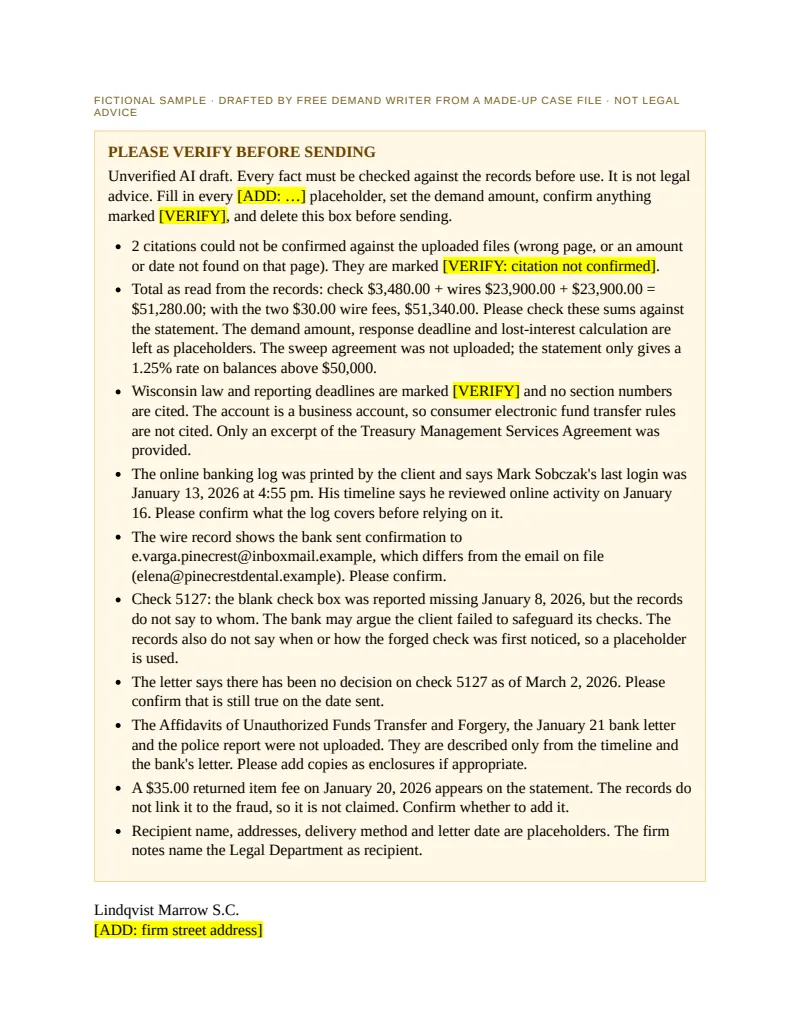
Fictional sample

See a sample draft

We made up a case file and ran it through Free Demand Writer, the same way your documents would be. This is the unedited draft. Everything in it is fictional: the people, the companies and the facts. A Wisconsin dental practice's bank sent two wires on a phone request from an impostor without the callback and token approval its own agreement requires, and also paid a forged check.

Fictional case file: account_statement.pdf, wire_and_check_records.pdf, treasury_agreement_excerpt.pdf, fraud_claim_and_bank_denial.pdf · State: Wisconsin

Page 1 of a fictional sample bank unauthorized wire / forged check (ucc) demand letter drafted by Free Demand Writer Download sample PDF

Fictional sample. Not legal advice. Your draft is built from your own documents.

Fictional sample · letter text

PLEASE VERIFY BEFORE SENDING

Unverified AI draft. Every fact must be checked against the records before use. It is not legal advice. Fill in every [ADD: …] placeholder, set the demand amount, confirm anything marked [VERIFY], and delete this box before sending.

  • Total as read from the records: check $3,480.00 + wires $23,900.00 + $23,900.00 = $51,280.00; with the two $30.00 wire fees, $51,340.00. Please check these sums against the statement. The demand amount, response deadline and lost-interest calculation are left as placeholders. The sweep agreement was not uploaded; the statement only gives a 1.25% rate on balances above $50,000.
  • Wisconsin law and reporting deadlines are marked [VERIFY] and no section numbers are cited. The account is a business account, so consumer electronic fund transfer rules are not cited. Only an excerpt of the Treasury Management Services Agreement was provided.
  • The online banking log was printed by the client and says Mark Sobczak's last login was January 13, 2026 at 4:55 pm. His timeline says he reviewed online activity on January 16. Please confirm what the log covers before relying on it.
  • The wire record shows the bank sent confirmation to e.varga.pinecrest@inboxmail.example, which differs from the email on file (elena@pinecrestdental.example). Please confirm.
  • Check 5127: the blank check box was reported missing January 8, 2026, but the records do not say to whom. The bank may argue the client failed to safeguard its checks. The records also do not say when or how the forged check was first noticed, so a placeholder is used.
  • The letter says there has been no decision on check 5127 as of March 2, 2026. Please confirm that is still true on the date sent.
  • The Affidavits of Unauthorized Funds Transfer and Forgery, the January 21 bank letter and the police report were not uploaded. They are described only from the timeline and the bank's letter. Please add copies as enclosures if appropriate.
  • A $35.00 returned item fee on January 20, 2026 appears on the statement. The records do not link it to the fraud, so it is not claimed. Confirm whether to add it.
  • Recipient name, addresses, delivery method and letter date are placeholders. The firm notes name the Legal Department as recipient.

Lindqvist Marrow S.C.
[ADD: firm street address]
[ADD: city, state ZIP]
[ADD: phone] · [ADD: email]

[ADD: date]

VIA [ADD: delivery method]

[ADD: recipient name]
Legal Department
Lakeshore Commerce Bank
[ADD: street address]
[ADD: city, state ZIP]

Re: Demand for recredit of unauthorized wires and forged check; Pinecrest Dental Studio LLC; Account ending 6158; Claim FR-26-01733; dates of loss January 12, 14 and 15, 2026

Dear [ADD: recipient name]:

Introduction

We represent Pinecrest Dental Studio LLC ("Pinecrest"), holder of the business checking account at Lakeshore Commerce Bank (the "Bank") ending 6158 [account_statement.pdf p.1] [firm notes]. This letter demands that the Bank recredit the account for two unauthorized outgoing wires and one forged check, together with the associated wire fees and lost interest. It also asks the Bank to produce its investigation file.

The unauthorized transactions

The January 2026 statement and the Bank's own wire and check records show the following items [account_statement.pdf p.1] [wire_and_check_records.pdf p.1]:

DateTypeAmountPayee or beneficiarySource
January 12, 2026Check no. 5127$3,480.00Bryce Holland[account_statement.pdf p.1] [wire_and_check_records.pdf p.1]
January 14, 2026Outgoing domestic wire$23,900.00Kestrel Supply Partners LLC[account_statement.pdf p.1] [wire_and_check_records.pdf p.1]
January 15, 2026Outgoing domestic wire$23,900.00Kestrel Supply Partners LLC[account_statement.pdf p.1] [wire_and_check_records.pdf p.1]

Total (as read from the bills): $51,280.00

The Bank also charged a $30.00 wire fee on January 14, 2026 and a $30.00 wire fee on January 15, 2026, for $60.00 in wire fees [account_statement.pdf p.1]. With those fees, the total as read is $51,340.00.

The wires were sent to an account ending 9031 at First Harborline Bank [wire_and_check_records.pdf p.1]. Pinecrest has no vendor named Kestrel Supply Partners LLC [fraud_claim_and_bank_denial.pdf p.1]. The Bank's records show that the January 14 wire was requested by telephone at 10:12 am by a caller identified as "Dr. Elena Varga, owner." The Bank's callback to the authorized number on file was "NOT PERFORMED," and the second authorized user's online token approval was "NOT RECEIVED" [wire_and_check_records.pdf p.1]. The January 15 wire, requested at 9:47 am, is recorded as a "Repeat request, verified by email reply," again with no callback and no token approval [wire_and_check_records.pdf p.1]. The Bank's online banking log for January 14 and 15, 2026 shows that no outgoing wire was created or approved through online banking on either date [account_statement.pdf p.1].

Check no. 5127 is dated January 10, 2026, payable to Bryce Holland for $3,480.00, with the memo "consulting." Its drawer signature reads "E. Varga" and does not match the signature card. Dr. Varga states that she did not write or sign it [wire_and_check_records.pdf p.1]. The check was endorsed "Bryce Holland" and deposited by mobile deposit at Northwind Valley Bank on January 12, 2026 [wire_and_check_records.pdf p.1]. It came from a box of blank checks reported missing from Pinecrest's office on January 8, 2026 [wire_and_check_records.pdf p.1].

Discovery and reporting

Pinecrest reported the fraud promptly. In date order [fraud_claim_and_bank_denial.pdf p.1]:

  • January 16, 2026, 8:20 am: A low balance alert, triggered by the payroll ACH, led Pinecrest's office manager, Mark Sobczak, to review online activity. He found the two wires to Kestrel Supply Partners LLC.
  • January 16, 2026, 8:41 am: Mr. Sobczak called the Bank's fraud line and spoke with "Nadia." A case was opened under reference FR-26-01733, and he asked the Bank to recall both wires.
  • January 16, 2026, 11:30 am: Dr. Varga signed and emailed the Bank's Affidavit of Unauthorized Funds Transfer for both wires and the Affidavit of Forgery for check 5127.
  • January 16, 2026, 2:15 pm: Pinecrest reported the matter to the Fennwick Falls Police Department, report no. 2026-00419, Detective S. Halvorsen.
  • January 21, 2026: The Bank wrote that a recall request had been sent to the beneficiary bank and that "[f]unds were withdrawn and no recovery is available at this time."
  • February 10, 2026: The Bank denied the wire claim, stating that the wires "were requested by a caller with knowledge of your account and confirmed through email" and that "[t]he bank acted in good faith." The same letter stated that the claim for check 5127 "remains under review."

The records do not show when or how Pinecrest first noticed the forged check [ADD: how and when the forged check was first noticed]. As of March 2, 2026, Pinecrest has received no decision on check 5127 [fraud_claim_and_bank_denial.pdf p.1].

Basis for reimbursement

The parties' Treasury Management Services Agreement, effective March 3, 2025 and signed for the Bank by Gregory Thalberg, Vice President, Treasury Services, is governed by Wisconsin law [treasury_agreement_excerpt.pdf p.1]. Section 4.2 sets the funds transfer security procedure that applies to every payment order. Payment orders are to be initiated through the Bank's online banking platform, and each order of $10,000 or more requires approval by a second authorized user using a one-time token. The Bank may accept a telephone payment order only in an emergency, and only after it calls back an authorized user at the number on file and confirms the order [treasury_agreement_excerpt.pdf p.1]. Section 4.6 states that the Bank "will not accept or verify any payment order by email" [treasury_agreement_excerpt.pdf p.1].

By the Bank's own records, neither wire followed this procedure. Each was a telephone request, neither involved a callback to the number on file, neither had a second-user token approval, and each was "confirmed" only by email, which Section 4.6 excludes [wire_and_check_records.pdf p.1] [treasury_agreement_excerpt.pdf p.1]. The email confirmation for the first wire was sent to e.varga.pinecrest@inboxmail.example. The authorized user record lists Dr. Varga's email as elena@pinecrestdental.example and her phone as ending 4410 [wire_and_check_records.pdf p.1]. Pinecrest did not authorize either wire. The Bank's stated reason for denial, that the caller had account knowledge and confirmed by email, does not satisfy the procedure the Bank itself set.

As to check 5127, the signature does not match the signature card, and Pinecrest submitted an Affidavit of Forgery on January 16, 2026, the same day it reported the wires [wire_and_check_records.pdf p.1] [fraud_claim_and_bank_denial.pdf p.1]. Section 7.1 of the Agreement requires Pinecrest to review statements promptly and report unauthorized items in writing as soon as reasonably possible [treasury_agreement_excerpt.pdf p.1]. Pinecrest did so within days of the wires and the check posting [fraud_claim_and_bank_denial.pdf p.1] [account_statement.pdf p.1].

These claims are governed by the Agreement and by the Uniform Commercial Code as adopted in Wisconsin, including its provisions on funds transfers and on the payment of checks. [VERIFY: Wisconsin rule on bank liability for unauthorized payments] [VERIFY: reporting deadlines under the account agreement and applicable law]

Demand

Pinecrest demands that the Bank:

  • Recredit the account in the amount of [ADD: demand amount], covering the two wires, check no. 5127, and the two wire fees, with lost interest on the funds from the dates of debit. Pinecrest's statement reflects a 1.25% annual rate on balances above the $50,000 sweep level [account_statement.pdf p.1]. [ADD: lost interest calculation]
  • Provide our office a written decision on check no. 5127 and a written reconsideration of the wire denial, together with the Bank's complete investigation file for Claim FR-26-01733 by [ADD: response deadline]. The file should include call recordings and notes for the January 14 and 15, 2026 wire requests (including banker T. Gruber's notes), the emails sent and received, the signature card comparison for check 5127, the Bank's communications with First Harborline Bank and Northwind Valley Bank, and the security procedure records for the account.

Please preserve all documents, recordings, emails, system logs and other data relating to the account, the two wires, check no. 5127, and Claim FR-26-01733, and suspend any routine deletion that could affect them.

Pinecrest reserves all rights and remedies, including those not described in this letter. Nothing in this letter waives any claim or right. Please direct all communications on this matter to our office.

Sincerely,

Peter A. Lindqvist
Lindqvist Marrow S.C.