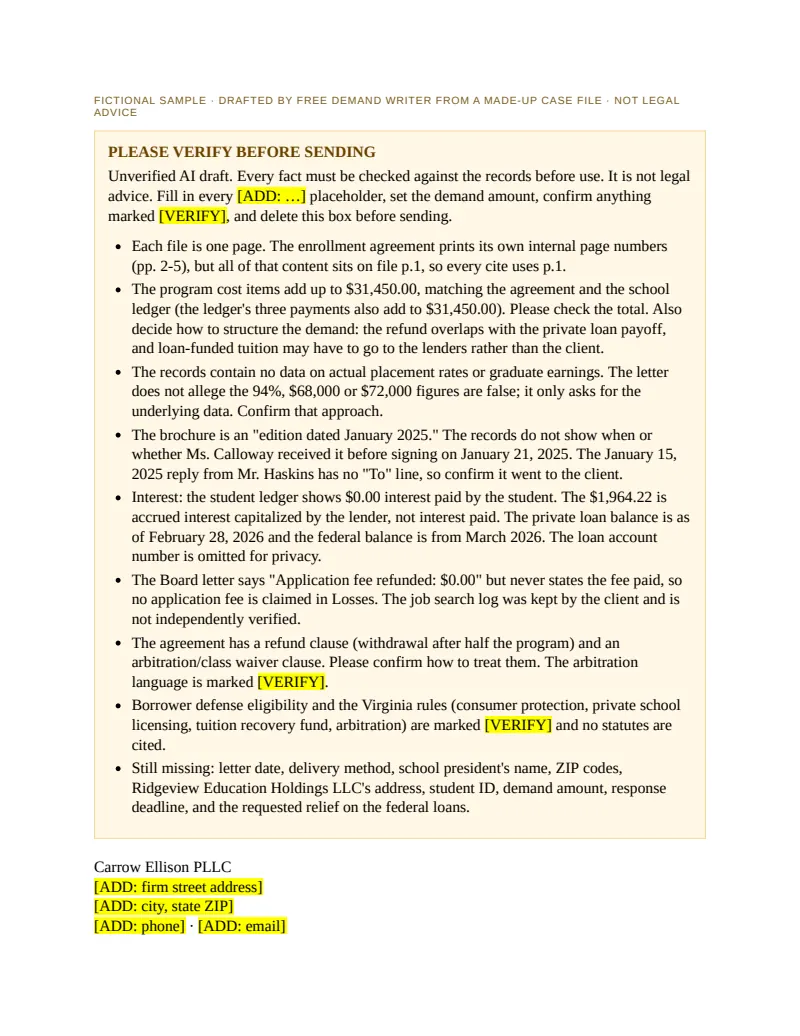
PLEASE VERIFY BEFORE SENDING
Unverified AI draft. Every fact must be checked against the records before use. It is not legal advice. Fill in every [ADD: …] placeholder, set the demand amount, confirm anything marked [VERIFY], and delete this box before sending.
- Each file is one page. The enrollment agreement prints its own internal page numbers (pp. 2-5), but all of that content sits on file p.1, so every cite uses p.1.
- The program cost items add up to $31,450.00, matching the agreement and the school ledger (the ledger's three payments also add to $31,450.00). Please check the total. Also decide how to structure the demand: the refund overlaps with the private loan payoff, and loan-funded tuition may have to go to the lenders rather than the client.
- The records contain no data on actual placement rates or graduate earnings. The letter does not allege the 94%, $68,000 or $72,000 figures are false; it only asks for the underlying data. Confirm that approach.
- The brochure is an "edition dated January 2025." The records do not show when or whether Ms. Calloway received it before signing on January 21, 2025. The January 15, 2025 reply from Mr. Haskins has no "To" line, so confirm it went to the client.
- Interest: the student ledger shows $0.00 interest paid by the student. The $1,964.22 is accrued interest capitalized by the lender, not interest paid. The private loan balance is as of February 28, 2026 and the federal balance is from March 2026. The loan account number is omitted for privacy.
- The Board letter says "Application fee refunded: $0.00" but never states the fee paid, so no application fee is claimed in Losses. The job search log was kept by the client and is not independently verified.
- The agreement has a refund clause (withdrawal after half the program) and an arbitration/class waiver clause. Please confirm how to treat them. The arbitration language is marked [VERIFY].
- Borrower defense eligibility and the Virginia rules (consumer protection, private school licensing, tuition recovery fund, arbitration) are marked [VERIFY] and no statutes are cited.
- Still missing: letter date, delivery method, school president's name, ZIP codes, Ridgeview Education Holdings LLC's address, student ID, demand amount, response deadline, and the requested relief on the federal loans.
Carrow Ellison PLLC
[ADD: firm street address]
[ADD: city, state ZIP]
[ADD: phone] · [ADD: email]
[ADD: date]
VIA [ADD: delivery method]
[ADD: president's name]
President's Office
Ridgeview Institute of Health Careers
7720 Laurel Point Boulevard, Suite 300
Ashby Crossing, Virginia [ADD: ZIP]
Re: Demand for refund of tuition and fees and loan relief. Jasmine Calloway, Diagnostic Medical Sonography program. Student ID: [ADD: student ID]. Enrollment agreement signed January 21, 2025
Dear [ADD: president's name]:
Introduction
We represent Jasmine Calloway, who enrolled in the Diagnostic Medical Sonography diploma program at Ridgeview Institute of Health Careers ("Ridgeview") by an enrollment agreement signed January 21, 2025, with a program start date of February 3, 2025 [enrollment_agreement.pdf p.1]. Ms. Calloway completed every course and was awarded her diploma on December 19, 2025 [registry_and_transfer_letters.pdf p.1]. Please direct all further communication about this matter to this office. A copy of this letter is being sent to Ridgeview Education Holdings LLC, the owner of Ridgeview [firm notes], [enrollment_agreement.pdf p.1].
The enrollment
The enrollment agreement identifies Ridgeview as "a campus of Ridgeview Education Holdings LLC" and was handled by Admissions Representative Troy Haskins [enrollment_agreement.pdf p.1]. The program was scheduled to run from February 3, 2025 to December 19, 2025 [enrollment_agreement.pdf p.1]. The agreement states the following costs [enrollment_agreement.pdf p.1]:
- Tuition: $29,800.00
- Registration fee: $150.00
- Lab and equipment fee: $1,200.00
- Books and scrubs: $300.00
- Total program cost: $31,450.00
The agreement contains a refund policy providing that "[a] student who withdraws after completing more than half of the program is not entitled to a tuition refund" [enrollment_agreement.pdf p.1]. That provision addresses students who withdraw. Ms. Calloway did not withdraw; she completed the program [registry_and_transfer_letters.pdf p.1]. The agreement also contains a binding individual arbitration provision and a class action waiver [enrollment_agreement.pdf p.1]. Ms. Calloway reserves all rights regarding that provision [VERIFY: Virginia rule on enforceability of arbitration clauses in enrollment agreements].
Ridgeview's student account ledger shows the program was paid for as follows [loan_and_payment_records.pdf p.1]:
- January 30, 2025: Beacon Arc Student Lending private education loan, $18,000.00 (11.9% variable rate)
- January 30, 2025: Federal Direct loans, $12,500.00 (subsidized $4,500.00; unsubsidized $8,000.00)
- February 3, 2025: cash payment by Ms. Calloway, $950.00, receipt R-55310
The ledger shows total paid toward the program of $31,450.00 and a balance of $0.00 [loan_and_payment_records.pdf p.1].
What the school represented
Before Ms. Calloway signed, Ridgeview's admissions representative and its program brochure made the following statements, in date order.
January 13, 2025 email from Mr. Haskins. He wrote: "our sonography program is fully accredited, so you sit for the national registry exam the week you graduate." He also wrote that "94% of our grads are working in the field within months," that "starting pay around here is $68,000," and that "[y]our credits also transfer to Blue Hollow Community College if you want an associate degree later" [recruiter_emails_and_brochure.pdf p.1].
January 15, 2025 exchange. Ms. Calloway asked in writing: "is the sonography program itself accredited? My cousin said that matters for the registry exam." Mr. Haskins replied: "Yes, 100%. You will be registry eligible when you finish. Don't worry about that." [recruiter_emails_and_brochure.pdf p.1]
Program brochure, edition dated January 2025. The cover reads "Graduate in under a year. Registry ready." Page 2 reads "Accredited program. 94% job placement. Graduates earn up to $72,000." The small print on the back cover reads: "Placement figures based on graduates who responded to our survey." [recruiter_emails_and_brochure.pdf p.1]
Enrollment agreement, signed January 21, 2025. The accreditation statement says only that "Ridgeview Institute is institutionally accredited" and that "[p]rogrammatic accreditation status for individual programs is available from the Admissions Office on request." [enrollment_agreement.pdf p.1] Mr. Haskins had already answered that question for Ms. Calloway in writing six days earlier.
What was true
Accreditation and registry eligibility. By letter dated January 22, 2026, the National Sonography Credentialing Board informed Ms. Calloway that to qualify through the graduate route an applicant must have completed a programmatically accredited sonography program. The Board stated that "the Diagnostic Medical Sonography program at Ridgeview Institute of Health Careers does not hold, and has never held, programmatic accreditation," and it did not approve her application under that route [registry_and_transfer_letters.pdf p.1]. This contradicts Mr. Haskins's statements that the program was "fully accredited," that the answer was "Yes, 100%," and that Ms. Calloway would be "registry eligible" when she finished, as well as the brochure's "Accredited program" and "Registry ready" claims.
Credit transfer. By letter dated February 3, 2026, the Office of the Registrar at Blue Hollow Community College stated that it "does not accept transfer credit from Ridgeview Institute for any course," with credits accepted: 0 [registry_and_transfer_letters.pdf p.1]. This contradicts Mr. Haskins's statement that Ms. Calloway's credits would transfer to Blue Hollow.
Employment. From December 2025 to March 2026, Ms. Calloway applied for 14 sonographer positions at hospitals and imaging centers. She received 11 replies, all stating that registry credentials or eligibility from an accredited program are required, and she received no interviews [registry_and_transfer_letters.pdf p.1]. On February 10, 2026, Ridgeview Career Services wrote to her: "We suggest applying for medical assistant or front desk roles while you look into other options." [registry_and_transfer_letters.pdf p.1]
Placement and earnings figures. The brochure's own small print limits the 94% figure to "graduates who responded to our survey" [recruiter_emails_and_brochure.pdf p.1]. We have not seen the survey, its response rate, or any data supporting the 94%, $68,000 or $72,000 figures, and we ask that Ridgeview provide them.
Losses
| Item | Date | Amount | Source |
|---|
| Tuition | Agreement signed January 21, 2025 | $29,800.00 | [enrollment_agreement.pdf p.1] |
| Registration fee | Agreement signed January 21, 2025 | $150.00 | [enrollment_agreement.pdf p.1] |
| Lab and equipment fee | Agreement signed January 21, 2025 | $1,200.00 | [enrollment_agreement.pdf p.1] |
| Books and scrubs | Agreement signed January 21, 2025 | $300.00 | [enrollment_agreement.pdf p.1] |
| Total (as read from the bills) | | $31,450.00 | [enrollment_agreement.pdf p.1]; [loan_and_payment_records.pdf p.1] |
The program was paid for as follows:
| Source of payment | Date | Amount | Source |
|---|
| Beacon Arc private education loan | January 30, 2025 | $18,000.00 | [loan_and_payment_records.pdf p.1] |
| Federal Direct loans (subsidized $4,500.00; unsubsidized $8,000.00) | January 30, 2025 | $12,500.00 | [loan_and_payment_records.pdf p.1] |
| Cash payment by Ms. Calloway (receipt R-55310) | February 3, 2025 | $950.00 | [loan_and_payment_records.pdf p.1] |
The loans carry the following balances:
| Loan | Date of statement | Balance | Source |
|---|
| Beacon Arc private loan (principal $18,000.00 plus capitalized accrued interest $1,964.22) | February 28, 2026 | $19,964.22 | [loan_and_payment_records.pdf p.1] |
| Federal Direct loans (including accrued interest) | March 2026 | $12,968.40 | [loan_and_payment_records.pdf p.1] |
Monthly payments on the private loan of $289.40 began in March 2026, and federal loan repayment begins in June 2026 [loan_and_payment_records.pdf p.1]. Ridgeview's ledger shows $0.00 in interest paid by Ms. Calloway on the private loan to date [loan_and_payment_records.pdf p.1].
Demand
Ms. Calloway demands that Ridgeview:
- Refund the tuition and fees she was charged in the amount of [ADD: demand amount].
- Pay off the Beacon Arc private education loan used to fund her enrollment [firm notes]. The statement balance as read is $19,964.22 as of February 28, 2026 [loan_and_payment_records.pdf p.1].
- Provide the following relief regarding her federal Direct loans: [ADD: loan relief requested on federal Direct loans].
Please respond in writing to this office by [ADD: response deadline]. Ms. Calloway may also seek federal loan relief through the U.S. Department of Education's borrower defense process [VERIFY: eligibility and application status]. Nothing in this letter limits her other rights or remedies, all of which are reserved.
State rules
Ridgeview operates in Virginia, and Ms. Calloway's rights are governed by Virginia law. We expect Ridgeview to consider its obligations under Virginia's consumer protection and private school licensing rules [VERIFY: Virginia consumer protection and private school licensing rules] and any available tuition recovery protections [VERIFY: Virginia tuition recovery fund]. We reserve the right to rely on those and any other applicable rules.
Sincerely,
Denise A. Carrow
Carrow Ellison PLLC
cc: Ridgeview Education Holdings LLC, [ADD: address or registered agent]