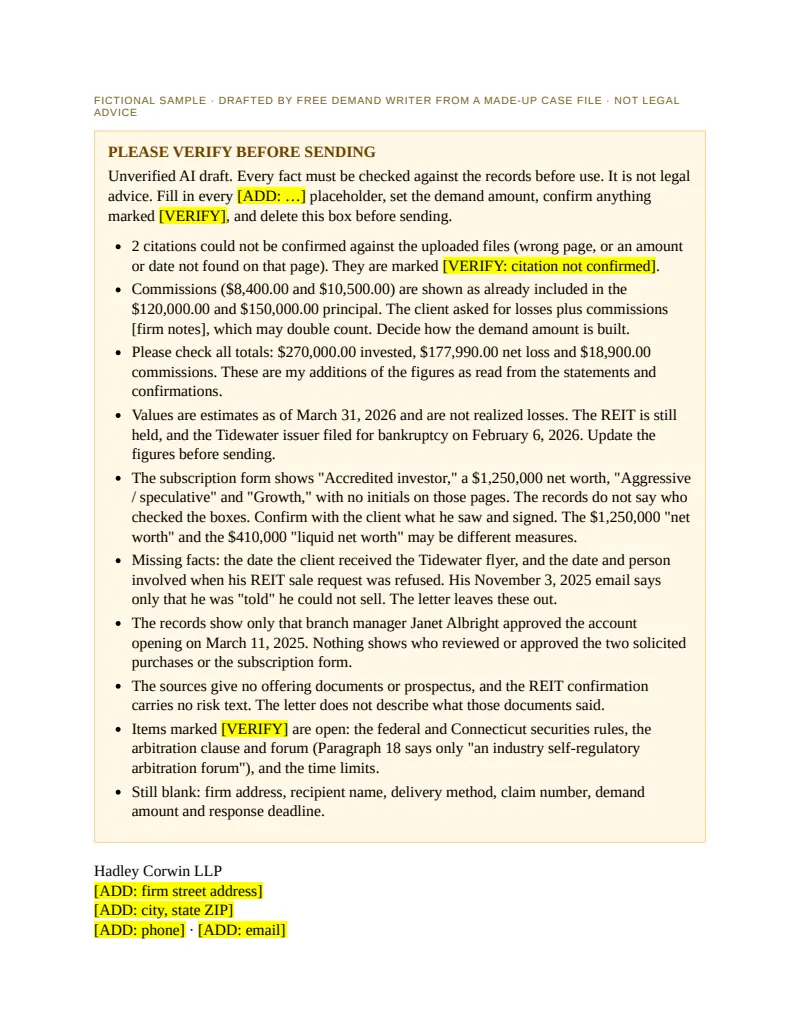
PLEASE VERIFY BEFORE SENDING
Unverified AI draft. Every fact must be checked against the records before use. It is not legal advice. Fill in every [ADD: …] placeholder, set the demand amount, confirm anything marked [VERIFY], and delete this box before sending.
- Commissions ($8,400.00 and $10,500.00) are shown as already included in the $120,000.00 and $150,000.00 principal. The client asked for losses plus commissions [firm notes], which may double count. Decide how the demand amount is built.
- Please check all totals: $270,000.00 invested, $177,990.00 net loss and $18,900.00 commissions. These are my additions of the figures as read from the statements and confirmations.
- Values are estimates as of March 31, 2026 and are not realized losses. The REIT is still held, and the Tidewater issuer filed for bankruptcy on February 6, 2026. Update the figures before sending.
- The subscription form shows "Accredited investor," a $1,250,000 net worth, "Aggressive / speculative" and "Growth," with no initials on those pages. The records do not say who checked the boxes. Confirm with the client what he saw and signed. The $1,250,000 "net worth" and the $410,000 "liquid net worth" may be different measures.
- Missing facts: the date the client received the Tidewater flyer, and the date and person involved when his REIT sale request was refused. His November 3, 2025 email says only that he was "told" he could not sell. The letter leaves these out.
- The records show only that branch manager Janet Albright approved the account opening on March 11, 2025. Nothing shows who reviewed or approved the two solicited purchases or the subscription form.
- The sources give no offering documents or prospectus, and the REIT confirmation carries no risk text. The letter does not describe what those documents said.
- Items marked [VERIFY] are open: the federal and Connecticut securities rules, the arbitration clause and forum (Paragraph 18 says only "an industry self-regulatory arbitration forum"), and the time limits.
- Still blank: firm address, recipient name, delivery method, claim number, demand amount and response deadline.
Hadley Corwin LLP
[ADD: firm street address]
[ADD: city, state ZIP]
[ADD: phone] · [ADD: email]
[ADD: date]
VIA [ADD: delivery method]
[ADD: compliance officer name]
Compliance Department
Ashgrove Capital Securities LLC
[ADD: street address]
[ADD: city, state ZIP]
Re: Demand for restitution – Harold Bensley, Account ending 2740 – Registered Representative Wade Corrigan – Purchases of April 2, 2025 and May 14, 2025 – Claim No. [ADD: claim number]
Dear [ADD: compliance officer name]:
Introduction
We represent Harold Bensley, a customer of Ashgrove Capital Securities LLC ("Ashgrove") through registered representative Wade Corrigan (rep code WC14), account ending 2740 [new_account_form.pdf p.1]. Mr. Bensley is seeking repayment of his losses on two investments recommended to him through Ashgrove, together with the commissions he paid on them [firm notes]. This letter sets out the basis for that request and asks that Ashgrove respond by the deadline stated below.
The client and the account
Mr. Bensley opened an individual brokerage account with Ashgrove on March 10, 2025 [new_account_form.pdf p.1]. The new account form records the following profile:
- Age 74, a retired public school teacher, with annual income of $46,000 from pension and Social Security [new_account_form.pdf p.1].
- Liquid net worth of $410,000 [new_account_form.pdf p.1].
- Investment experience of 20 years in certificates of deposit and bond funds, with no experience in stocks or alternative investments [new_account_form.pdf p.1].
- Investment objective of "Income with preservation of capital," and a risk tolerance of "Conservative" [new_account_form.pdf p.1].
- A short to intermediate time horizon, and a need for access to funds for home care costs [new_account_form.pdf p.1].
- No update to the profile after it was completed [new_account_form.pdf p.1].
Mr. Bensley signed the form on March 10, 2025, and branch manager Janet Albright approved it on March 11, 2025 [new_account_form.pdf p.1]. On March 31, 2025, the account held $410,000.00 in total, made up of a short-term bond fund ($165,400.00) and cash ($244,600.00). The certificates of deposit had been redeemed on March 28, 2025 [account_statements.pdf p.1].
The investments and what was said
Meridian Hollow Income REIT, Inc. On March 24, 2025, Mr. Corrigan emailed Mr. Bensley that "your CDs pay next to nothing," that the Meridian Hollow REIT "pays about 6.6% a year and the share price is fixed at $10, so it does not go up and down like the stock market." He also wrote, "You can get your money back whenever you need it for your home care. It is a great fit for a conservative investor like you." [broker_emails.pdf p.1]
On April 2, 2025, Ashgrove bought 12,000 shares of Class A Meridian Hollow Income REIT, Inc., a non-traded real estate investment trust, for Mr. Bensley at $10.00 per share, for a principal amount of $120,000.00. The confirmation shows a selling commission and dealer manager fee of $8,400.00 included in the price, and it marks the trade "Solicited: YES" [trade_confirmations.pdf p.1].
The account statements do not show a fixed share price. The estimated value per share was $10.00 on June 30, 2025, $6.15 on December 31, 2025 and $5.40 on March 31, 2026. The statement for December 31, 2025 notes that the share redemption program was suspended in October 2025 [account_statements.pdf p.1]. On November 3, 2025, Mr. Bensley wrote to Mr. Corrigan that he had asked to sell the REIT for his home care bills and "was told I cannot," adding, "You told me I could get it back whenever I needed it." The records show no reply [broker_emails.pdf p.1].
Tidewater Energy Partners Secured Notes. On April 28, 2025, Mr. Bensley wrote to Mr. Corrigan about the energy notes: "I cannot afford to lose this money. Is it safe?" [broker_emails.pdf p.1] On April 29, 2025, Mr. Corrigan replied: "these are secured notes, backed by the oil and gas wells. They are as safe as a CD but pay 14%. I have my own mother in them. I will take care of the paperwork, just sign where the tabs are." [broker_emails.pdf p.1]
The Tidewater investor flyer given to Mr. Bensley described the notes on its first page as "14% secured income. Asset-backed. Monthly reporting." Its second page, in small print, stated that the notes "are speculative, illiquid and involve a high degree of risk, including loss of the entire investment" and are "suitable only for accredited investors who can afford to lose their investment." [broker_emails.pdf p.1] Mr. Bensley had told Mr. Corrigan in writing that he could not afford to lose this money [broker_emails.pdf p.1].
On May 14, 2025, Ashgrove bought Tidewater Energy Partners Secured Notes (a private placement of 14% notes) for Mr. Bensley, for a principal amount of $150,000.00. The confirmation shows a commission of $10,500.00 included in the principal, and it marks the trade "Solicited: YES" [trade_confirmations.pdf p.1].
The subscription form for the notes shows entries that do not match the new account form:
- The "Accredited investor" box is checked, and a net worth of $1,250,000 is written on the form. The new account form recorded liquid net worth of $410,000. Mr. Bensley's initials do not appear next to the net worth figure [trade_confirmations.pdf p.1; new_account_form.pdf p.1].
- The risk tolerance box checked is "Aggressive / speculative," and the investment objective box checked is "Growth." The confirmation records that these do not match the new account form [trade_confirmations.pdf p.1].
- Mr. Bensley signed the subscription form on page 9 only. The pages with the checked boxes are not initialed [trade_confirmations.pdf p.1].
Both purchases were paid for by selling certificates of deposit and a short-term bond fund held in the account, with sales on March 28 and May 9, 2025 [trade_confirmations.pdf p.1]. Together the two purchases total $270,000.00, taken from an account that held $410,000.00 on March 31, 2025 [trade_confirmations.pdf p.1; account_statements.pdf p.1].
Losses
The table below is taken from the account statements and trade confirmations. Values are the estimated values shown as of March 31, 2026.
| Investment | Date bought | Amount invested | Value or proceeds | Loss | Source |
|---|
| Meridian Hollow Income REIT, Class A (12,000 shares) | April 2, 2025 | $120,000.00 | Estimated value $64,800.00; distributions received $3,960.00 | $51,240.00 | [trade_confirmations.pdf p.1]; [account_statements.pdf p.1] |
| Tidewater Energy Partners Secured Notes (14%) | May 14, 2025 | $150,000.00 | Estimated value $18,000.00; interest received $5,250.00 | $126,750.00 | [trade_confirmations.pdf p.1]; [account_statements.pdf p.1] |
| Total (as read from the bills) | | $270,000.00 | | $177,990.00 | |
The Tidewater issuer missed the interest payment due November 15, 2025, and filed for bankruptcy protection on February 6, 2026 [account_statements.pdf p.1].
The commissions and fees shown on the confirmations, each already included in the amounts invested above, are:
| Investment | Commission or fee | Source |
|---|
| Meridian Hollow Income REIT | $8,400.00 (selling commission and dealer manager fee) | [trade_confirmations.pdf p.1] |
| Tidewater Energy Partners Secured Notes | $10,500.00 | [trade_confirmations.pdf p.1] |
| Total (as read from the bills) | $18,900.00 | |
Basis for the claim
Based on the records we have reviewed, Mr. Bensley has claims arising from the following, which we describe here in general terms.
Suitability. Both purchases were solicited [trade_confirmations.pdf p.1]. They were recommended to a 74-year-old retiree whose account form recorded a conservative risk tolerance, an objective of income with preservation of capital, no experience with stocks or alternative investments, and a need for access to funds for home care [new_account_form.pdf p.1]. A non-traded REIT and a private placement of speculative, illiquid notes do not appear consistent with that profile.
Misrepresentation and omission. Mr. Corrigan's written statements described the REIT as having a fixed share price, as available "whenever you need it," and as "a great fit for a conservative investor." He described the notes as "as safe as a CD" [broker_emails.pdf p.1]. The later statements show a declining estimated REIT share price and a suspended redemption program, and the flyer's small print describes the notes as speculative and illiquid with a risk of total loss [account_statements.pdf p.1; broker_emails.pdf p.1]. The records do not show that the limits on liquidity and the risk of loss were explained to Mr. Bensley in the terms he used to describe his needs.
Supervision. The subscription form for the notes contains a risk tolerance, objective, accredited investor status and net worth that differ from the account profile, without Mr. Bensley's initials on those entries [trade_confirmations.pdf p.1]. Ashgrove approved the new account form and had a profile on file that was never updated [new_account_form.pdf p.1]. We ask Ashgrove to account for how these solicited purchases and the subscription form were reviewed and approved. [ADD: any supervisory approval records identified for the two purchases]
Federal and Connecticut securities laws and industry rules may apply to these claims [VERIFY: applicable federal and Connecticut securities rules]. The customer agreement provides for arbitration before an industry self-regulatory arbitration forum and states that it is governed by Connecticut law [new_account_form.pdf p.1] [VERIFY: arbitration clause and forum]. We have not taken a position in this letter on the time limits that apply to these claims [VERIFY: time limits for this claim].
Demand
Mr. Bensley demands that Ashgrove pay him [ADD: demand amount] by [ADD: response deadline], in repayment of his losses on the Meridian Hollow Income REIT and Tidewater Energy Partners Secured Notes investments and the commissions paid on them [firm notes].
We also ask that Ashgrove preserve all records relating to Mr. Bensley and these investments, including:
- the account opening documents, profile information and any updates;
- all subscription documents and signature pages for both investments, in complete form;
- all emails, text messages, notes and call recordings between Mr. Corrigan or other Ashgrove personnel and Mr. Bensley;
- all marketing and offering materials provided to Mr. Bensley for either investment;
- supervisory, compliance and principal-approval records for the account and for both purchases;
- commission and compensation records for both purchases; and
- all records of Mr. Bensley's request to sell the REIT and Ashgrove's response.
This letter is not a complete statement of the facts or of Mr. Bensley's claims. He reserves all rights, claims and remedies, including the right to pursue them in any appropriate forum. We look forward to your timely response.
Sincerely,
Miriam S. Hadley
Hadley Corwin LLP