When to use this letter
Use this letter when your client is the beneficiary of a credit or guarantee and the party behind it has defaulted. Typical cases:
- A tenant defaulted on a commercial lease secured by a standby letter of credit.
- A contractor or supplier failed to perform, and the owner holds a performance or advance payment guarantee.
- A buyer did not pay for goods shipped under a documentary credit.
- A borrower or counterparty defaulted on an obligation backed by a bank guarantee.
- The credit is close to expiry and the beneficiary needs to draw before it lapses.
A draw demand often has a legally required form, content and notice period that vary by state and by the rules the credit names, and it must be checked before sending. The credit's own terms control what must be presented. A small discrepancy or a late presentation can be enough for the bank to refuse.
What to upload
Upload up to 5 PDFs, 500 pages in total. The credit itself, with every amendment, matters most.
- The letter of credit or guarantee
- The full instrument as issued, including any annexes, forms of draft or forms of demand.
- Amendments and extensions
- Every amendment, extension or transfer, since these can change the amount, expiry date or required documents.
- The underlying contract
- The lease, construction contract, supply agreement or loan that the credit secures.
- Default records
- Notices of default, unpaid invoices, rent ledgers or other proof of what the applicant failed to do.
- Earlier correspondence with the bank
- Any prior draws, discrepancy notices or bank letters about the credit.
What the draft includes
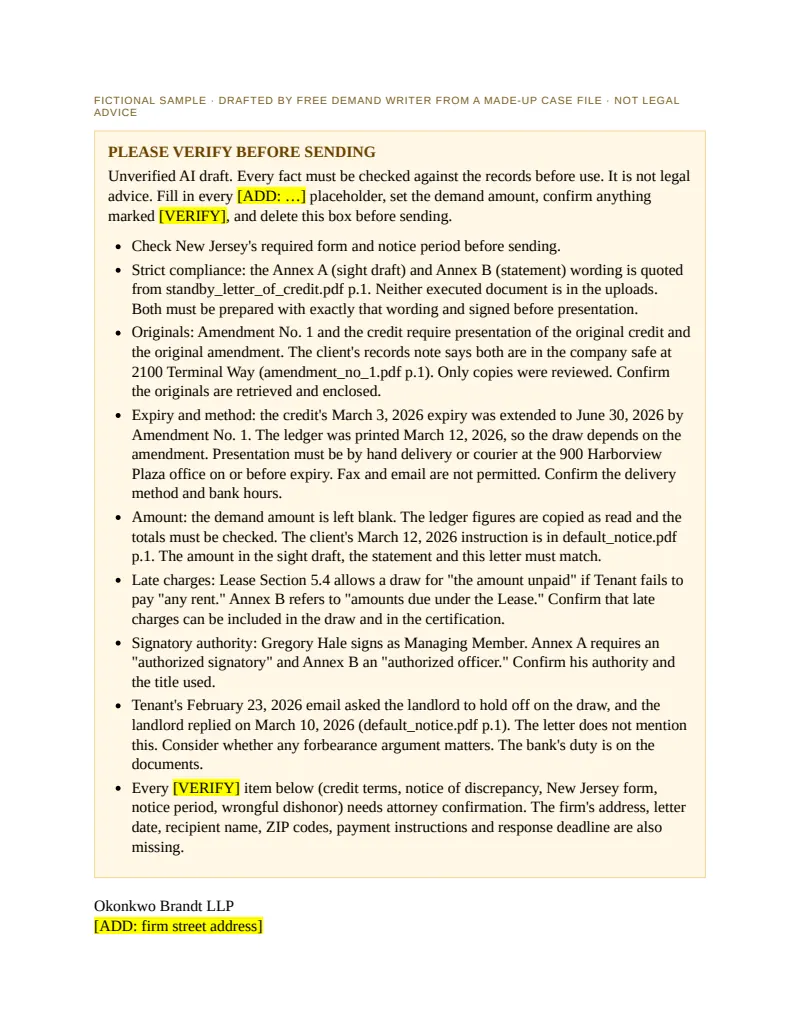
An editable Word letter built only from what your documents say. Missing facts become [ADD: …] placeholders, never guesses, and any law cited is marked [VERIFY].
- Please verify box. A short notice at the top reminding the reviewer that this is an unverified AI draft, with the required form and notice period flagged first.
- The credit's key terms. Issuer, number, amount, expiry date and place, and presentation method, quoted with the page they come from.
- Presentation checklist. A table of each required document and the exact statement wording the credit requires, each marked [VERIFY].
- The default. A short, cited summary of the applicant's failure to perform.
- Governing rules. The rules the credit says it is subject to, named generally, plus [VERIFY] notes on your state's rules.
- Placeholders for missing items. Any required document or statement not in your uploads is marked [ADD: ...] instead of guessed.
- The demand. The draw amount, payment instructions and response deadline are placeholders for you to set.
Before you send it
The result is an unverified AI draft for attorney review, not legal advice.
- Compare every document and statement in the draft, word for word, against the credit and its amendments.
- Confirm the expiry date, place of presentation and delivery method, and allow time for delivery.
- Check the governing rules named in the credit and your state's rules on presentation and dishonor.
- Confirm the draw amount and whether partial or multiple draws are allowed.
- Fill in every [ADD: ...] placeholder and remove the Please verify box.
Common mistakes
Banks refuse draws on technical grounds more often than on the merits. These are the errors most worth fixing first.
- Paraphrasing the required statement If the credit requires specific wording, use it. A summary in your own words can be treated as a discrepancy.
- Presenting after expiry or at the wrong place A late presentation, or one sent to an office the credit does not name, may be refused outright.
- Missing an amendment Amendments can reduce the amount, change the expiry date or add documents. Work from the credit as amended.
- Arguing the underlying dispute The bank decides on the documents, not on who is right under the contract. Keep the default summary short.
- Inconsistent names and numbers Beneficiary names, credit numbers and amounts that differ between documents can give the bank a reason to refuse.
Free letter of credit / bank guarantee draw demand template
Prefer to write it yourself? Download a plain Word template with fields to fill in. No AI, no email needed. Sample template, not legal advice.
Questions
Is the letter of credit draw demand letter free?
Yes. No account and no payment.
Who is the letter from and to?
It is written for the beneficiary's counsel and addressed to the issuing bank, or a confirming bank if the documents show one.
Will it write the required statement for me?
Only if the credit states it. The draft copies the wording from the credit and marks it [VERIFY]. It never supplies wording the credit does not give.
Does it work for bank guarantees and standby credits?
Yes. It works from whatever instrument you upload, including standby letters of credit, documentary credits and demand guarantees.
Does it tell me the presentation deadline?
No. It shows the expiry date as read from the credit and flags the governing rules for your attorney to check.
What happens to the documents I upload?
They are deleted as soon as the draft is generated. The Word file is deleted after 48 hours or 3 downloads.