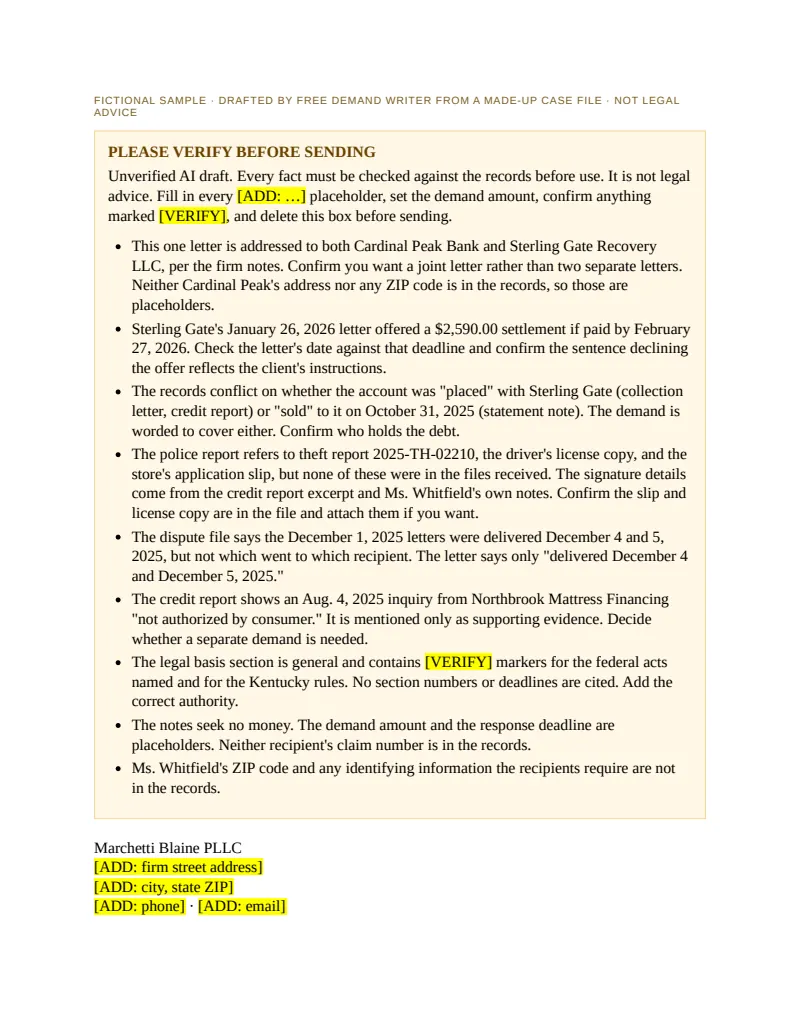
PLEASE VERIFY BEFORE SENDING
Unverified AI draft. Every fact must be checked against the records before use. It is not legal advice. Fill in every [ADD: …] placeholder, set the demand amount, confirm anything marked [VERIFY], and delete this box before sending.
- This one letter is addressed to both Cardinal Peak Bank and Sterling Gate Recovery LLC, per the firm notes. Confirm you want a joint letter rather than two separate letters. Neither Cardinal Peak's address nor any ZIP code is in the records, so those are placeholders.
- Sterling Gate's January 26, 2026 letter offered a $2,590.00 settlement if paid by February 27, 2026. Check the letter's date against that deadline and confirm the sentence declining the offer reflects the client's instructions.
- The records conflict on whether the account was "placed" with Sterling Gate (collection letter, credit report) or "sold" to it on October 31, 2025 (statement note). The demand is worded to cover either. Confirm who holds the debt.
- The police report refers to theft report 2025-TH-02210, the driver's license copy, and the store's application slip, but none of these were in the files received. The signature details come from the credit report excerpt and Ms. Whitfield's own notes. Confirm the slip and license copy are in the file and attach them if you want.
- The dispute file says the December 1, 2025 letters were delivered December 4 and 5, 2025, but not which went to which recipient. The letter says only "delivered December 4 and December 5, 2025."
- The credit report shows an Aug. 4, 2025 inquiry from Northbrook Mattress Financing "not authorized by consumer." It is mentioned only as supporting evidence. Decide whether a separate demand is needed.
- The legal basis section is general and contains [VERIFY] markers for the federal acts named and for the Kentucky rules. No section numbers or deadlines are cited. Add the correct authority.
- The notes seek no money. The demand amount and the response deadline are placeholders. Neither recipient's claim number is in the records.
- Ms. Whitfield's ZIP code and any identifying information the recipients require are not in the records.
Marchetti Blaine PLLC
[ADD: firm street address]
[ADD: city, state ZIP]
[ADD: phone] · [ADD: email]
[ADD: date]
VIA [ADD: delivery method]
Cardinal Peak Bank
Attn: [ADD: recipient name or department]
[ADD: street address]
[ADD: city, state ZIP]
Sterling Gate Recovery LLC
Attn: [ADD: recipient name]
4100 Commerce Loop, Suite 300
Ridgeport, Ohio [ADD: ZIP] [collection_letter_and_statement.pdf p.1]
Re: Identity theft and fraudulent account: Lorraine Whitfield; Cardinal Peak Bank / Brightwell Home Furnishings credit card, account ending 9926; Cardinal Peak claim no. [ADD: claim number]; Sterling Gate file no. [ADD: claim number]
Dear [ADD: recipient name]:
Introduction
We represent Lorraine Whitfield, 61 Dogwood Terrace, Pell Creek, Kentucky [ADD: ZIP] [firm notes] [police_and_identity_theft_report.pdf p.1]. Ms. Whitfield did not open or authorize the account described below. For identification, please use [ADD: identifying information the recipient requires]. Please direct all further communications about this account to our office and not to Ms. Whitfield.
The fraudulent account
| Account (last four digits) | Date opened | Balance claimed | Source |
|---|
| 9926, Cardinal Peak Bank / Brightwell Home Furnishings credit card | August 4, 2025 | $4,318.77 | [collection_letter_and_statement.pdf p.1] |
| 9926, Sterling Gate Recovery LLC collection account (original creditor: Cardinal Peak Bank) | Placed for collection November 2025 | $4,318.77 | [credit_report_excerpt.pdf p.1; collection_letter_and_statement.pdf p.1] |
The statement closing September 28, 2025 lists three purchases at Brightwell Home Furnishings, Lexridge store 112: a sectional sofa ($2,899.00) and a television stand ($649.00) on August 4, 2025, and a mattress set ($611.25) on August 21, 2025. It also lists interest and late fees of $159.52 [collection_letter_and_statement.pdf p.1]. The statement shows no payments received [collection_letter_and_statement.pdf p.1].
Why the account is not our client's
Ms. Whitfield has never shopped at Brightwell Home Furnishings, never applied for the card, and never authorized anyone to apply for it in her name [police_and_identity_theft_report.pdf p.1]. The records support her position:
- Ms. Whitfield's purse, which held her driver's license, was stolen from her car at the Pell Creek Community Center on July 19, 2025. She reported the theft that day under report 2025-TH-02210 [police_and_identity_theft_report.pdf p.1]. The account was opened on August 4, 2025 [collection_letter_and_statement.pdf p.1].
- The billing address on the account, 3304 Quarry Bend Road, Apt 12, Lexridge, Kentucky, is not and has never been her address. The phone number on the account is not hers, and she does not work for Tri-County Logistics [police_and_identity_theft_report.pdf p.1].
- Her credit report shows that the Quarry Bend Road address, the Tri-County Logistics employer and a second phone number were all first reported in August 2025. Her long-standing address is 61 Dogwood Terrace, Pell Creek [credit_report_excerpt.pdf p.1].
- The retail credit application slip later obtained from the Lexridge store is signed "L. Whitfeld," a misspelled name, and shows the Quarry Bend Road address [dispute_letters.pdf p.1]. Ms. Whitfield's signature on her driver's license copy differs from the signature on that slip [credit_report_excerpt.pdf p.1].
- Her credit report shows two hard inquiries on August 4, 2025: Cardinal Peak Bank (Brightwell retail credit) and Northbrook Mattress Financing, which the report marks "not authorized by consumer" [credit_report_excerpt.pdf p.1].
Ms. Whitfield first learned of the account on November 12, 2025, when she received Sterling Gate's collection letter [police_and_identity_theft_report.pdf p.1]. She reported the identity theft to the Ashford County Sheriff's Office on November 18, 2025 (Incident Report No. 2025-IT-03381) [police_and_identity_theft_report.pdf p.1]. On November 19, 2025 she submitted a federal identity theft report (No. 188420571), signed under penalty of perjury [police_and_identity_theft_report.pdf p.1].
Prior disputes
- December 1, 2025: Ms. Whitfield sent a written dispute by certified mail to Cardinal Peak Bank, Card Disputes, and to Sterling Gate Recovery LLC. The letters were delivered December 4 and December 5, 2025. They enclosed the sheriff's report, the identity theft report and a copy of her driver's license showing her address. They asked that the account be closed, collection stopped, and a copy of the application and any signed sales slips be sent to her [dispute_letters.pdf p.1].
- December 18, 2025: Sterling Gate acknowledged the dispute, said it had requested verification from the original creditor, and said collection activity was paused [dispute_letters.pdf p.1].
- January 12, 2026: Cardinal Peak stated that the account "was opened in person with a valid driver's license," that it had "verified the account as belonging to you," and that it was "unable to provide application records" [dispute_letters.pdf p.1].
- January 26, 2026: Sterling Gate stated that the original creditor had verified the debt and that collection activity would resume. It claimed $4,318.77 and offered to settle for $2,590.00 if paid by February 27, 2026 [dispute_letters.pdf p.1].
- January 30, 2026: Ms. Whitfield obtained a copy of the application slip from the Lexridge store manager, despite Cardinal Peak's statement that it could not provide application records [dispute_letters.pdf p.1].
Cardinal Peak's January 12 verification does not address the misspelled name on the application slip, the signature difference, or the address, phone number and employer that first appeared in August 2025. Ms. Whitfield does not owe any part of this balance, and the settlement offer does not change that.
Legal basis
Federal and Kentucky law give identity theft victims rights to dispute fraudulent accounts, to have fraudulent information blocked from their credit reports, and to obtain the application and account records relating to an account opened in their name. These rights bind creditors, furnishers of credit information and debt collectors, and they include the Fair Credit Reporting Act [VERIFY] and the Fair Debt Collection Practices Act [VERIFY]. [VERIFY: federal and Kentucky rights of identity theft victims that apply] [VERIFY: Kentucky rule on identity theft victims' rights to account records and on creditor and collector duties after an identity theft report]
Demand
On behalf of Ms. Whitfield, we demand that by [ADD: response deadline], you do each of the following:
- Close account ending 9926 and remove it from Ms. Whitfield's name.
- Confirm in writing to our office that Ms. Whitfield owes nothing on this account.
- Stop all collection activity against Ms. Whitfield, including calls, letters and the settlement offer described above.
- Withdraw all credit reporting on this account, including the Cardinal Peak Bank tradeline and the Sterling Gate Recovery LLC collection tradeline, with every consumer reporting agency to which it was reported, and confirm to our office that you have done so.
- Cardinal Peak Bank: recall the account from Sterling Gate Recovery LLC and from any other collector or debt buyer. Sterling Gate Recovery LLC: return the account to the original creditor and stop acting on it, whether the account was placed with you or sold to you.
- Send our office complete copies of the application and all account records, including signed sales slips and any identification presented when the account was opened.
Our client's position is that she owes no money on this account. [ADD: demand amount, if any]. Ms. Whitfield reserves all rights and remedies under federal and Kentucky law, and nothing in this letter waives any of them. Please direct your response to the undersigned.
Sincerely,
Joseph R. Marchetti
Marchetti Blaine PLLC