Skip to content
Free Demand Writer
Menu
Free Demand Writer

Free Data Breach / Privacy Violation Demand Letter

A data breach demand letter asks a company that exposed your client's personal or financial information to pay for the harm and to take concrete steps to limit further damage. The strongest letters are specific: what data was exposed, when the company said so, and what it has cost the client since, from fraudulent charges to hours spent freezing credit.

Free Demand Writer reads the breach notice letter, bank and credit records and identity theft reports you upload and drafts an editable Word letter. It lays out the incident and the client's losses in date order, cites the file and page for each fact, and marks every state law point [VERIFY] for your attorney to confirm.

New to this kind of letter? Our guide explains what goes into a demand letter, when to send one and what happens next.

  • Free
  • No sign-up
  • Editable Word (.docx)
  • Files deleted after drafting

When to use this letter

Use this letter when a client's personal information was exposed or misused by a business and the client has suffered losses or wants specific remedial steps. Typical cases:

  • The client received a breach notice letter and then saw fraudulent charges or new accounts opened in their name.
  • A medical provider, retailer or employer exposed health, payment card or Social Security information.
  • A company shared or sold the client's data in a way its own privacy policy did not allow.
  • Account login details were exposed and the client lost money or access to accounts.
  • The company offered credit monitoring the client considers too short or too limited for the data involved.

Data security, breach notice and privacy laws vary by state and by the type of data involved, and some claims may be affected by arbitration clauses or class actions already filed. The draft does not decide which laws apply. Check them before you send.

What to upload

Upload up to 5 PDFs, 500 pages in total. The breach notice and proof of what happened afterward matter most.

The breach notice
The letter or email the company sent, plus any follow-up notices, FAQs or offers of credit monitoring.
Fraud and account records
Bank and card statements, fraud alerts, new-account notices and dispute letters showing misuse of the data.
Credit reports and freezes
Credit reports, freeze and fraud alert confirmations, and any identity theft report filed with police or a federal agency.
Costs and time records
Receipts for credit monitoring, replacement cards or documents, and the client's own log of time spent.
Privacy policy and terms
The company's privacy policy or terms of service as they stood when the client gave the data, saved as PDF.

What the draft includes

An editable Word letter built only from what your documents say. Missing facts become [ADD: …] placeholders, never guesses, and any law cited is marked [VERIFY].

  1. Please verify box. A short notice at the top reminding the reviewer that this is an unverified AI draft.
  2. The breach. Date of the incident, date of notice and the types of data involved, from the company's own notice.
  3. Harm timeline. Fraud, credit alerts and account problems after the breach, in date order, each cited to the page.
  4. Losses table. Item, date, amount and source for each documented cost, with the total as read from the records.
  5. Legal basis. General terms only, with state data security and privacy law points marked [VERIFY].
  6. The demand. Compensation, credit monitoring, an explanation of the incident and a preservation request. The amount and deadline are placeholders.

Before you send it

The result is an unverified AI draft for attorney review, not legal advice.

  • Confirm the dates and data types against the breach notice itself.
  • Check each loss in the table against the statement or receipt cited.
  • Confirm which state laws apply and whether an arbitration clause or a pending class action affects the claim.
  • Make sure no account numbers or other sensitive data appear in the letter.
  • Set the amount and deadline, and remove the Please verify box.

Common mistakes

Companies that suffer a breach often receive many demands at once. These are the problems that get a letter set aside.

  • No link between breach and loss A fraudulent charge months later may have another cause. Show the timing and the type of data that would make the misuse possible.
  • Repeating the exposed data A demand letter should never restate account numbers, Social Security numbers or passwords. Describe the data by type only.
  • Undocumented losses Time spent and stress are real, but the reader will look for receipts and statements. Tie each item to a document or leave a placeholder.
  • Ignoring the terms of service Arbitration, class waiver and limitation clauses can change where and how the claim proceeds. Read them before choosing a strategy.
  • Forgetting preservation Logs and forensic reports can be overwritten. Ask the company in writing to preserve records about the incident.

Free data breach / privacy violation demand letter template

Prefer to write it yourself? Download a plain Word template with fields to fill in. No AI, no email needed. Sample template, not legal advice.

Questions

Is the data breach demand letter free?

Yes. No account and no payment.

Can it be used for a class of affected customers?

It drafts a letter for one client from that client's documents. Class claims need a different strategy, which your attorney decides.

Will it say which privacy laws were violated?

It describes the legal basis in general terms and marks every state law point [VERIFY]. It never invents statutes or cases.

Does it calculate damages for identity theft?

It lists the costs your documents show and totals them as read. The amount demanded is always left to your attorney.

What happens to the documents I upload?

They are deleted as soon as the draft is generated. The Word file is deleted after 48 hours or 3 downloads.
Fictional sample

See a sample draft

We made up a case file and ran it through Free Demand Writer, the same way your documents would be. This is the unedited draft. Everything in it is fictional: the people, the companies and the facts. A Virginia customer of an online outdoor gear retailer suffered fraudulent card charges and a fraudulent store account after the retailer's unencrypted order database was breached.

Fictional case file: breach_notice.pdf, fraud_and_credit_records.pdf, costs_and_time_log.pdf, privacy_policy_excerpt.pdf · State: Virginia

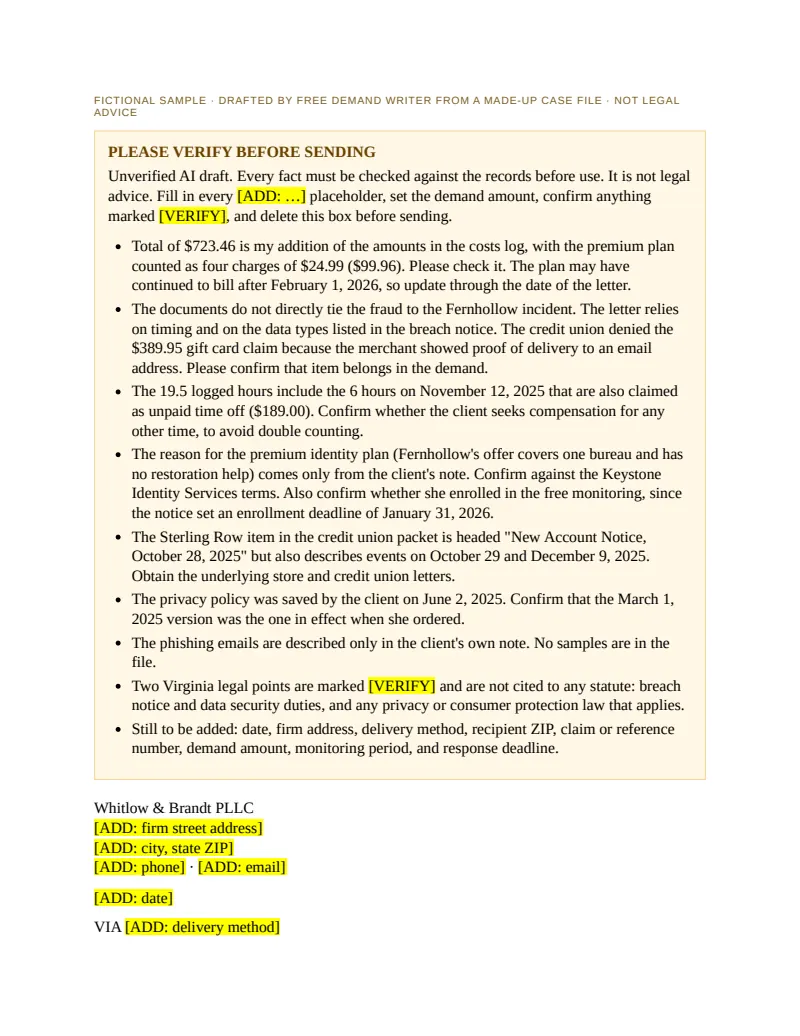
Page 1 of a fictional sample data breach / privacy violation demand letter drafted by Free Demand Writer Download sample PDF

Fictional sample. Not legal advice. Your draft is built from your own documents.

Fictional sample · letter text

PLEASE VERIFY BEFORE SENDING

Unverified AI draft. Every fact must be checked against the records before use. It is not legal advice. Fill in every [ADD: …] placeholder, set the demand amount, confirm anything marked [VERIFY], and delete this box before sending.

  • Total of $723.46 is my addition of the amounts in the costs log, with the premium plan counted as four charges of $24.99 ($99.96). Please check it. The plan may have continued to bill after February 1, 2026, so update through the date of the letter.
  • The documents do not directly tie the fraud to the Fernhollow incident. The letter relies on timing and on the data types listed in the breach notice. The credit union denied the $389.95 gift card claim because the merchant showed proof of delivery to an email address. Please confirm that item belongs in the demand.
  • The 19.5 logged hours include the 6 hours on November 12, 2025 that are also claimed as unpaid time off ($189.00). Confirm whether the client seeks compensation for any other time, to avoid double counting.
  • The reason for the premium identity plan (Fernhollow's offer covers one bureau and has no restoration help) comes only from the client's note. Confirm against the Keystone Identity Services terms. Also confirm whether she enrolled in the free monitoring, since the notice set an enrollment deadline of January 31, 2026.
  • The Sterling Row item in the credit union packet is headed "New Account Notice, October 28, 2025" but also describes events on October 29 and December 9, 2025. Obtain the underlying store and credit union letters.
  • The privacy policy was saved by the client on June 2, 2025. Confirm that the March 1, 2025 version was the one in effect when she ordered.
  • The phishing emails are described only in the client's own note. No samples are in the file.
  • Two Virginia legal points are marked [VERIFY] and are not cited to any statute: breach notice and data security duties, and any privacy or consumer protection law that applies.
  • Still to be added: date, firm address, delivery method, recipient ZIP, claim or reference number, demand amount, monitoring period, and response deadline.

Whitlow & Brandt PLLC
[ADD: firm street address]
[ADD: city, state ZIP]
[ADD: phone] · [ADD: email]

[ADD: date]

VIA [ADD: delivery method]

Legal Department
Fernhollow Outfitters LLC
2050 Canopy Ridge Drive [privacy_policy_excerpt.pdf p.1]
Ashmont, Virginia [ADD: ZIP]

Re: Demand arising from the data security incident disclosed October 6, 2025. Our client: Marisol Teague. Reference no.: [ADD: claim or reference number, if any]. Unauthorized access period: August 4, 2025 to August 19, 2025

Dear Legal Department:

Introduction

This firm represents Marisol Teague regarding the exposure of her personal and payment information by Fernhollow Outfitters LLC ("Fernhollow"). Please direct all further communication about this matter to our office and not to Ms. Teague.

The breach

Fernhollow's October 6, 2025 Notice of Data Security Incident states that an unauthorized person had access to a legacy order database between August 4, 2025 and August 19, 2025 [breach_notice.pdf p.1]. Fernhollow reports that it discovered unusual activity on a server supporting its online store on August 27, 2025 [breach_notice.pdf p.1]. The notice to Ms. Teague is dated October 6, 2025 [breach_notice.pdf p.1].

According to the notice, the information from Ms. Teague's order included her name, billing and shipping address, email address, phone number, online account password, and her payment card number, expiration date and security code [breach_notice.pdf p.1]. Fernhollow also stated that the information in the legacy order database was not encrypted [breach_notice.pdf p.1].

Ms. Teague placed her order, no. FH-778214, on June 2, 2025 [privacy_policy_excerpt.pdf p.1]. At that time, Fernhollow's posted privacy policy stated that it used "industry-standard safeguards, including encryption of payment card information both in transit and at rest" [privacy_policy_excerpt.pdf p.1]. The policy also stated that Fernhollow keeps payment card information "only as long as needed to complete your transaction and process any return" and does not "store your full card security code after your order is authorized" [privacy_policy_excerpt.pdf p.1]. It further promised that, if it learned of unauthorized access, it would "notify you promptly" [privacy_policy_excerpt.pdf p.1]. Her order confirmation email stated that her payment information was "protected by bank-level encryption" [privacy_policy_excerpt.pdf p.1].

Harm to our client

The events below followed the exposure of Ms. Teague's information, in date order.

  • On September 13, 2025, two transactions posted to Ms. Teague's credit card: $612.40 at an online electronics merchant and $389.95 at a gift card merchant. On September 14, 2025, a further attempted charge of $1,140.00 at an online travel merchant was declined [fraud_and_credit_records.pdf p.1].
  • The credit union issued a fraud alert on September 14, 2025 and replaced her card on September 15, 2025 [fraud_and_credit_records.pdf p.1]. She spent 2.0 hours on calls with the credit union on September 14 and 1.5 hours updating her card on automatic payments on September 16 [costs_and_time_log.pdf p.1].
  • On October 6, 2025, Ms. Teague read Fernhollow's notice and called its incident line, which took 1.0 hour [costs_and_time_log.pdf p.1].
  • The credit union credited the $612.40 claim on October 21, 2025. It denied the $389.95 claim in a letter dated November 3, 2025, because the merchant provided proof of delivery of a digital gift card to an email address [fraud_and_credit_records.pdf p.1].
  • On October 26, 2025, a Sterling Row Home Goods store credit account was opened in Ms. Teague's name, using her name and address, and $1,876.33 was charged the same day [fraud_and_credit_records.pdf p.1]. She reported the account as fraud on October 29, 2025, after 2.5 hours on calls with the store's fraud team [fraud_and_credit_records.pdf p.1; costs_and_time_log.pdf p.1]. In a letter dated December 9, 2025, the store confirmed that it closed the account as fraudulent and that she owes nothing [fraud_and_credit_records.pdf p.1].
  • On October 30, 2025, she filed Brierfield Police Department report no. BPD-25-11873 and placed security freezes with all three national credit bureaus. Confirmations arrived between November 4 and November 7, 2025 [fraud_and_credit_records.pdf p.1]. That day's work took 3.0 hours [costs_and_time_log.pdf p.1].
  • On November 12, 2025, she took 6 hours of unpaid time off work to meet with the police and the credit union [costs_and_time_log.pdf p.1].
  • Her November 20, 2025 credit report showed a hard inquiry from Sterling Row Home Goods dated October 26, 2025 that she did not authorize. She filed a dispute on November 21, 2025, and the inquiry was removed on January 8, 2026 [fraud_and_credit_records.pdf p.1].
  • In total, Ms. Teague logged 19.5 hours dealing with these events through January 8, 2026 [costs_and_time_log.pdf p.1].
  • She reports that she changed the password on every online account that used the same email address, and that she still receives several phishing emails a week that reference her Fernhollow orders [costs_and_time_log.pdf p.1].

Ms. Teague's documented out-of-pocket losses are as follows. The $612.40 charge was credited back, and the Sterling Row balance is not owed, so neither is included.

ItemDateAmountSource
Gift card charge not reimbursed by credit unionSeptember 13, 2025$389.95[costs_and_time_log.pdf p.1; fraud_and_credit_records.pdf p.1]
Notary fee, identity theft affidavitOctober 30, 2025$15.00[costs_and_time_log.pdf p.1]
Certified mail to Sterling Row Home Goods and two bureausOctober 31, 2025$29.55[costs_and_time_log.pdf p.1]
Premium identity protection plan, first monthNovember 1, 2025$24.99[costs_and_time_log.pdf p.1]
Unpaid time off work, 6 hours at $31.50November 12, 2025$189.00[costs_and_time_log.pdf p.1]
Premium identity protection planDecember 1, 2025$24.99[costs_and_time_log.pdf p.1]
Premium identity protection planJanuary 1, 2026$24.99[costs_and_time_log.pdf p.1]
Premium identity protection planFebruary 1, 2026$24.99[costs_and_time_log.pdf p.1]
Premium identity protection plan, charges after February 1, 2026[ADD: dates][ADD: amount][ADD: source]

Total (as read from the bills): $723.46

Ms. Teague bought the premium plan because the free monitoring Fernhollow offered covers only one credit bureau and does not include identity restoration help [costs_and_time_log.pdf p.1]. Fernhollow offered monitoring through January 31, 2027 [breach_notice.pdf p.1].

Legal basis

Fernhollow collected Ms. Teague's payment and account information and held it in a database that, by its own account, was not encrypted [breach_notice.pdf p.1]. Its published policy represented that payment card information was encrypted at rest, was kept only as long as needed, and did not include a stored security code [privacy_policy_excerpt.pdf p.1]. Fernhollow's notice describes a different situation. Fernhollow also told customers it would notify them promptly of unauthorized access [privacy_policy_excerpt.pdf p.1]. Its notice to Ms. Teague is dated October 6, 2025, after the August 27, 2025 discovery date it reports and after the September 13, 2025 fraudulent charges on her card [breach_notice.pdf p.1; fraud_and_credit_records.pdf p.1].

We believe these facts support claims against Fernhollow under Virginia law, including for failure to safeguard customer information and failure to give timely notice. [VERIFY: Virginia rule on data breach notice and data security duties] [VERIFY: Virginia privacy or consumer protection law that may apply]

Demand

On behalf of Ms. Teague, we demand that Fernhollow:

  • Pay our client [ADD: demand amount], including reimbursement of the documented losses above and any further documented costs through the date of payment.
  • Provide credit monitoring and identity restoration services for [ADD: period], covering all three national credit bureaus.
  • Explain in writing exactly what data of Ms. Teague's was taken or accessed, whether it was copied or removed from Fernhollow's systems, and what steps Fernhollow has taken to secure its systems and customer data.
  • Preserve all records about the incident, including server and access logs, the investigation and outside security firm's findings, records of the legacy order database and its retention, and all communications with customers and law enforcement about the incident.

Please respond in writing by [ADD: response deadline]. If we do not receive a satisfactory response, Ms. Teague will consider all remedies available to her. Nothing in this letter waives any of her rights or remedies, all of which are reserved.

Sincerely,

Catherine M. Whitlow
Whitlow & Brandt PLLC