Skip to content
Free Demand Writer
Menu
Free Demand Writer

Free ADA / Accessibility Compliance Demand Letter

An ADA accessibility letter tells a business that its premises or website has barriers that keep people with disabilities from using it, and asks for those barriers to be fixed. A good letter is neutral and specific: each barrier, where it is, when the client met it, and the photos or screenshots that show it. It reads as a request for remediation, not a demand for payment.

Free Demand Writer reads the photos, audit reports, screenshots and notes you upload and drafts an editable Word letter. It lists each documented barrier with a citation to the file and page, describes how it affected your client, and flags the state rules on pre-suit accessibility letters for your attorney to check.

Required form. This letter often has a legally required form, content and notice period that vary by state. Check your state's rules before sending; the draft lists them to verify.

New to this kind of letter? Our guide explains what goes into a demand letter, when to send one and what happens next.

  • Free
  • No sign-up
  • Editable Word (.docx)
  • Files deleted after drafting

When to use this letter

Use this letter when a client with a disability met access barriers at a business or on its website and wants them removed. Typical cases:

  • No accessible parking, a step at the entrance, or a door too heavy or narrow to use.
  • A restroom, counter or fitting room the client could not use.
  • A website or app that does not work with a screen reader or keyboard navigation.
  • An online checkout or booking form with unlabeled fields or inaccessible captchas.
  • A business that refused a service animal or a reasonable change to its policy.

This letter often has a legally required form, content and notice period that vary by state. Some states require specific advisory wording in pre-suit accessibility letters and limit what they may demand. Check the rules for your state before sending.

What to upload

Upload up to 5 PDFs, 500 pages in total. Dated evidence of each barrier matters most.

Photos of the barriers
Dated photos saved as PDF, ideally with a tape measure or level in the frame where measurements matter.
Website evidence
Screenshots, screen reader notes or an automated or manual accessibility audit, with the pages and dates tested.
Visit records
Receipts, booking confirmations or the client's notes showing the dates of each visit or attempt.
Prior contact
Any complaint the client made to the business and its reply, by email, letter or online form.
Expert or consultant reports
An access consultant's inspection report, if one was done.

What the draft includes

An editable Word letter built only from what your documents say. Missing facts become [ADD: …] placeholders, never guesses, and any law cited is marked [VERIFY].

  1. Please verify box. A short notice at the top reminding the reviewer that this is an unverified AI draft, with the state letter rules flagged.
  2. The business and visits. The location or website and the dates the client tried to use it, cited.
  3. Barriers encountered. One entry per barrier, with where it is, the date and the evidence, drawn only from the documents.
  4. Effect on the client. How each barrier limited access, from the records, with a placeholder for the client's own account.
  5. Legal basis. The federal Americans with Disabilities Act in general terms, with state access law marked [VERIFY].
  6. Requested remediation. Removal of each barrier, a written plan and a contact person, with the deadline left as a placeholder.

Before you send it

The result is an unverified AI draft for attorney review, not legal advice.

  • Check the required form, advisory wording, notice period and delivery method for your state.
  • Confirm each barrier against the dated photo or screenshot cited.
  • Decide whether the letter may or should ask for money under your state's rules.
  • Set the response deadline, and remove the Please verify box.

Common mistakes

Accessibility letters are read closely, and some states penalize letters that do not follow their rules. These are the errors most worth fixing.

  • Generic barrier lists A list that could apply to any building invites a dismissive reply. Name the specific barriers the client met, with dates and evidence.
  • Leading with money A letter that demands payment before describing any barrier reads as a shakedown. Lead with the barriers and the remediation requested.
  • Missing state wording Some states require advisory language or restrict what a pre-suit letter may say or demand. Check the rules before sending.
  • Measurements without proof Slopes, widths and heights need a measurement in the record. Do not estimate them in the letter.
  • Stale website evidence Sites change often. Note the date each page was tested, and recheck before sending.

Free ada / accessibility compliance demand letter template

Prefer to write it yourself? Download a plain Word template with fields to fill in. No AI, no email needed. Sample template, not legal advice.

Questions

Is the ADA accessibility demand letter free?

Yes. No account and no payment.

Does it work for website accessibility?

Yes. Upload the screenshots or audit report and the draft will list each barrier with the page and date tested.

Will it demand money from the business?

It focuses on the barriers and the remediation requested. Any payment request is a placeholder, flagged so you can check whether your state allows it in this letter.

Does it include my state's required wording?

No. It flags that the form, wording, notice period and delivery method must be checked, because they vary by state.

What happens to the documents I upload?

They are deleted as soon as the draft is generated. The Word file is deleted after 48 hours or 3 downloads.
Fictional sample

See a sample draft

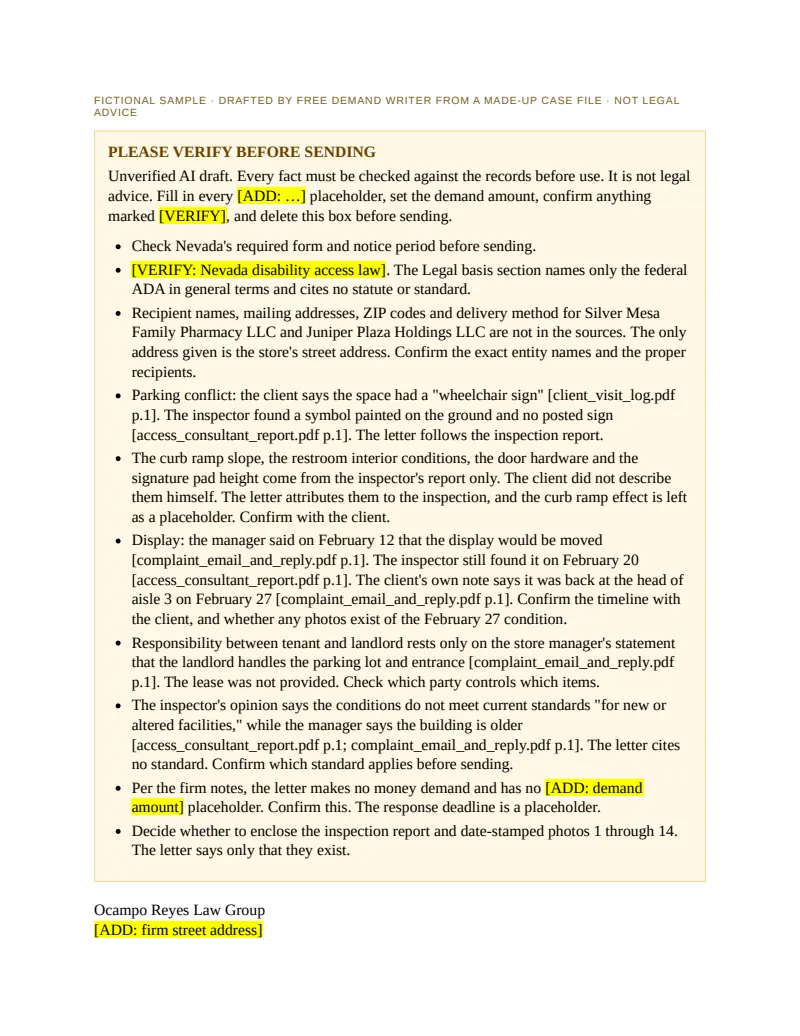
We made up a case file and ran it through Free Demand Writer, the same way your documents would be. This is the unedited draft. Everything in it is fictional: the people, the companies and the facts. A Nevada wheelchair user found a neighborhood pharmacy's parking, entrance, aisles, counter and restroom inaccessible on two visits and wants the barriers removed.

Fictional case file: client_visit_log.pdf, access_consultant_report.pdf, complaint_email_and_reply.pdf · State: Nevada

Page 1 of a fictional sample ada / accessibility compliance demand letter drafted by Free Demand Writer Download sample PDF

Fictional sample. Not legal advice. Your draft is built from your own documents.

Fictional sample · letter text

PLEASE VERIFY BEFORE SENDING

Unverified AI draft. Every fact must be checked against the records before use. It is not legal advice. Fill in every [ADD: …] placeholder, set the demand amount, confirm anything marked [VERIFY], and delete this box before sending.

  • Check Nevada's required form and notice period before sending.
  • [VERIFY: Nevada disability access law]. The Legal basis section names only the federal ADA in general terms and cites no statute or standard.
  • Recipient names, mailing addresses, ZIP codes and delivery method for Silver Mesa Family Pharmacy LLC and Juniper Plaza Holdings LLC are not in the sources. The only address given is the store's street address. Confirm the exact entity names and the proper recipients.
  • Parking conflict: the client says the space had a "wheelchair sign" [client_visit_log.pdf p.1]. The inspector found a symbol painted on the ground and no posted sign [access_consultant_report.pdf p.1]. The letter follows the inspection report.
  • The curb ramp slope, the restroom interior conditions, the door hardware and the signature pad height come from the inspector's report only. The client did not describe them himself. The letter attributes them to the inspection, and the curb ramp effect is left as a placeholder. Confirm with the client.
  • Display: the manager said on February 12 that the display would be moved [complaint_email_and_reply.pdf p.1]. The inspector still found it on February 20 [access_consultant_report.pdf p.1]. The client's own note says it was back at the head of aisle 3 on February 27 [complaint_email_and_reply.pdf p.1]. Confirm the timeline with the client, and whether any photos exist of the February 27 condition.
  • Responsibility between tenant and landlord rests only on the store manager's statement that the landlord handles the parking lot and entrance [complaint_email_and_reply.pdf p.1]. The lease was not provided. Check which party controls which items.
  • The inspector's opinion says the conditions do not meet current standards "for new or altered facilities," while the manager says the building is older [access_consultant_report.pdf p.1; complaint_email_and_reply.pdf p.1]. The letter cites no standard. Confirm which standard applies before sending.
  • Per the firm notes, the letter makes no money demand and has no [ADD: demand amount] placeholder. Confirm this. The response deadline is a placeholder.
  • Decide whether to enclose the inspection report and date-stamped photos 1 through 14. The letter says only that they exist.

Ocampo Reyes Law Group
[ADD: firm street address]
[ADD: city, state ZIP]
[ADD: phone] · [ADD: email]

[ADD: date]

VIA [ADD: delivery method]

[ADD: recipient name]
Silver Mesa Family Pharmacy LLC
[ADD: mailing address]
[ADD: city, state ZIP]

Re: Accessibility barriers at Silver Mesa Family Pharmacy, 1480 Cottonwood Bend Road, Juniper Wells, Nevada. Our client: Desmond Okafor. Dates of visits: January 14, 2026 and February 9, 2026

Dear [ADD: recipient name]:

Introduction

We represent Desmond Okafor [firm notes]. Mr. Okafor uses a manual wheelchair and drives a van with a side ramp. Silver Mesa Family Pharmacy, 1480 Cottonwood Bend Road, Juniper Wells, Nevada, is the closest pharmacy to his home and fills his monthly prescriptions [client_visit_log.pdf p.1].

Mr. Okafor visited the pharmacy on January 14, 2026 and February 9, 2026 and bought items on both dates [client_visit_log.pdf p.1]. He wants to keep using this pharmacy and would return if the problems described below were fixed [client_visit_log.pdf p.1]. We are writing to ask that you remove these barriers and give us a written plan for doing so. We are sending a copy of this letter to the property owner, Juniper Plaza Holdings LLC.

Barriers encountered

On February 20, 2026, a certified access specialist from High Desert Access Consulting inspected the premises at our request. She took measurements with a calibrated tape measure, digital level and door pressure gauge and took date-stamped photographs [access_consultant_report.pdf p.1]. Mr. Okafor's own accounts of his visits are cited separately below. The barriers are:

  • Accessible parking. The lot has 38 spaces. One has a wheelchair symbol painted on the ground, with no posted sign and no adjacent access aisle. The next space is directly beside it, the space measured 98 inches wide, and there is no van-accessible space [access_consultant_report.pdf p.1, Photos 1-3]. On January 14, 2026, a car was parked beside the space and Mr. Okafor could not lower his ramp. He parked across two spaces at the far end of the lot. He reports the same parking problem on February 9, 2026 [client_visit_log.pdf p.1].
  • Route to the entrance. The curb ramp slope measured 11.8 percent at its steepest point [access_consultant_report.pdf p.1, Photo 4].
  • Entrance door. The raised threshold measured 1 1/4 inches high with a square edge. The door opening force measured 14 pounds. The hardware is a round knob-style pull [access_consultant_report.pdf p.1, Photos 5-7]. On January 14, 2026, Mr. Okafor's front casters caught on the threshold and he nearly tipped forward. A customer held the door because he could not pull it open while holding his chair [client_visit_log.pdf p.1].
  • Interior aisle. A freestanding display at the head of aisle 3 left a clear width of 27 inches [access_consultant_report.pdf p.1, Photos 8-9]. On January 14, 2026, a display of seasonal items blocked the main aisle [client_visit_log.pdf p.1]. Mr. Okafor reports that on February 27, 2026, the display had been moved back to the head of aisle 3 and nothing else had changed [complaint_email_and_reply.pdf p.1].
  • Pharmacy counter. The counter measured 43 1/2 inches high for its full length, with no lowered section. The signature pad is mounted at 46 inches [access_consultant_report.pdf p.1, Photos 10-11].
  • Restroom. The door clear opening measured 27 1/2 inches. A storage cabinet blocks the interior turning space. There is one grab bar on the side wall and none on the rear wall. The pipes under the lavatory are exposed [access_consultant_report.pdf p.1, Photos 12-14]. On February 9, 2026, Mr. Okafor could not enter the restroom because the door was too narrow for his chair [client_visit_log.pdf p.1].

On February 10, 2026, Mr. Okafor emailed the store about these problems and asked whether it planned to fix them [complaint_email_and_reply.pdf p.1]. The store manager, Gina Thornquist, replied on February 12, 2026. She said the landlord handles the parking lot and entrance and that the store would move the display. She said staff would come around the counter to help, and that the store had no plans for the restroom at that time [complaint_email_and_reply.pdf p.1].

Effect on our client

  • Parking. Mr. Okafor could not lower his van ramp next to the accessible space and had to park across two spaces at the far end of the lot [client_visit_log.pdf p.1].
  • Entrance. He nearly tipped forward when his casters caught on the threshold. He could not open the door himself while holding his chair [client_visit_log.pdf p.1].
  • Aisle. He could not reach the pain relief shelf [client_visit_log.pdf p.1].
  • Counter. He could not see over the pickup counter or sign the screen, and the pharmacist had to come around the counter [client_visit_log.pdf p.1].
  • Restroom. He could not use the restroom and had to leave and go home early on February 9, 2026 [client_visit_log.pdf p.1].
  • Curb ramp. [ADD: how the curb ramp slope affected the client, if at all]

Legal basis

The federal Americans with Disabilities Act may apply to the pharmacy as a business open to the public, and may also apply to the owner of the property where it operates. [VERIFY: Nevada disability access law]. We raise these matters in general terms and reserve all of our client's rights.

Requested remediation

We ask that Silver Mesa Family Pharmacy LLC, and Juniper Plaza Holdings LLC to the extent a condition is within its control, take the following steps by [ADD: response deadline]:

  • Correct the parking conditions identified in the inspection: no posted sign, no adjacent access aisle, a 98-inch-wide space, and no van-accessible space.
  • Correct the curb ramp on the route to the entrance, which measured 11.8 percent at its steepest point.
  • Correct the raised 1 1/4-inch threshold, the 14-pound door opening force and the knob-style door hardware at the entrance.
  • Clear the 27-inch aisle at the head of aisle 3 and keep the aisles clear on a continuing basis.
  • Provide a section of the pharmacy counter and a signature pad that a person using a wheelchair can use.
  • Correct the restroom conditions identified in the inspection: the 27 1/2-inch door opening, the blocked turning space, the missing rear grab bar and the exposed lavatory pipes.
  • Send us a written remediation plan with a timeline for each item, stating which party is responsible for each.
  • Name a contact person for this matter.

In the inspector's opinion, the parking, entrance and display items can be corrected quickly and at low cost. The counter and restroom items need minor alterations [access_consultant_report.pdf p.1]. Mr. Okafor is not seeking money in this letter. He wants the barriers fixed and a written plan [firm notes].

We would welcome a call to discuss the plan and a reasonable schedule. Please contact me at [ADD: phone] or [ADD: email]. Mr. Okafor would prefer to resolve this without litigation.

Sincerely,

Teresa Ocampo
Ocampo Reyes Law Group

cc: Juniper Plaza Holdings LLC, [ADD: recipient name and mailing address]