When to use this letter
Use this letter when your client was hurt by a condition on someone else's property and treatment has ended or reached a stable point. Typical cases:
- Slip and fall on a wet floor, spilled liquid, ice or snow at a store, restaurant or office.
- Trip and fall on uneven pavement, broken stairs, loose mats or cords in a walkway.
- Falls caused by poor lighting, missing handrails or unmarked changes in floor level.
- Injuries from falling merchandise, collapsing fixtures or unsafe conditions at a rental property.
If the property belongs to a city, county, school district or other public body, special notice-of-claim rules often apply and can be short. They vary by state. Check them before relying on this letter. For a dog or other animal attack, use the dog bite letter.
What to upload
Upload up to 5 PDFs, 500 pages in total. Liability evidence matters as much as the medical file here.
- Incident report
- The store or property incident report, any police report, and written statements from your client and witnesses.
- Photos of the scene
- Pictures of the hazard, the area and any warning signs, saved into a PDF, so the draft can cite them by page.
- Notice evidence
- Prior complaints, maintenance requests, inspection or cleaning logs, and emails or texts about the condition.
- Medical records
- ER and urgent care notes, imaging, specialist visits and therapy notes.
- Itemized bills
- Billing ledgers or claim forms from each provider, for the medical specials table.
- Insurer correspondence
- Claim acknowledgment or adjuster letters, so the draft picks up the claim number and insured name.
What the draft includes
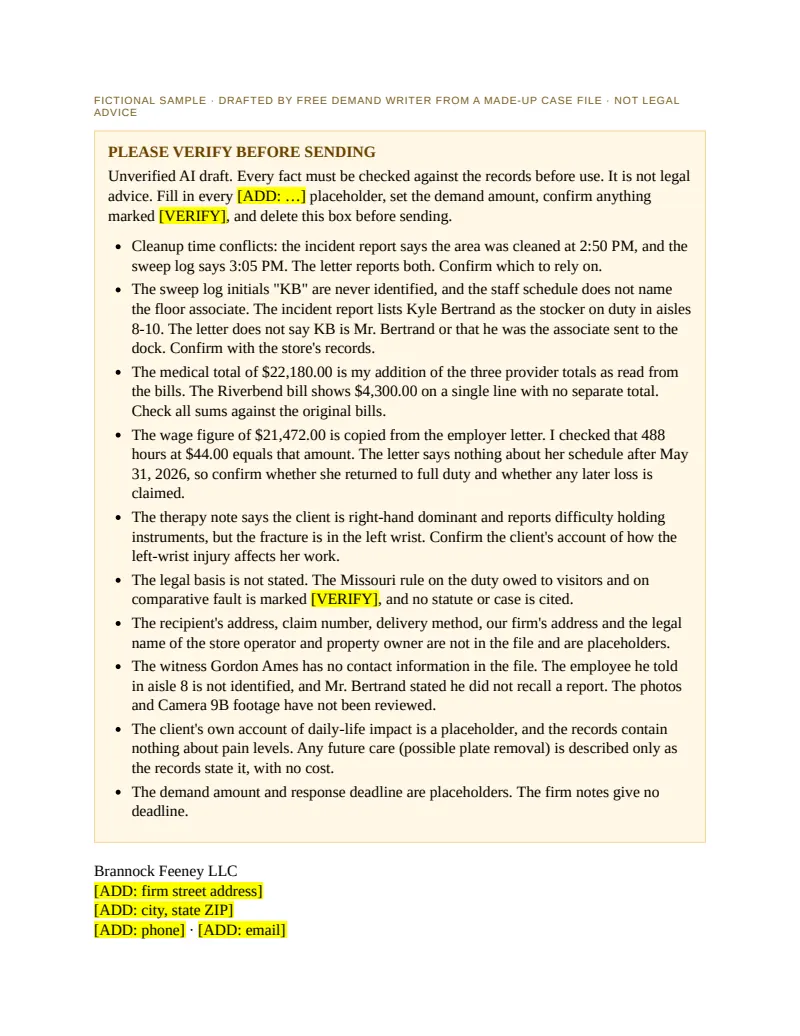
An editable Word letter built only from what your documents say. Missing facts become [ADD: …] placeholders, never guesses, and any law cited is marked [VERIFY].
- Please verify box. A short notice at the top reminding the reviewer that this is an unverified AI draft.
- Letterhead and addressee placeholders. Firm, owner or insurer, adjuster, claim number and date of incident, filled in where the documents show them.
- The property and the hazard. What the condition was, where it was and how it caused the fall, with sources in brackets such as [incident_report.pdf p.1].
- Notice and liability. Only what the records show about whether the owner knew or should have known, plus a [VERIFY] note on your state's duty and comparative fault rules.
- Treatment chronology. Each provider and visit in date order, with diagnoses and treatment as recorded.
- Medical specials table. Billed amounts by provider as read from the bills, with a total for you to confirm.
- Preservation request. A request to keep surveillance video, incident reports and inspection or cleaning records.
- The demand. The amount and the response deadline are always placeholders. The tool never suggests a number.
Before you send it
The result is an unverified AI draft for attorney review, not legal advice.
- Match every date, provider, dollar amount and liability fact to the page cited in brackets.
- Confirm who owned, leased, managed or maintained the property, and who insures each of them.
- Check your state's rules on the duty owed to visitors, comparative fault and any public-entity notice.
- Fill in every [ADD: …] placeholder, including your client's own account of daily-life impact.
- Set the demand amount and deadline, and remove the Please verify box.
Common mistakes
Premises claims are often denied on liability, not damages. These are the gaps adjusters look for first.
- No proof of notice A fall alone is not enough. The letter needs facts showing the owner created the hazard, knew about it, or should have found it. Ask for cleaning and inspection logs early.
- Losing the video Many businesses record over surveillance footage routinely. Send a preservation request as soon as you are retained.
- Suing or writing to the wrong party The business, landlord, property manager and maintenance contractor may all share control. Check leases and contracts first.
- Ignoring your client's own conduct Expect the adjuster to argue the hazard was open and obvious. Answer with facts from the records, and check how your state treats shared fault.
- Missing public-entity notice Claims against public property often require a formal notice of claim in a set form. A demand letter usually does not replace it, and the rules vary by state.
Free premises liability (slip and fall) demand letter template
Prefer to write it yourself? Download a plain Word template with fields to fill in. No AI, no email needed. Sample template, not legal advice.
Questions
Is the premises liability demand letter free?
Yes. No account and no payment.
Will the draft argue that the owner had notice of the hazard?
Only with facts from your documents, such as prior complaints. If the records don't show notice, the draft leaves a placeholder.
Can it use photos of the scene?
Yes, if they are in a PDF. Scanned pages and photos are read as images, and the draft cites them by file and page.
Does it handle claims against a city or other public body?
It drafts the demand, but it does not decide which notice rules apply. Public-entity claims often need a separate formal notice, and the rules vary by state.
What happens to the documents I upload?
They are used only to draft the letter and are deleted as soon as the draft is generated. The Word file is deleted after 48 hours or 3 downloads.