When to use this letter
Use this letter when treatment has ended or reached a stable point and you are ready to open settlement talks with the carrier. Typical cases:
- Motor vehicle collisions, including rear-end, intersection, rideshare and commercial vehicle crashes.
- Premises liability claims such as slip and fall or trip and fall on a business or residential property.
- Dog bites and other animal attacks covered by a homeowner's or renter's policy.
- Pedestrian and bicycle injuries, and other negligence claims with medical treatment and bills.
If the injuries are serious and coverage is limited, consider the insurance claim / bad faith letter instead. It frames a time-limited offer to settle within limits. For injuries caused by a doctor, hospital or other provider, use the medical malpractice letter.
What to upload
Upload up to 5 PDFs, 500 pages in total. Combine smaller files into one PDF per source where you can. The more complete the file, the fewer placeholders in the draft.
- Medical records
- ER and urgent care notes, specialist visits, imaging reports, physical therapy and chiropractic notes.
- Itemized bills
- Billing ledgers or UB-04 and CMS-1500 forms from each provider, so the draft can build a table of medical specials.
- Incident report
- The police or crash report, incident report, or any written account that describes how the injury happened.
- Wage loss proof
- An employer letter, pay stubs or a lost-time statement, if your client missed work.
- Insurer correspondence
- The claim acknowledgment or adjuster letters, so the draft can pick up the claim number, insured and adjuster names.
What the draft includes
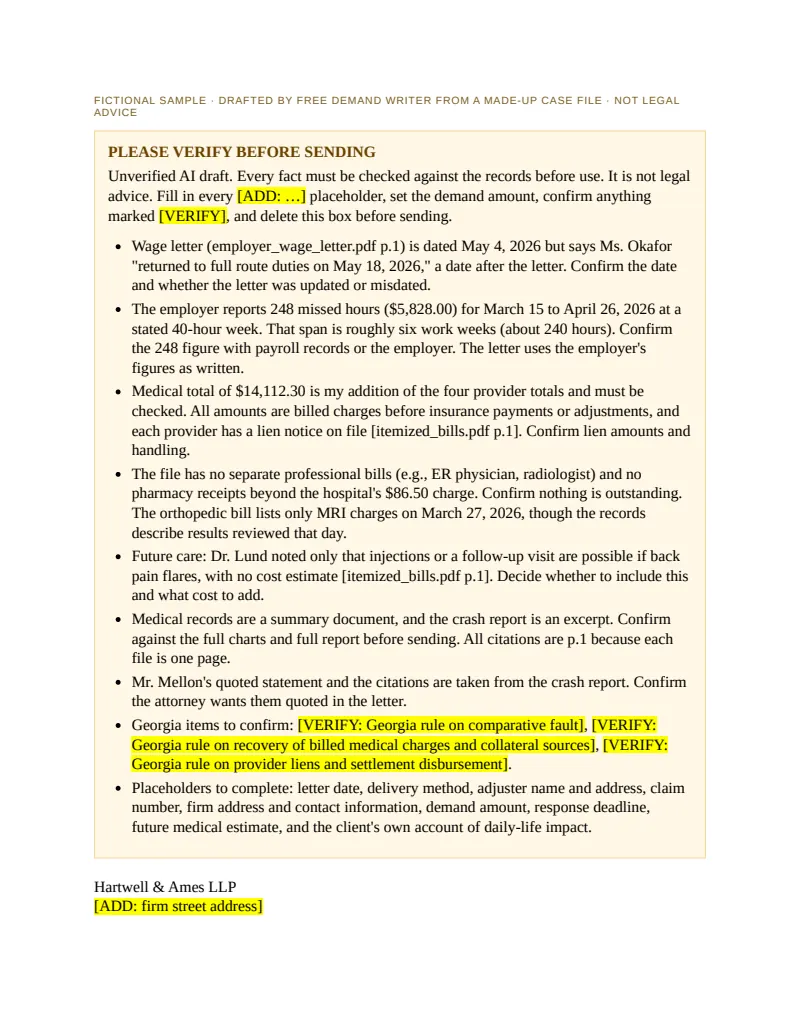
An editable Word letter built only from what your documents say. Missing facts become [ADD: …] placeholders, never guesses, and any law cited is marked [VERIFY].
- Please verify box. A short notice at the top reminding the reviewer that this is an unverified AI draft.
- Letterhead and addressee placeholders. Firm, insurer, adjuster, claim number and date of loss, filled in where the documents show them.
- Facts and liability. How the incident happened, taken only from the reports and records, with sources in brackets such as [police_report.pdf p.2].
- Treatment chronology. Each provider and visit in date order, with diagnoses and treatment as recorded.
- Medical specials table. Provider-by-provider billed amounts as read from the bills, with a total for you to confirm.
- Lost wages and daily-life impact. Only what the documents say, with [ADD: …] placeholders for facts your client can supply.
- The demand. The amount and the response deadline are always placeholders. The tool never suggests a number.
Before you send it
The result is an unverified AI draft for attorney review, not legal advice.
- Match every date, provider and dollar amount to the page cited in brackets.
- Fill in every [ADD: …] placeholder, including client details and pain and suffering facts.
- Confirm liens, write-offs and paid amounts if your state treats billed and paid amounts differently.
- Set the demand amount and deadline, and remove the Please verify box.
Common mistakes
Most weak personal injury demands fail on the file, not the writing. These are the problems adjusters tend to spot first.
- Sending before treatment ends A demand sent while your client is still treating can undervalue the claim, and many carriers will not evaluate it until care is complete. Wait for a clear prognosis, or say plainly that treatment is ongoing and future care is expected.
- Missing bills or records Gaps in the file give the adjuster a reason to discount. Request records and itemized bills from every provider, including imaging centers, pharmacies and ambulance services, before you draft.
- Specials totals that don't match If the table in the letter, the bills and your summary show different totals, expect the adjuster to use the lowest. Reconcile each provider's billed amount against its itemized bill.
- Leaving out liens Health plan, government program and provider liens affect what your client takes home and how a release must be worded. Identify them before you set the demand. The rules vary by plan type and by state.
- Unexplained treatment gaps A long gap before first treatment, or between visits, invites the argument that something else caused the injury. Explain gaps with facts from the records or your client, never with guesses.
Free personal injury demand letter template
Prefer to write it yourself? Download a plain Word template with fields to fill in. No AI, no email needed. Sample template, not legal advice.
Questions
Is the personal injury demand letter free?
Yes. No account and no payment.
Will the draft calculate pain and suffering or suggest a settlement amount?
No. The demand amount is always left as a placeholder. Valuing the claim is the attorney's call, so the draft gives you the facts and specials to support it.
Can it handle a large set of medical records?
Yes, up to 500 pages across 5 PDFs. Scanned pages are read as images, and blank pages are skipped.
Does it cite where each fact came from?
Key facts are followed by the source file and page, for example [ER_records.pdf p.3], so your team can check them quickly.
What happens to the documents I upload?
They are used only to draft the letter and are deleted as soon as the draft is generated. The Word file is deleted after 48 hours or 3 downloads.