When to use this letter
Use this letter when an insurer has paid a claim and wants to recover the payments from the party responsible. Typical cases:
- Auto property damage and collision payments after another driver caused the crash.
- Property claims for fire, water or other damage caused by a contractor, neighbor or product.
- Medical payments or personal injury protection benefits paid after a third party caused the injury.
- Health plan or workers' compensation recovery from a liability carrier.
- Recovery of the policyholder's deductible along with the insurer's payments.
Subrogation rights depend on the policy and on state law. The made-whole doctrine, anti-subrogation rules and limits for certain coverages vary by state, and some recoveries are governed by federal law, such as self-funded employee health plans. The draft marks these for your attorney to check.
What to upload
Upload up to 5 PDFs, 500 pages in total. The payment record and the liability evidence matter most.
- Loss and liability reports
- Police or incident reports, cause-and-origin reports, photos and statements.
- Payment records
- Payment logs, check copies or claim payment summaries showing each amount and date paid.
- Estimates and invoices
- Repair estimates, contractor invoices and appraisals that support each payment.
- Policy documents
- The declarations page and the policy's subrogation clause.
- Subrogation receipt
- Any subrogation receipt, assignment or release signed by the policyholder.
- Correspondence
- Letters with the at-fault party or its insurer, for claim numbers and any liability position.
What the draft includes
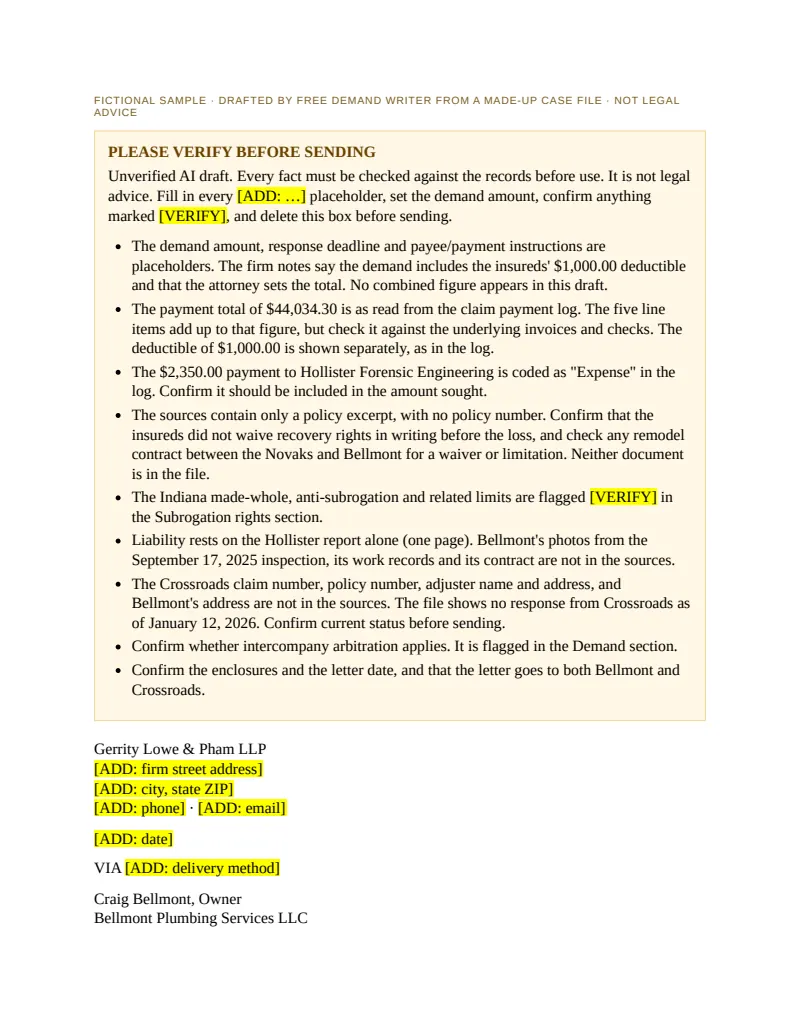
An editable Word letter built only from what your documents say. Missing facts become [ADD: …] placeholders, never guesses, and any law cited is marked [VERIFY].
- Please verify box. A short notice at the top reminding the reviewer that this is an unverified AI draft.
- Parties and claim numbers. The insurer as subrogee of its insured, the recipient and both claim numbers, filled in where the documents show them.
- The loss and liability. How the loss happened and why the recipient is responsible, with sources such as [police_report.pdf p.2].
- Payments table. Each payment by payee and date as read, with the deductible listed separately and a total for you to confirm.
- Subrogation rights. The policy clause and any signed receipt or assignment, cited, plus a [VERIFY] note on your state's rules.
- Preservation request. A request to keep evidence of the loss.
- The demand. The amount, response deadline and payment instructions are placeholders.
Before you send it
The result is an unverified AI draft for attorney review, not legal advice.
- Reconcile the payments table with the payment log and confirm the total.
- Decide whether the demand includes the policyholder's deductible.
- Check your state's made-whole and anti-subrogation rules for this coverage.
- Check whether the claim belongs in an intercompany arbitration program instead.
- Fill in every [ADD: …] placeholder, set the amount and deadline, and remove the Please verify box.
Common mistakes
Liability carriers handle subrogation demands in volume. These are the reasons they set them aside.
- Payments that don't reconcile If the letter, the payment log and the invoices show different totals, expect the lowest figure or a request for proof. Match each payment to its record.
- No proof of subrogation rights Attach the policy clause or a signed subrogation receipt. Without it, the recipient may question the insurer's standing to recover.
- Ignoring the made-whole rule In some states the insurer cannot recover until the policyholder is fully compensated. Check the rule before you demand.
- Losing the evidence Damaged parts and products are often discarded after repair. Preserve them, and ask the other side to preserve theirs.
Free subrogation demand letter template
Prefer to write it yourself? Download a plain Word template with fields to fill in. No AI, no email needed. Sample template, not legal advice.
Questions
Is the subrogation demand letter free?
Yes. No account and no payment.
Who is the letter from?
The insurer, or the firm as the insurer's counsel. It is addressed to the at-fault party or that party's liability insurer, never written as if the firm represents the policyholder.
Does it include the deductible?
It lists the deductible separately if the records show it, and leaves it to you to decide whether the demand includes it.
Does it check the made-whole doctrine?
No. It marks your state's made-whole and anti-subrogation rules for your attorney to verify, because they vary by state.
What happens to the documents I upload?
They are used only to draft the letter and are deleted as soon as the draft is generated. The Word file is deleted after 48 hours or 3 downloads.