When to use this letter
Use this letter when a consumer paid a business and did not get what was promised, and your firm wants a refund or must give notice before filing. Typical cases:
- Misleading ads, listings or sales pitches that led to the purchase.
- Unauthorized or recurring charges, including subscriptions that were cancelled but kept billing.
- Goods or services paid for but never delivered, or delivered far from what was described.
- Hidden fees or add-ons that were not disclosed before payment.
- A business that refused to honor its own refund, return or cancellation policy.
This letter often has a legally required form. Some states require a written pre-suit demand before a consumer protection claim can be filed, with specific content, delivery and timing. Those rules vary by state and must be checked before sending. The draft leaves a placeholder for them; your attorney must confirm and complete it.
What to upload
Upload up to 5 PDFs, 500 pages in total. The strongest files show what was promised, what was paid and what happened next.
- Proof of payment
- Receipts, invoices, order confirmations, and bank or card statements showing each charge.
- What was promised
- Ads, product listings, sales emails, quotes or screenshots of the offer, saved as PDF with dates visible.
- Terms and policies
- The contract, terms of service, subscription terms or refund policy in effect at the time of purchase.
- Cancellation and refund requests
- Emails, chat transcripts or letters asking to cancel or for a refund, and the business's replies.
- Dispute records
- Chargeback or card dispute filings and results, and any complaints made to the business or an agency.
What the draft includes
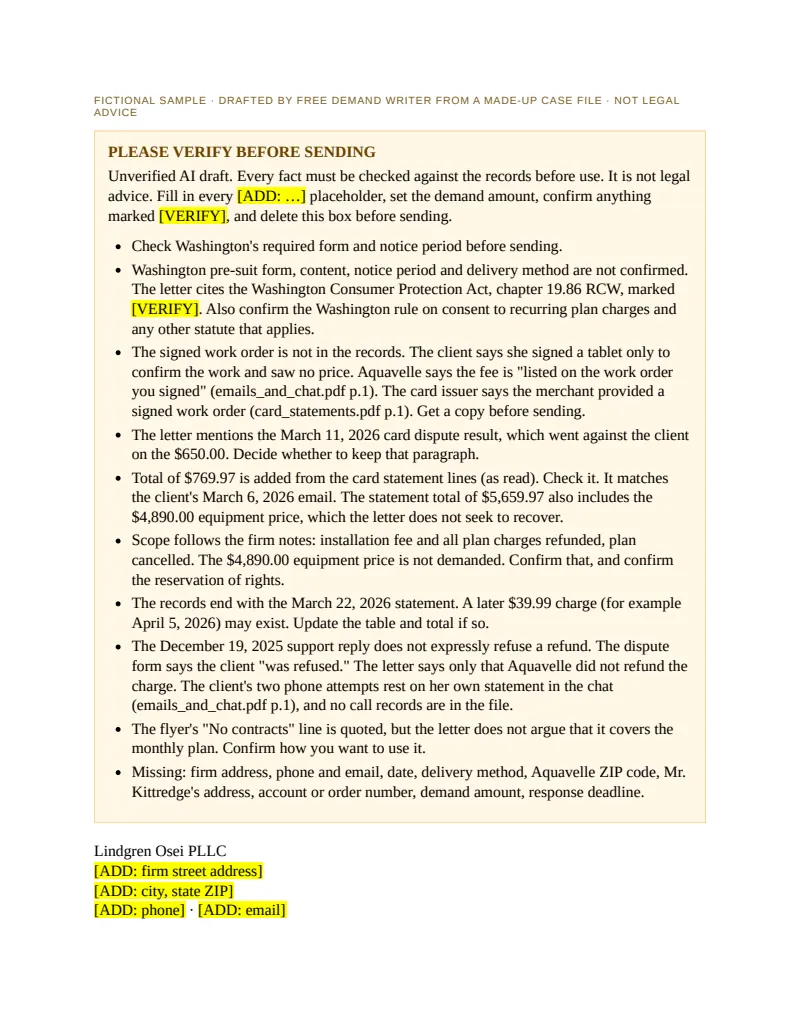
An editable Word letter built only from what your documents say. Missing facts become [ADD: …] placeholders, never guesses, and any law cited is marked [VERIFY].
- Please verify box. A short notice at the top reminding the reviewer that this is an unverified AI draft.
- The transaction. What was bought, when, from whom and for how much, cited to the documents.
- The practice complained of. The representation, charge or failure to deliver, quoted or described from the records with dates.
- Refund history. Each request for a refund or cancellation and the business's response, in date order.
- Statutory notice placeholder. A clear [ADD: …] section for your state's required notice content, delivery method and response period.
- Losses. A table of charges and out-of-pocket costs the documents support, with a total for you to confirm.
- The demand. The refund or other relief and the response deadline are placeholders for you to set.
Before you send it
The result is an unverified AI draft for attorney review, not legal advice.
- Confirm which consumer law applies and whether a written pre-suit demand is required.
- Complete the notice placeholder with the required content, delivery method and timing.
- Match each charge in the losses table to the statement or receipt cited.
- Check the terms for arbitration clauses or class waivers.
- Set the relief and deadline, and remove the Please verify box.
Common mistakes
Pre-suit consumer notices are more technical than most demand letters. These misses cost leverage or the claim itself.
- Treating it as an ordinary demand Where a state requires a pre-suit demand, the law may dictate its content, how it is delivered and how long the business has to respond. Check those rules before you date and send it.
- Describing the practice vaguely A notice that does not identify the specific statement, charge or omission may not give the business enough to respond. Quote the ad or term and give the date it was made.
- Losses that don't add up List each charge with its date and amount, and make sure the total matches the statements. Refunds or chargeback credits already received should be shown and subtracted.
- Ignoring a pending chargeback A card dispute in progress can change what is still owed. Note its status, or leave a placeholder, before demanding the full amount.
- Using the wrong version of the terms Online terms and refund policies change. Use the version in effect when the consumer bought, and keep a dated copy in the file.
Free consumer protection / refund demand letter template
Prefer to write it yourself? Download a plain Word template with fields to fill in. No AI, no email needed. Sample template, not legal advice.
Questions
Is the consumer refund demand letter free?
Yes. No account and no payment.
Does the draft meet my state's pre-suit notice requirements?
Not on its own. It adds a placeholder for your state's notice rules. Your attorney must confirm what is required and complete it before sending.
Will it name the consumer protection statute?
Only if the statute appears in your documents, and it is marked [VERIFY]. The tool never invents statutes or case law.
Can it handle subscription or recurring charge disputes?
Yes. Upload the statements and the cancellation emails. The draft lists each charge after the cancellation date, cited to the page.
What happens to the documents I upload?
They are deleted as soon as the draft is generated. The Word file is deleted after 48 hours or 3 downloads.