When to use this letter
Use this letter when your client has a medical bill that is wrong, or that bills more than the client owes. Typical cases:
- An out-of-network bill for emergency care, or from a provider the client did not choose at an in-network facility.
- A balance bill for the difference between the provider's charge and the plan's allowed amount.
- Duplicate charges, unbundled codes, or charges for services, supplies or days the client did not receive.
- A bill the insurer already paid or adjusted, still sent to the patient in full.
- A disputed bill sent to collections or reported to the credit bureaus.
Federal surprise-billing protections may apply to some emergency and out-of-network services, and state balance-billing rules vary by state and by type of plan. Check which apply before sending.
What to upload
Upload up to 5 PDFs, 500 pages in total. The itemized bill and the matching EOBs matter most.
- Itemized bill
- The full itemized statement with dates of service, codes and charges, not just the summary bill.
- Explanations of benefits
- Every EOB for the same dates of service, showing the allowed amount and the patient's share.
- Plan and network documents
- The plan summary, network directory pages, or letters showing whether the provider is in network.
- Medical records
- Discharge summaries or visit notes that show what was actually provided, where a charge is disputed.
- Collection letters
- Letters from the provider or a collector, and any credit report entries for the account.
- Prior disputes
- Earlier calls, letters, appeals and responses from the provider or insurer.
What the draft includes
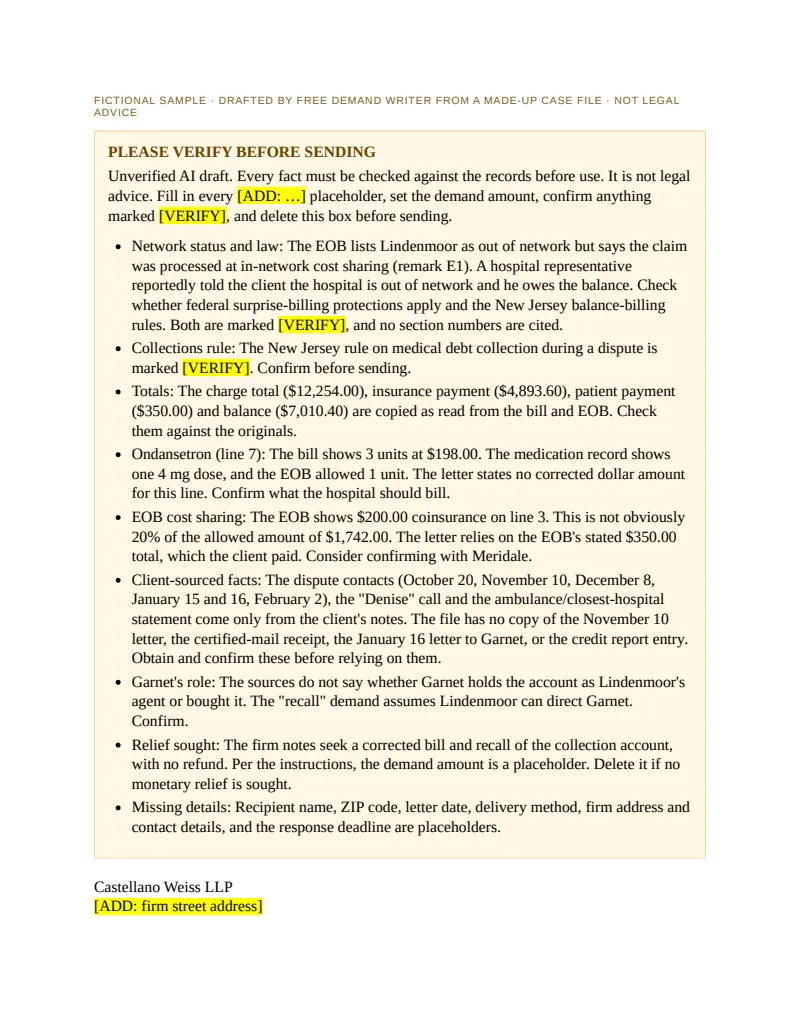
An editable Word letter built only from what your documents say. Missing facts become [ADD: …] placeholders, never guesses, and any law cited is marked [VERIFY].
- Please verify box. A short notice at the top reminding the reviewer that this is an unverified AI draft.
- Services and coverage. What was provided, the insurer, and the network status shown in the documents.
- Charge table. Each disputed charge by date, code and amount, against the EOB patient share, with the source.
- The errors. Why each charge is wrong, from the bill, the EOBs and the records.
- Legal basis. The network contract and surprise-billing protections in general terms. State rules are marked [VERIFY].
- Collections hold. A request that collection and credit reporting stop while the dispute is open.
- The demand. A corrected bill, a refund of overpayments and written confirmation by a deadline you set.
Before you send it
The result is an unverified AI draft for attorney review, not legal advice.
- Match each disputed charge to the itemized bill and the EOB for the same date of service.
- Confirm the provider's network status and the type of plan.
- Check whether federal surprise-billing protections and state balance-billing rules apply.
- Set the deadline and any amount, and remove the Please verify box.
Common mistakes
Billing offices handle disputes by account and date of service. These are the errors that slow a dispute down.
- Disputing the summary bill A summary bill does not show codes or line items. Ask for the itemized bill first and dispute specific lines.
- Skipping the EOB The EOB shows what the plan allowed and what the patient owes. Without it the provider can say the balance is correct.
- Assuming network status A provider at an in-network hospital may be out of network. Check the documents before arguing either way.
- Sharing full account numbers Use the last digits or the provider's reference. Never include full account or Social Security numbers.
- Not asking for a collections hold A bill in dispute can still go to collections. Ask that collection and reporting stop while it is reviewed.
Free medical billing error / balance billing demand letter template
Prefer to write it yourself? Download a plain Word template with fields to fill in. No AI, no email needed. Sample template, not legal advice.
Questions
Is the medical billing error demand letter free?
Yes. No account and no payment.
Can it compare the bill to the EOB?
Yes. Upload both and the draft tables each disputed charge against the patient share the EOB shows, with page citations.
Does it cite the federal surprise-billing law?
It refers to federal surprise-billing protections only in general terms and marks whether they apply [VERIFY] for your attorney to check.
Can the letter go to the insurer instead of the provider?
It is written to the provider or its billing company. If your client's dispute is with the insurer, an insurance bad faith letter may fit better.
What happens to the documents I upload?
They are deleted as soon as the draft is generated. The Word file is deleted after 48 hours or 3 downloads.