When to use this letter
Use this letter when your client has received a written demand and you want to answer it in writing rather than pay, ignore it or wait to be sued. Typical cases:
- A former customer, vendor or business partner demands payment your client disputes.
- A claimant or their lawyer demands damages for an incident your client sees differently.
- A former employee demands back pay, severance or other compensation.
- The amount demanded is partly owed and your client wants to counter or propose payment terms.
A demand letter is not a lawsuit, but its deadline still matters. Calendar it, check whether insurance may cover the claim and whether the carrier must be notified, and check any contract notice clause. These rules vary by state and by policy.
What to upload
Upload up to 5 PDFs, 500 pages in total. Include the demand itself and your client's side of the story.
- The demand letter received
- The full letter with its enclosures. The draft finds it by its content, so any file name works.
- Contracts and agreements
- Any agreement, invoice, lease or policy the demand relies on, with amendments.
- Your client's records
- Payment records, receipts, delivery confirmations, work logs or photos saved as PDF.
- Correspondence
- Emails, letters and texts with the sender, saved as PDF, especially anything that contradicts the demand.
- Prior responses or notes
- Earlier replies, so the response stays consistent with what was already said.
What the draft includes
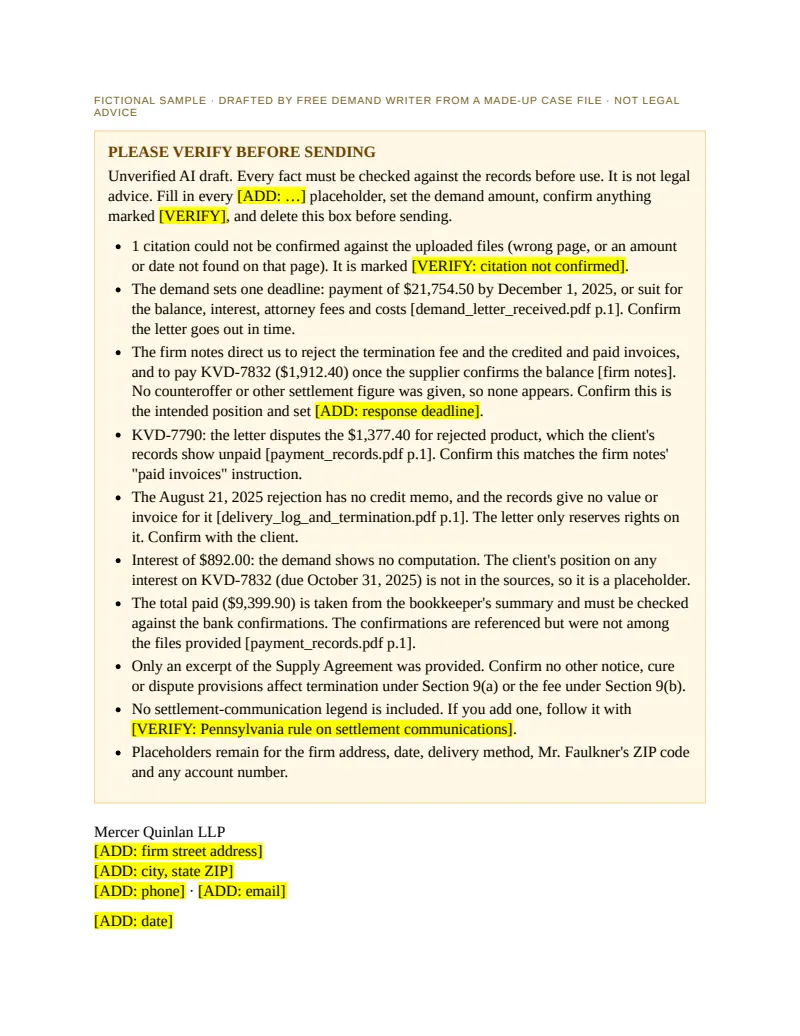
An editable Word letter built only from what your documents say. Missing facts become [ADD: …] placeholders, never guesses, and any law cited is marked [VERIFY].
- Please verify box. What to check, including every deadline the demand set.
- Summary of the demand. A neutral account of what the sender claims, framed as claims, not facts.
- Point-by-point response. Each claim in the demand, followed by your client's position with citations to your client's own documents.
- Placeholders where records are silent. Points the client's documents don't address are marked [ADD: ...], never conceded.
- Your client's position. A rejection, counteroffer or proposed terms, as your notes direct. Any counteroffer amount is always a placeholder.
- Settlement communication line. Marked [VERIFY] so you can check your state's rule.
- Reservation of rights. A statement that the response waives no rights or defenses.
Before you send it
The result is an unverified AI draft for attorney review, not legal advice.
- Confirm the draft identified the right file as the demand and summarized it accurately.
- Read each response point against the cited client documents, and remove anything the client cannot stand behind.
- Decide the client's position and any counteroffer amount or terms, and set your own deadline if you give one.
- Check the deadlines listed in the Please verify box, the limitation period and any insurance notice duty.
Common mistakes
A response can become evidence if the dispute goes further. These are the errors most worth catching before it goes out.
- Admitting facts in passing Phrases like "our client accepts that" can be read as admissions. Say nothing the records don't support.
- Missing the demand's deadline It is not a court deadline, but ignoring it can lead to a lawsuit with less room to negotiate.
- Forgetting the insurer Many liability policies require prompt notice of a claim, and a late notice can put coverage at risk. Check the client's policies before responding.
- Relying on settlement protections without checking Labels like "without prejudice" or "for settlement purposes only" are treated differently from state to state. Check how your state treats them.
- Countering without a basis A figure not tied to the documents invites an arbitrary reply. Keep it consistent with the client's position on liability.
Free response to a demand letter template
Prefer to write it yourself? Download a plain Word template with fields to fill in. No AI, no email needed. Sample template, not legal advice.
Questions
Is the response to a demand letter free?
Yes. No account and no payment.
How does it know which file is the demand letter?
It reads the content: another sender's letterhead, the word demand, an amount demanded and a deadline. If no file looks like a demand letter, the draft says so and leaves a placeholder.
Will the draft admit liability or accept the amount demanded?
No. It never concedes liability or admits a fact your client's documents don't support. Points the documents don't address are left as [ADD: ...] placeholders for you.
Can it write a counteroffer?
Yes, if your notes ask for one. The counteroffer amount is always a placeholder for you to set. If your notes don't say whether to reject, counter or propose terms, the draft takes a measured position and flags the choice for you.
Does a demand letter mean my client is being sued?
No. A demand letter is not a lawsuit, but it often comes before one. A clear written response can narrow the dispute or show the client engaged in good faith.
What happens to the documents I upload?
They are deleted as soon as the draft is generated. The Word file is deleted after 48 hours or 3 downloads.