Skip to content
Free Demand Writer
Menu
Free Demand Writer

Free Preservation of Evidence (Spoliation) Letter

A preservation of evidence letter, also called a spoliation letter or litigation hold demand, puts the other side on notice that a claim exists and that it must keep the evidence. Surveillance video is often overwritten on a short cycle, vehicles get repaired or scrapped, and electronic data is deleted in the ordinary course of business. A prompt, specific letter is often the best way to keep that evidence available.

Free Demand Writer reads the incident report, photos, claim correspondence and other documents you upload and drafts the letter in Word. It summarizes the claim with page citations and lists the categories of evidence that fit the facts, with dates, places and people drawn from the records.

New to this kind of letter? Our guide explains what goes into a demand letter, when to send one and what happens next.

  • Free
  • No sign-up
  • Editable Word (.docx)
  • Files deleted after drafting

When to use this letter

Send this letter as early as possible, once you know who holds evidence that matters. Typical cases:

  • A truck or commercial vehicle crash, where driver logs, telematics and dash cam footage may be lost.
  • A slip and fall or security incident at a store, where surveillance video may be overwritten.
  • A product failure, where the product, its parts and the maker's testing records must be kept intact.
  • An employment or business dispute, where emails, texts and chat messages may be deleted.
  • A workplace or construction injury, where equipment, inspection records and incident reports matter.

Rules on the duty to preserve and the consequences of losing evidence vary by state and by court. A clear letter helps show that the recipient knew about the claim and what to keep. The draft notes the duty and leaves the state rule for your attorney to confirm.

What to upload

Upload up to 5 PDFs, 500 pages in total. The draft only needs enough to describe the claim and identify the evidence.

Incident or police report
The report that identifies the date, time, place, vehicles and people involved.
Photos
Scene, vehicle, product or property photos that show what physical evidence exists and where cameras were.
Claim correspondence
Letters or emails with the other party or its insurer, so the draft picks up names and claim numbers.
Witness statements
Statements that mention cameras, employees on duty, phones or other sources of evidence.
Employment or contract records
For business and employment disputes, the documents that show which systems and people hold the data.

What the draft includes

An editable Word letter built only from what your documents say. Missing facts become [ADD: …] placeholders, never guesses, and any law cited is marked [VERIFY].

  1. Please verify box. A short notice at the top reminding the reviewer that this is an unverified AI draft.
  2. Claim summary. A short account of the incident or dispute, with sources in brackets such as [incident_report.pdf p.1].
  3. Evidence categories. Video and photos, electronically stored information, physical items and documents, as they fit the facts.
  4. Specific time windows. Dates and times for footage and records, taken from the documents or left as placeholders.
  5. Litigation hold request. A request to suspend routine deletion and send a hold notice to the staff and vendors who hold the data.
  6. Inspection request. Notice and a chance to inspect before any vehicle, product or item is repaired, altered or destroyed.
  7. Response deadline. A placeholder for the date by which the recipient should confirm in writing.

Before you send it

The result is an unverified AI draft for attorney review, not legal advice.

  • Confirm the recipient actually holds or controls the evidence listed, and add any party missed.
  • Narrow or widen each category and time window to fit the case.
  • Check the state rule on spoliation flagged with [VERIFY] before relying on it.
  • Set the response deadline and delivery method, and remove the Please verify box.

Common mistakes

A preservation letter works best when it is fast and specific. These are the common problems.

  • Waiting too long Video systems often overwrite footage on a short cycle. Send the letter as soon as you know who has the cameras or the data.
  • Asking for everything A demand to preserve every record the company has is easy to ignore and hard to enforce. Tie each category to the incident, the dates and the people involved.
  • Forgetting electronic data Texts, chats, GPS, telematics and event data recorders are lost quietly. Name them, and ask that they be kept in native format with metadata.
  • Missing third parties Security vendors, fleet managers and cloud providers may hold the evidence. Ask the recipient to notify them, and send separate letters where needed.
  • Overstating the threat Note the duty to preserve and leave it there. Threats beyond that rarely help and can sour early talks.

Free preservation of evidence (spoliation) letter template

Prefer to write it yourself? Download a plain Word template with fields to fill in. No AI, no email needed. Sample template, not legal advice.

Questions

Is the preservation of evidence demand letter free?

Yes. No account and no payment.

Does the letter ask for money?

Usually not. Its job is to keep evidence. If your notes ask for a demand, the amount is left as a placeholder.

Can I send it before I have the full file?

Yes. The draft only needs enough to describe the claim and identify the evidence, and gaps are left as placeholders.

Does it explain the consequences of destroying evidence?

It notes the duty to preserve and that lost evidence may matter in later litigation, and flags the state rule for your attorney to confirm.

What happens to the documents I upload?

They are used only to draft the letter and are deleted as soon as the draft is generated. The Word file is deleted after 48 hours or 3 downloads.
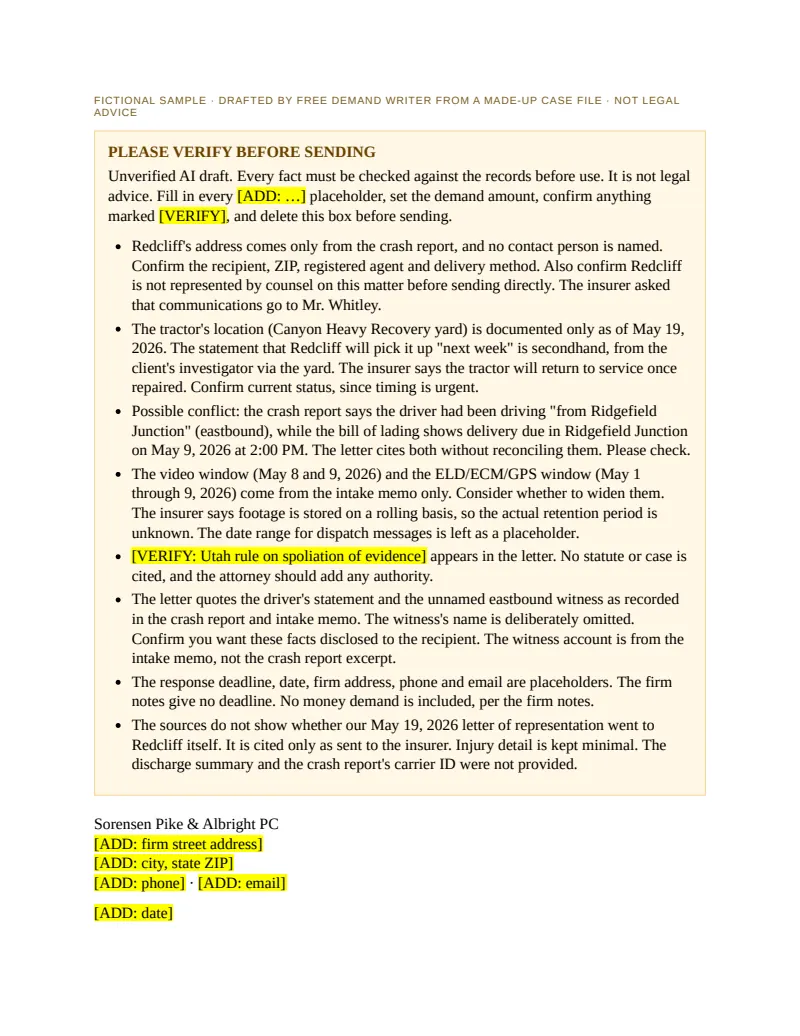
Fictional sample

See a sample draft

We made up a case file and ran it through Free Demand Writer, the same way your documents would be. This is the unedited draft. Everything in it is fictional: the people, the companies and the facts. A Utah driver is seriously injured when a freight carrier's tractor-trailer drifts across the center line on a mountain highway, and the firm needs the truck's dash camera, electronic logs and maintenance records preserved.

Fictional case file: highway_patrol_crash_report.pdf, client_intake_memo.pdf, insurer_acknowledgment_email.pdf · State: Utah

Page 1 of a fictional sample preservation of evidence (spoliation) letter drafted by Free Demand Writer Download sample PDF

Fictional sample. Not legal advice. Your draft is built from your own documents.

Fictional sample · letter text

PLEASE VERIFY BEFORE SENDING

Unverified AI draft. Every fact must be checked against the records before use. It is not legal advice. Fill in every [ADD: …] placeholder, set the demand amount, confirm anything marked [VERIFY], and delete this box before sending.

  • Redcliff's address comes only from the crash report, and no contact person is named. Confirm the recipient, ZIP, registered agent and delivery method. Also confirm Redcliff is not represented by counsel on this matter before sending directly. The insurer asked that communications go to Mr. Whitley.
  • The tractor's location (Canyon Heavy Recovery yard) is documented only as of May 19, 2026. The statement that Redcliff will pick it up "next week" is secondhand, from the client's investigator via the yard. The insurer says the tractor will return to service once repaired. Confirm current status, since timing is urgent.
  • Possible conflict: the crash report says the driver had been driving "from Ridgefield Junction" (eastbound), while the bill of lading shows delivery due in Ridgefield Junction on May 9, 2026 at 2:00 PM. The letter cites both without reconciling them. Please check.
  • The video window (May 8 and 9, 2026) and the ELD/ECM/GPS window (May 1 through 9, 2026) come from the intake memo only. Consider whether to widen them. The insurer says footage is stored on a rolling basis, so the actual retention period is unknown. The date range for dispatch messages is left as a placeholder.
  • [VERIFY: Utah rule on spoliation of evidence] appears in the letter. No statute or case is cited, and the attorney should add any authority.
  • The letter quotes the driver's statement and the unnamed eastbound witness as recorded in the crash report and intake memo. The witness's name is deliberately omitted. Confirm you want these facts disclosed to the recipient. The witness account is from the intake memo, not the crash report excerpt.
  • The response deadline, date, firm address, phone and email are placeholders. The firm notes give no deadline. No money demand is included, per the firm notes.
  • The sources do not show whether our May 19, 2026 letter of representation went to Redcliff itself. It is cited only as sent to the insurer. Injury detail is kept minimal. The discharge summary and the crash report's carrier ID were not provided.

Sorensen Pike & Albright PC
[ADD: firm street address]
[ADD: city, state ZIP]
[ADD: phone] · [ADD: email]

[ADD: date]

VIA [ADD: delivery method]

[ADD: recipient name or registered agent]
Redcliff Freight Lines Inc.
900 Depot Way
Granger Point, Utah [ADD: ZIP] [highway_patrol_crash_report.pdf p.1]

Re: Demand to Preserve Evidence. Our client: Tyler M. Jakobsen. Date of loss: May 9, 2026. Utah Highway Patrol Report No. UHP-26-1-04471. Tractor R-2208 / Trailer T-7719. Summit Range Transport Insurance Claim No. SRT-26-31877

Dear [ADD: recipient name]:

Introduction

We represent Tyler M. Jakobsen regarding the head-on collision on May 9, 2026 on State Route 214 near mile post 38, Sunderland Canyon, Utah. The collision involved Redcliff Freight Lines Inc. tractor No. R-2208 with trailer No. T-7719, driven by Redcliff employee Lyle Brandvold [highway_patrol_crash_report.pdf p.1]. This letter asks Redcliff to preserve all evidence relevant to that collision and to any claims or litigation arising from it. We have notified your insurer, Summit Range Transport Insurance, of our representation [insurer_acknowledgment_email.pdf p.1].

The claim

According to the Utah Highway Patrol crash report, the collision occurred at about 6:05 AM on May 9, 2026, at dawn on a dry road, in a left-hand curve on a two-lane highway posted at 55 mph [highway_patrol_crash_report.pdf p.1]. The report states that Mr. Brandvold's eastbound tractor-trailer drifted across the double yellow center line in the curve and struck Mr. Jakobsen's westbound pickup head-on, offset on the driver's side, pushing the pickup into the guardrail [highway_patrol_crash_report.pdf p.1].

The report records that Mr. Brandvold stated he "must have zoned out for a second" and that he had been driving since late the previous evening from Ridgefield Junction. It also records that the paper log in the cab did not match the time he described [highway_patrol_crash_report.pdf p.1]. A motorist driving behind the truck reportedly told the trooper that the truck "had been wandering over the line for about a mile" [client_intake_memo.pdf p.1]. The tractor is equipped with an electronic logging device, a forward-facing dash camera and an in-cab driver-facing camera [highway_patrol_crash_report.pdf p.1].

Mr. Jakobsen was extricated by Sunderland County Fire and flown to Granger Point Medical Center [highway_patrol_crash_report.pdf p.1]. He was hospitalized there from May 9 to May 18, 2026 [client_intake_memo.pdf p.1].

The tractor and trailer were towed to the Canyon Heavy Recovery yard at 455 Freight Spur Road, Granger Point, where they remained as of May 19, 2026 [highway_patrol_crash_report.pdf p.1; client_intake_memo.pdf p.1]. Summit Range has told us that Redcliff's camera system stores footage on a rolling basis and that the tractor is scheduled to return to service once repaired [insurer_acknowledgment_email.pdf p.1]. On May 22, 2026, we asked Summit Range to have Redcliff refrain from repairing, moving or releasing the tractor and trailer and from allowing footage or electronic data from May 8 and 9, 2026 to be overwritten. We had received no reply as of May 26, 2026 [insurer_acknowledgment_email.pdf p.1]. We therefore send this formal notice.

Evidence to preserve

Redcliff must preserve all evidence in its possession, custody or control, or in the possession of anyone acting for it, that relates to the collision, Mr. Brandvold, or the operation and condition of tractor R-2208 and trailer T-7719. This includes, without limitation:

  • Video and photographs. All forward-facing dash camera and driver-facing in-cab camera video from tractor R-2208 for May 8 and May 9, 2026 [client_intake_memo.pdf p.1], including any event-triggered clips and footage stored on the camera system or any server or cloud account. Please suspend any rolling or automatic overwriting of this footage [insurer_acknowledgment_email.pdf p.1]. Also preserve any photographs or video of the scene, the vehicles or the load.
  • Electronic data. Electronic logging device data, engine control module data, and GPS or telematics data for tractor R-2208 for May 1 through May 9, 2026 [client_intake_memo.pdf p.1]. Also preserve dispatch messages and other electronic communications with Mr. Brandvold for [ADD: date range for dispatch messages]. Please keep all of this in native format with metadata intact, and do not reset, clear or reprogram any unit.
  • The tractor and trailer. Tractor R-2208 and trailer T-7719 must not be repaired, moved, released, altered, sold or destroyed before we have had an opportunity to inspect them. This includes the electronic logging device, camera units, and brake and steering components, as well as any parts removed or replaced after the collision.
  • Driver records. Mr. Brandvold's hours of service records, including the paper log found in the cab, along with his fuel and toll receipts, hiring file, training records, and the results of any drug and alcohol testing after the crash [client_intake_memo.pdf p.1; highway_patrol_crash_report.pdf p.1].
  • Policies. Redcliff's cell phone use policy [client_intake_memo.pdf p.1] and any other policy on driver hours, fatigue or in-cab technology in effect on May 9, 2026.
  • Maintenance records. Maintenance and inspection records for the tractor and trailer, including all brake and steering work [client_intake_memo.pdf p.1].
  • Load and trip documents. The bill of lading and related dispatch and delivery records for the load from shipper Bluefield Packaging Co., which was due for delivery in Ridgefield Junction on May 9, 2026 at 2:00 PM [client_intake_memo.pdf p.1].
  • Incident materials. Any accident or incident reports, witness statements or witness lists, and internal or insurer communications about the collision, including those that Redcliff considers privileged, which should be preserved and logged.

Litigation hold

Redcliff is on notice of its obligation to preserve this evidence, and the loss, alteration or destruction of relevant evidence may carry consequences in later litigation [VERIFY: Utah rule on spoliation of evidence]. We ask that Redcliff immediately suspend routine deletion, overwriting and recycling of the materials described above, and that it issue a written litigation hold notice to all employees, contractors and vendors who hold or control them. These include Mr. Brandvold, dispatch and safety personnel, maintenance personnel, any camera, electronic logging or telematics providers, and Canyon Heavy Recovery, which is holding the tractor and trailer [highway_patrol_crash_report.pdf p.1].

Inspection and response

Before any item described above is moved, repaired, altered or released, please give us written notice and a reasonable opportunity to inspect it and to take part in the download and imaging of its electronic data. We specifically ask for an inspection of tractor R-2208 and trailer T-7719 in their current condition.

Please confirm in writing by [ADD: response deadline] that Redcliff has put a litigation hold in place and will preserve the evidence described in this letter, and tell us where the tractor and trailer are now located. Please direct your response to me. Because Summit Range has asked that claim communications go to Mr. Whitley, we are sending him a copy of this letter.

Sincerely,

Hannah L. Sorensen
Sorensen Pike & Albright PC

cc: Graham Whitley, Senior Claims Specialist, Summit Range Transport Insurance, Claim No. SRT-26-31877, via [ADD: delivery method] [insurer_acknowledgment_email.pdf p.1]