Skip to content
Free Demand Writer
Menu
Free Demand Writer

Free Pre-Suit Class Action Statutory Notice

A pre-suit class action notice tells a business that a consumer, and others like them, were harmed by a deceptive or unfair practice, and gives the business a chance to correct it before suit. Some state consumer-protection laws require this notice, with a window to cure, before a damages claim or a class claim can be filed. Others do not require it, but a clear notice can still frame the dispute.

Free Demand Writer reads the receipts, ads, labels, terms and correspondence you upload and drafts the notice in Word. It describes the practice and your client's harm with page citations, leaves the class definition as a placeholder, and flags the state's notice and cure rules for your attorney to confirm.

Required form. This letter often has a legally required form, content and notice period that vary by state. Check your state's rules before sending; the draft lists them to verify.

New to this kind of letter? Our guide explains what goes into a demand letter, when to send one and what happens next.

  • Free
  • No sign-up
  • Editable Word (.docx)
  • Files deleted after drafting

When to use this letter

Use this notice when a business practice harmed your client and likely many other consumers in the same way. Typical cases:

  • Hidden fees, drip pricing or charges that did not match the advertised price.
  • Product labels or marketing claims that the product does not live up to.
  • Auto-renewals and subscription charges billed without the required disclosures.
  • Standard contract terms or practices applied the same way to every customer.
  • Data use or privacy practices that differ from what the business told consumers.

This notice often has a legally required form, content, notice period and delivery method that vary by state, and it must be checked before sending. In some states a defective notice or a filing made before the cure window ends can limit the claim. The draft never states a notice period; your attorney confirms it.

What to upload

Upload up to 5 PDFs, 500 pages in total. Show what your client saw, what they paid and what happened next.

Receipts and statements
Order confirmations, invoices or card statements showing what your client paid and when.
Ads, labels and web pages
Screenshots or printouts of the advertising, packaging, pricing or claims at issue.
Terms and policies
The terms of service, subscription terms or privacy policy in effect at the time.
Correspondence
Complaints, cancellation attempts and the business's replies, with dates.
Other consumers' accounts
Public complaints or reviews that describe the same practice, if you have collected them.

What the draft includes

An editable Word letter built only from what your documents say. Missing facts become [ADD: …] placeholders, never guesses, and any law cited is marked [VERIFY].

  1. Please verify box. A short notice at the top reminding the reviewer that this is an unverified AI draft.
  2. Required notice section. [VERIFY] placeholders for the state's required form, content, notice period, delivery method and cure rules.
  3. The practice. What the business did and how your client encountered it, quoting short phrases, with sources such as [ad.pdf p.1].
  4. Your client's harm. A table of purchases and charges as read from the documents, with a total for you to confirm.
  5. Proposed class. A placeholder for the class definition. The draft never estimates class size or class-wide damages.
  6. Demand and cure. Stop the practice, correct it and compensate those affected, with the relief and deadline as placeholders.
  7. Preservation request. A request that the business keep the records relevant to the practice.

Before you send it

The result is an unverified AI draft for attorney review, not legal advice.

  • Confirm whether your state requires a pre-suit notice, and its form, content, recipient and delivery method.
  • Write the proposed class definition and check it against the facts.
  • Match every date, price and quoted phrase to the page cited in brackets.
  • Set the relief demanded and the deadline, and remove the Please verify box.

Common mistakes

Pre-suit notices are judged on what they say and how they were sent. These are the common problems.

  • Filing before the window closes Where a state requires notice and a cure window, filing a damages claim too early can cause problems. Calendar the window from the date of delivery.
  • A vague description of the practice Some statutes require the notice to identify the practice and the injury with reasonable detail. Quote the ad or term and state what your client paid.
  • Sending to the wrong address Some states require delivery to a principal place of business or registered agent by a specific method. Check before sending and keep proof.
  • Ignoring a cure offer A timely, adequate cure offer may affect the claim or fees in some states. Review any offer carefully with the client.
  • Overstating the class Describe the class from the facts you have. Inflated numbers undercut credibility.

Free pre-suit class action statutory notice template

Prefer to write it yourself? Download a plain Word template with fields to fill in. No AI, no email needed. Sample template, not legal advice.

Questions

Is the pre-suit class action notice free?

Yes. No account and no payment.

Does the draft know my state's notice and cure rules?

No. They vary by state and statute, so the draft flags them with [VERIFY] placeholders for your attorney to confirm.

Will it define the class or estimate damages?

No. The class definition and the relief demanded are placeholders. The draft covers your client's own facts and harm.

Can it name the consumer law that applies?

Only generally, and only with a [VERIFY] flag. It never cites section numbers or penalty amounts.

What happens to the documents I upload?

They are used only to draft the notice and are deleted as soon as the draft is generated. The Word file is deleted after 48 hours or 3 downloads.
Fictional sample

See a sample draft

We made up a case file and ran it through Free Demand Writer, the same way your documents would be. This is the unedited draft. Everything in it is fictional: the people, the companies and the facts. A Virginia home internet customer signs up for an advertised flat monthly price and is billed a separate 'network access fee' on every statement that the ads and order page never mentioned.

Fictional case file: advertisement_and_order_page.pdf, monthly_statements.pdf, customer_service_chat.pdf · State: Virginia

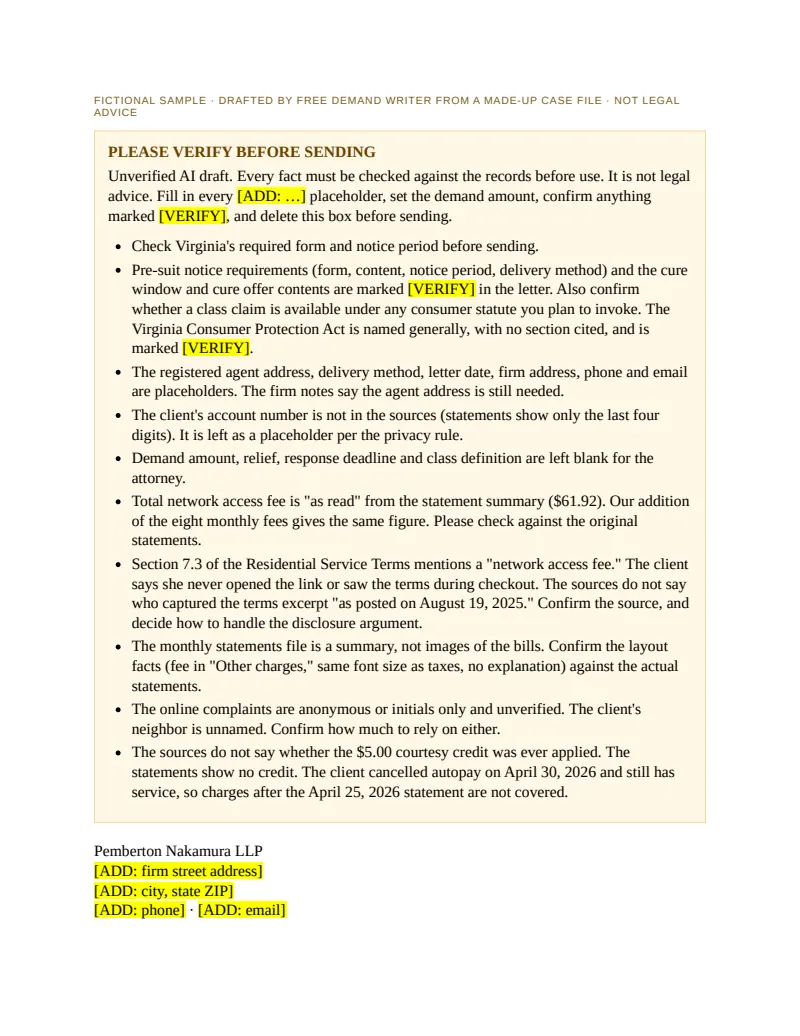
Page 1 of a fictional sample pre-suit class action statutory notice drafted by Free Demand Writer Download sample PDF

Fictional sample. Not legal advice. Your draft is built from your own documents.

Fictional sample · letter text

PLEASE VERIFY BEFORE SENDING

Unverified AI draft. Every fact must be checked against the records before use. It is not legal advice. Fill in every [ADD: …] placeholder, set the demand amount, confirm anything marked [VERIFY], and delete this box before sending.

  • Check Virginia's required form and notice period before sending.
  • Pre-suit notice requirements (form, content, notice period, delivery method) and the cure window and cure offer contents are marked [VERIFY] in the letter. Also confirm whether a class claim is available under any consumer statute you plan to invoke. The Virginia Consumer Protection Act is named generally, with no section cited, and is marked [VERIFY].
  • The registered agent address, delivery method, letter date, firm address, phone and email are placeholders. The firm notes say the agent address is still needed.
  • The client's account number is not in the sources (statements show only the last four digits). It is left as a placeholder per the privacy rule.
  • Demand amount, relief, response deadline and class definition are left blank for the attorney.
  • Total network access fee is "as read" from the statement summary ($61.92). Our addition of the eight monthly fees gives the same figure. Please check against the original statements.
  • Section 7.3 of the Residential Service Terms mentions a "network access fee." The client says she never opened the link or saw the terms during checkout. The sources do not say who captured the terms excerpt "as posted on August 19, 2025." Confirm the source, and decide how to handle the disclosure argument.
  • The monthly statements file is a summary, not images of the bills. Confirm the layout facts (fee in "Other charges," same font size as taxes, no explanation) against the actual statements.
  • The online complaints are anonymous or initials only and unverified. The client's neighbor is unnamed. Confirm how much to rely on either.
  • The sources do not say whether the $5.00 courtesy credit was ever applied. The statements show no credit. The client cancelled autopay on April 30, 2026 and still has service, so charges after the April 25, 2026 statement are not covered.

Pemberton Nakamura LLP
[ADD: firm street address]
[ADD: city, state ZIP]
[ADD: phone] · [ADD: email]

[ADD: date]

VIA [ADD: delivery method]

Clearwave Home Broadband LLC
Attn: Registered Agent
[ADD: address or registered agent for notice] [VERIFY]
[ADD: city, state ZIP]

Re: Pre-Suit Notice on Behalf of Denise R. Holloway and All Others Similarly Situated; Clearwave "Network Access Fee"; Account No. [ADD: account number]; Order No. CW-0819-55271 [advertisement_and_order_page.pdf p.1]

Dear Sir or Madam:

Introduction

This firm represents Denise R. Holloway, individually and on behalf of all others similarly situated. This letter is notice before suit concerning the monthly "network access fee" that Clearwave Home Broadband LLC ("Clearwave") charges its residential customers.

Required notice

This letter is sent as the notice that may be required before a consumer claim is brought, including any claim under the Virginia Consumer Protection Act [VERIFY]. [VERIFY: Virginia rule on pre-suit notice before a consumer class claim: required form, content, notice period and delivery method]

We invite Clearwave to correct the practice described below and to make our client and those similarly situated whole. [VERIFY: Virginia rule on the cure window and what a cure offer must include]

The practice

Clearwave mailed our client an advertisement postmarked August 11, 2025. Its headline reads: "Fiber-Fast 500. $49.99 a month. Price locked through 2027." The body states: "No hidden fees. No equipment charges. What you see is what you pay." The only qualification in the small print is: "Taxes extra. Offer for new residential customers in eligible areas." [advertisement_and_order_page.pdf p.1]

On August 19, 2025, our client ordered through Clearwave's website. The order page listed the Fiber-Fast 500 plan at a "Monthly price" of $49.99, "Equipment: Included," "Installation: $0.00 (online offer)," and an "Estimated first bill: $49.99 plus taxes." [advertisement_and_order_page.pdf p.1] Clearwave's confirmation email of the same date (Order No. CW-0819-55271) stated that the plan "is $49.99 per month, price locked through December 31, 2027." [advertisement_and_order_page.pdf p.1] The mailer, the order page and the confirmation email do not name a network access fee. [advertisement_and_order_page.pdf p.1]

The order page offered only a checkbox reading "I agree to the Residential Service Terms," with a link. Our client did not open that link and was not shown the terms on any screen during checkout. [monthly_statements.pdf p.1] Section 7.3 of the terms, as posted on August 19, 2025, states that Clearwave "may assess a network access fee to recover costs of maintaining and upgrading its network" and that the fee "is not part of the advertised plan price and may change." [advertisement_and_order_page.pdf p.1]

Service began September 2, 2025. [monthly_statements.pdf p.1] Every statement since has included a network access fee. It appears in the "Other charges" section, below the plan price, in the same font size as the taxes, and the statement does not explain it. The "Plan summary" box at the top of each statement reads "Fiber-Fast 500, $49.99/mo, price locked." [monthly_statements.pdf p.1] The fee was $6.99 per month on the first four statements. A January 2026 bill insert announced: "Starting this month, the network access fee will be $8.49 to support continued investment in our network." [monthly_statements.pdf p.1]

On February 27, 2026, our client contacted Clearwave support, noted that the advertisement promised "no hidden fees" and $49.99 a month, and asked that the fee be removed and refunded. The agent responded that the fee "applies to all residential internet accounts," that he was "not able to remove the fee, since it's charged to every customer," and offered a one-time $5.00 courtesy credit. [customer_service_chat.pdf p.1] Our client declined that offer and asked for escalation (Reference ESC-226841). On March 9, 2026, Clearwave Customer Relations replied that the fee "was billed correctly under the Residential Service Terms" and that "[n]o further credit is available." [customer_service_chat.pdf p.1]

Our client's purchase and harm

Our client paid a network access fee on each of the eight statements below, by autopay from her checking account. [monthly_statements.pdf p.1]

ItemDateAmountSource
Network access fee09/25/2025$6.99[monthly_statements.pdf p.1]
Network access fee10/25/2025$6.99[monthly_statements.pdf p.1]
Network access fee11/25/2025$6.99[monthly_statements.pdf p.1]
Network access fee12/25/2025$6.99[monthly_statements.pdf p.1]
Network access fee01/25/2026$8.49[monthly_statements.pdf p.1]
Network access fee02/25/2026$8.49[monthly_statements.pdf p.1]
Network access fee03/25/2026$8.49[monthly_statements.pdf p.1]
Network access fee04/25/2026$8.49[monthly_statements.pdf p.1]

Total (as read from the bills): $61.92 [monthly_statements.pdf p.1]

Our client cancelled autopay on April 30, 2026 and still has service. [customer_service_chat.pdf p.1] Charges after the April 25, 2026 statement are not included above, and our client reserves her claim for them.

The proposed class

Our client seeks to represent a class of Clearwave customers who were charged the network access fee. The proposed class definition is: [ADD: proposed class definition]. Clearwave's own support agent stated that the fee applies to all residential internet accounts and is charged to every customer. [customer_service_chat.pdf p.1] Other Clearwave customers have also publicly reported being charged the fee after seeing a $49.99 price. [customer_service_chat.pdf p.1]

Demand and cure

On behalf of our client and the proposed class, we demand that Clearwave:

  • Stop charging the network access fee, or otherwise correct its advertising, ordering and billing so that the price advertised is the price charged.
  • Refund the network access fee to our client and to all other affected customers.
  • Provide our client the relief set out here: [ADD: demand amount or relief demanded].

Please respond in writing by [ADD: response deadline].

We also ask that Clearwave preserve all documents and electronically stored information relating to this matter. This includes advertising and mailers, website order pages and checkout flows (and their version histories), the Residential Service Terms in every version, customer billing records, communications about the network access fee, customer complaints and escalations, and records of the fee's adoption and increase.

This letter is not a complete statement of the facts or of our client's claims. Our client and the proposed class reserve all rights and remedies.

Sincerely,

Julian K. Pemberton
Pemberton Nakamura LLP