When to use this letter
Use this letter when your client needs someone to stop an ongoing activity, and a clear written demand may end it without litigation. Typical cases:
- Harassment or repeated unwanted contact by calls, texts, email, social media or in person.
- Trespass, encroachment or unauthorized use of your client's land, building or driveway.
- Unfair competition, such as passing off, interfering with customers or misusing a business name.
- Nuisance conduct by a neighbor or business, such as noise, drainage or obstruction.
- Interference with a contract or business relationship your client has with a third party.
For copyright or trademark use, false statements about your client, or a breach of an NDA or non-compete, use the letter type built for that claim. A cease and desist letter can also prompt the recipient to sue first, so your attorney should weigh that risk before sending.
What to upload
Upload up to 5 PDFs, 500 pages in total. Save screenshots, web pages and messages as PDF so dates, names and URLs are visible.
- Evidence of the conduct
- Text messages, call logs, emails, social posts, photos or video stills showing what the recipient did and when.
- Incident log
- Your client's dated log of each incident, with witnesses, and any police or incident reports.
- Proof of your client's rights
- A deed, survey, lease or business registration that shows the right being interfered with.
- Prior contact
- Earlier requests to stop, no-contact requests or notices, and the recipient's replies.
- Harm to your client
- Lost customers, repair invoices, complaints or other proof that the conduct is causing damage.
What the draft includes
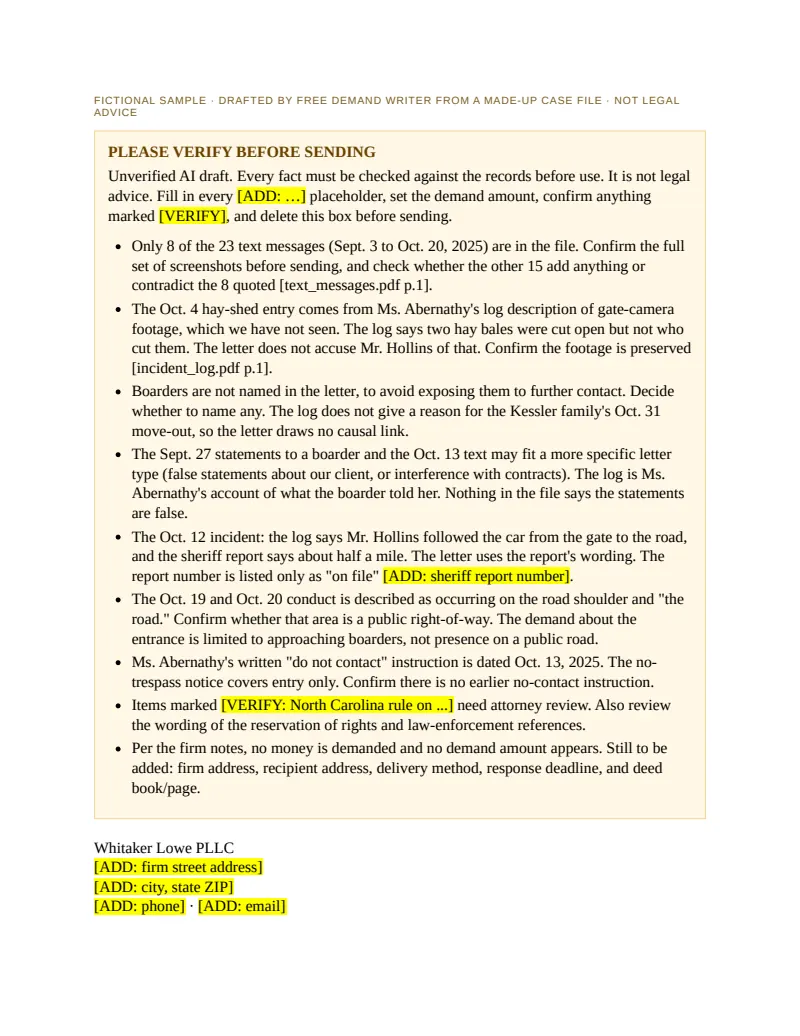
An editable Word letter built only from what your documents say. Missing facts become [ADD: …] placeholders, never guesses, and any law cited is marked [VERIFY].
- Please verify box. A short notice at the top reminding the reviewer that this is an unverified AI draft.
- Identification of the parties. Who your client is, who the recipient is, and how they are connected, from the documents.
- The conduct. Each incident in date order, what the recipient did and where, cited to the evidence file and page.
- Your client's rights. The ownership, agreement or other basis for the demand, with any law cited marked [VERIFY].
- Specific demands. Stop the contact, stay off the property, end the practice or confirm in writing. Placeholders for anything the documents don't settle.
- Deadline and consequences. A response deadline placeholder and a neutral statement of possible next steps for you to tailor.
- Preservation reminder. A placeholder to ask the recipient to preserve relevant evidence, if your attorney wants one.
Before you send it
The result is an unverified AI draft for attorney review, not legal advice.
- Confirm the evidence still reflects current conduct, and capture fresh copies if needed.
- Verify any dates, property descriptions and contract terms cited.
- Review the tone and threats carefully; overstated claims can backfire.
- Set the deadline and demands, and remove the Please verify box.
Common mistakes
A cease and desist letter is often forwarded, posted online or attached to a court filing. Write it expecting the recipient's lawyer, and perhaps a judge, to read it.
- Overstating the claim Claiming rights your client does not have, or exaggerating the harm, weakens credibility and can invite a counterclaim. Stick to what the evidence shows.
- Vague demands Telling someone to stop harassing is not enough. List the specific conduct, such as calls, visits or posts, and say what written confirmation you expect and by when.
- Stale or incomplete evidence Posts and messages get edited or deleted. Capture dated copies with names and URLs before sending, and keep the originals in the file.
- Threats that cross the line Threatening criminal charges or agency complaints to gain leverage in a civil dispute may be improper, and the rules vary by state. Keep the consequences to remedies your client can actually pursue.
- Skipping a protective order Where harassment involves threats or stalking, a letter may not be enough and can escalate things. Your attorney should consider whether a court order is the better first step.
Free cease and desist demand letter template
Prefer to write it yourself? Download a plain Word template with fields to fill in. No AI, no email needed. Sample template, not legal advice.
Questions
Is the cease and desist demand letter free?
Yes. No account and no payment.
Can I send this as a non-lawyer?
This tool is for licensed attorneys and their staff only. The draft is meant to be reviewed and sent by a law firm.
Will it say which laws were broken?
Only if the documents support it, and any statute or case named is marked [VERIFY]. The tool never invents legal authority.
Should I use this for copyright, trademark or defamation claims?
Use the copyright or trademark infringement letter or the defamation letter instead. Each is built around the evidence those claims need.
What happens to the documents I upload?
They are deleted as soon as the draft is generated. The Word file is deleted after 48 hours or 3 downloads.