When to use this letter
Use this letter when someone has published a false statement of fact that is harming your client's reputation or business. Typical cases:
- Fake or false online reviews about a business or professional.
- Social media posts or videos accusing your client of a crime, fraud or misconduct.
- Statements to customers, employers or a professional board that are false.
- Articles, blogs or newsletters that publish false facts about your client.
- Spoken statements at meetings or to third parties, where witnesses can confirm the words.
Defamation law varies by state, including the time to sue, how retraction requests work and what a public figure must prove. Some states limit damages if a retraction is not requested in time. Opinion and true statements are generally not defamatory. Check the state's rules before sending.
What to upload
Upload up to 5 PDFs, 500 pages in total. Save every post or review as PDF with the author, date and URL visible.
- The statements
- Screenshots or captured pages of each post, review, article or message, showing the exact words.
- Publication details
- URLs, dates, platforms, share or view counts, and the account or author name for each statement.
- Proof of falsity
- Records, contracts, invoices, licenses or other documents that show the statement is untrue.
- Witness accounts
- Written statements from people who heard spoken remarks, with the date and setting.
- Evidence of harm
- Cancelled contracts, lost customers, revenue records or messages from people who saw the statement.
What the draft includes
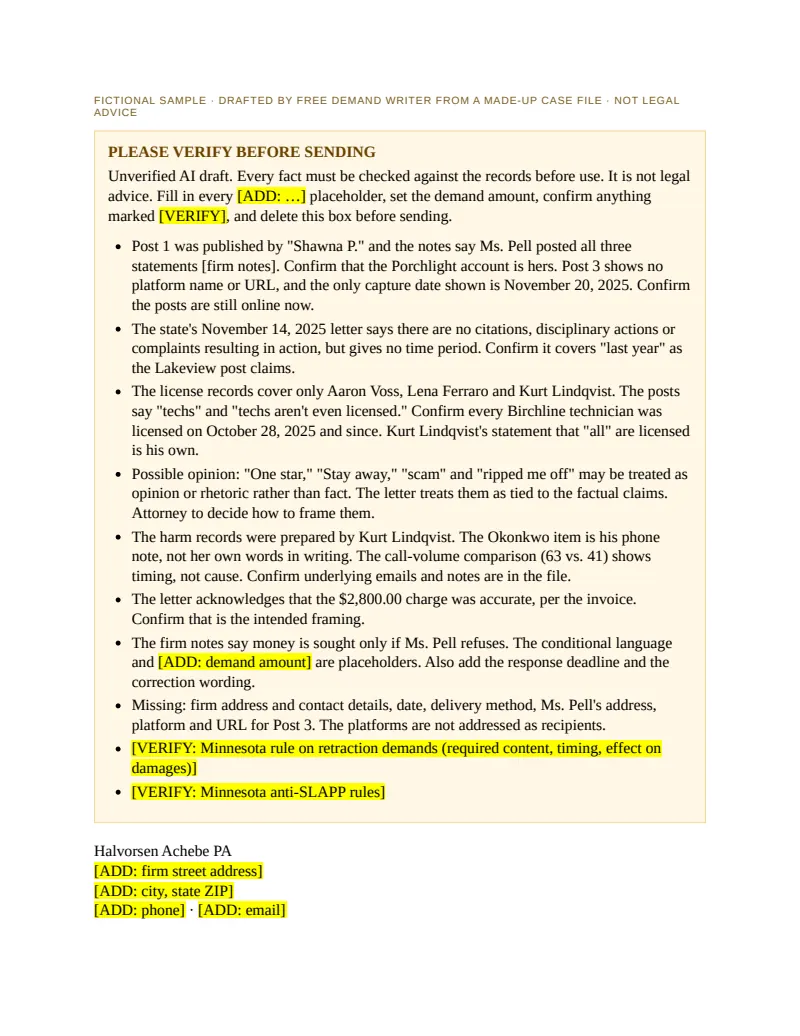
An editable Word letter built only from what your documents say. Missing facts become [ADD: …] placeholders, never guesses, and any law cited is marked [VERIFY].
- Please verify box. A short notice at the top reminding the reviewer that this is an unverified AI draft.
- The statements. Each statement quoted exactly, with where and when it was published, cited to the page.
- Why each is false. The facts from your documents that contradict each statement, kept separate from opinion.
- Harm to your client. Lost business or other harm the records support, with [ADD: …] placeholders for the rest.
- Retraction, removal and correction. A request to remove each statement, publish a correction and stop repeating it.
- Preservation request. A placeholder asking the author to keep the posts, account data and messages.
- The demand. Any damages amount and the response deadline are placeholders for you to set.
Before you send it
The result is an unverified AI draft for attorney review, not legal advice.
- Compare each quoted statement to the screenshot, word for word.
- Separate statements of fact from opinion, and check whether your client is a public figure.
- Check the state's retraction rules and the time to sue.
- Set the deadline and remove the Please verify box.
Common mistakes
Defamation demands are frequently published by the recipient. Write each line expecting the public to read it.
- Paraphrasing the statement A demand that describes the statement loosely lets the recipient argue they never said it. Quote the exact words and give the date and location of each.
- Targeting opinion Statements like a bad experience or poor service are often opinion. Focus the letter on false statements of fact that can be proven untrue.
- Repeating the claim to new people Sending copies to employers, platforms or customers can spread the statement further. Address the letter to the publisher and keep the distribution narrow.
- Asking for the wrong remedy Ask for retraction, removal and correction in specific terms: which post, what wording and where the correction must appear.
- Losing the evidence Posts are often deleted after a demand. Capture dated copies before sending, so removal does not erase the proof.
Free defamation (libel/slander) demand letter template
Prefer to write it yourself? Download a plain Word template with fields to fill in. No AI, no email needed. Sample template, not legal advice.
Questions
Is the defamation demand letter free?
Yes. No account and no payment.
Can it handle fake online reviews?
Yes. Upload each review as a PDF with the date and URL visible. The draft quotes it exactly and asks for removal.
Does it work for spoken statements?
Yes, if you upload a witness statement or notes that record the words. Anything not recorded becomes an [ADD: …] placeholder.
Will it decide whether a statement is defamatory?
No. It sets out the statements and the facts in your documents. Whether a claim exists is for your attorney to decide.
What happens to the documents I upload?
They are deleted as soon as the draft is generated. The Word file is deleted after 48 hours or 3 downloads.