When to use this letter
Use this letter when someone is using your client's creative work, brand name or logo without permission. Typical cases:
- Copied photos, artwork, text or video on a website, listing or social media account.
- A competitor using a confusingly similar business name, product name or logo.
- Counterfeit or knockoff goods sold under your client's mark.
- A former licensee still using the work or mark after the license ended.
- Software, designs or written materials reproduced or distributed without a license.
Rights and remedies depend on whether a work or mark is registered, when it was registered and how it has been used. Online platforms also have their own takedown procedures, which may be faster for some content. A demand can prompt the recipient to sue first, so your attorney should weigh that risk.
What to upload
Upload up to 5 PDFs, 500 pages in total. Save web pages and listings as PDF with the URL and capture date visible.
- Registrations
- Copyright registration certificates, trademark registrations or pending applications, with numbers and dates.
- Your client's work or mark in use
- The original work, specimens, product packaging, website pages or ads that show the mark in use and since when.
- The infringing use
- Screenshots, product listings, photos of goods and captured web pages showing the recipient's use.
- Licenses and agreements
- Any license, assignment or work-for-hire agreement that shows who owns the rights or who was allowed to use them.
- Evidence of confusion or harm
- Misdirected customer emails, reviews, lost sales records or prior takedown notices and replies.
What the draft includes
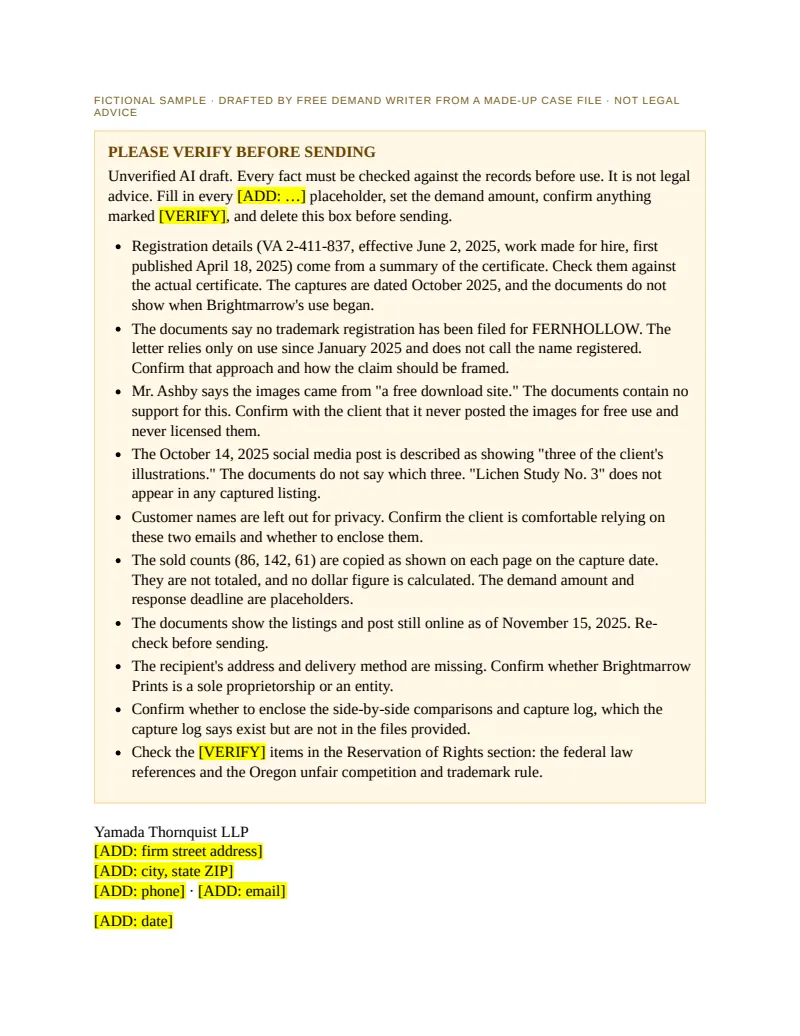
An editable Word letter built only from what your documents say. Missing facts become [ADD: …] placeholders, never guesses, and any law cited is marked [VERIFY].
- Please verify box. A short notice at the top reminding the reviewer that this is an unverified AI draft.
- The protected work or mark. What it is, who owns it and any registration number and date, taken only from the documents.
- Your client's use. How and since when your client has used the work or mark, as the records show.
- The infringing use. Each use by the recipient with the location, URL or product and date, cited to the page.
- Basis for the claim. The ownership and use facts tied to the claim. Any statute named is marked [VERIFY].
- Specific demands. Stop the use, remove listed content, surrender goods, account for sales or confirm in writing.
- The demand. Any license fee or damages amount and the response deadline are placeholders for you to set.
Before you send it
The result is an unverified AI draft for attorney review, not legal advice.
- Verify every registration number, owner name and date against the certificate or record.
- Confirm each infringing use is still live, and capture fresh dated copies.
- Check ownership, licenses and any fair use or prior use defenses.
- Set the demands and deadline, and remove the Please verify box.
Common mistakes
Infringement letters are often posted online by recipients who think they are overreaching. These are the errors that make that happen.
- Claiming a registration that doesn't exist Never describe a work or mark as registered unless the certificate or record is in the file. State pending applications as pending.
- Mixing up copyright and trademark A copied logo may raise both claims, but a copied phrase or product name usually raises only one. Match each demand to the right claim.
- Not identifying the infringing material List each URL, listing, product or page. A general demand to stop infringing gives the recipient room to remove little.
- Ignoring the ownership chain If a contractor, photographer or former partner created the work, show the assignment or work-for-hire agreement before claiming ownership.
- Overreaching on remedies Threatening damages or fees your client may not be eligible for weakens the letter. Leave remedies to your attorney's review of the registration facts.
Free copyright or trademark infringement demand letter template
Prefer to write it yourself? Download a plain Word template with fields to fill in. No AI, no email needed. Sample template, not legal advice.
Questions
Is the copyright or trademark infringement demand letter free?
Yes. No account and no payment.
What if my client's work or mark is not registered?
The draft describes the work or mark and its use from your documents and does not claim a registration. What rights apply is for your attorney to confirm.
Can it send a platform takedown notice?
No. It drafts a letter to the party using the work or mark. Platform takedown forms and notices follow their own rules.
Will it calculate damages or a license fee?
No. Any amount demanded is always left as a placeholder for your attorney.
What happens to the documents I upload?
They are deleted as soon as the draft is generated. The Word file is deleted after 48 hours or 3 downloads.