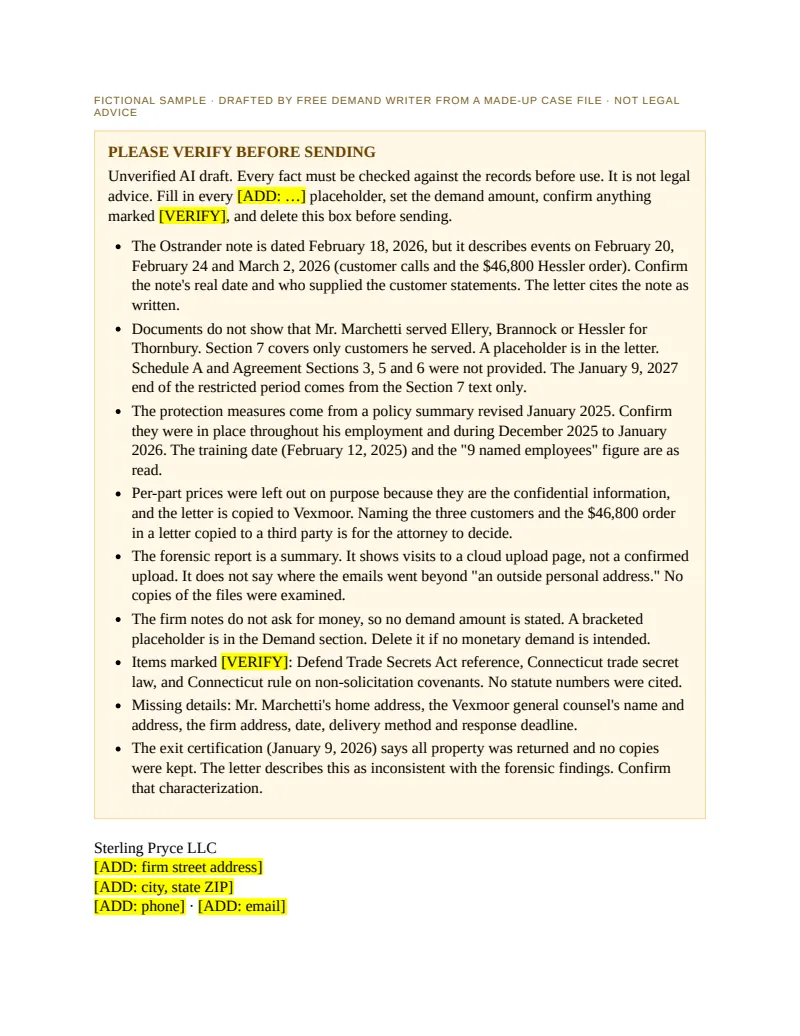
PLEASE VERIFY BEFORE SENDING
Unverified AI draft. Every fact must be checked against the records before use. It is not legal advice. Fill in every [ADD: …] placeholder, set the demand amount, confirm anything marked [VERIFY], and delete this box before sending.
- The Ostrander note is dated February 18, 2026, but it describes events on February 20, February 24 and March 2, 2026 (customer calls and the $46,800 Hessler order). Confirm the note's real date and who supplied the customer statements. The letter cites the note as written.
- Documents do not show that Mr. Marchetti served Ellery, Brannock or Hessler for Thornbury. Section 7 covers only customers he served. A placeholder is in the letter. Schedule A and Agreement Sections 3, 5 and 6 were not provided. The January 9, 2027 end of the restricted period comes from the Section 7 text only.
- The protection measures come from a policy summary revised January 2025. Confirm they were in place throughout his employment and during December 2025 to January 2026. The training date (February 12, 2025) and the "9 named employees" figure are as read.
- Per-part prices were left out on purpose because they are the confidential information, and the letter is copied to Vexmoor. Naming the three customers and the $46,800 order in a letter copied to a third party is for the attorney to decide.
- The forensic report is a summary. It shows visits to a cloud upload page, not a confirmed upload. It does not say where the emails went beyond "an outside personal address." No copies of the files were examined.
- The firm notes do not ask for money, so no demand amount is stated. A bracketed placeholder is in the Demand section. Delete it if no monetary demand is intended.
- Items marked [VERIFY]: Defend Trade Secrets Act reference, Connecticut trade secret law, and Connecticut rule on non-solicitation covenants. No statute numbers were cited.
- Missing details: Mr. Marchetti's home address, the Vexmoor general counsel's name and address, the firm address, date, delivery method and response deadline.
- The exit certification (January 9, 2026) says all property was returned and no copies were kept. The letter describes this as inconsistent with the forensic findings. Confirm that characterization.
Sterling Pryce LLC
[ADD: firm street address]
[ADD: city, state ZIP]
[ADD: phone] · [ADD: email]
[ADD: date]
VIA [ADD: delivery method]
Kyle Marchetti
[ADD: home street address]
[ADD: city, state ZIP]
Re: Demand to Cease Use of Confidential Information and Return Company Property. Thornbury Precision Coatings Inc. / Kyle Marchetti. File no. [ADD: firm file number]
Dear Mr. Marchetti:
Introduction
We represent Thornbury Precision Coatings Inc. ("Thornbury") [firm notes]. We write to demand that you stop using and disclosing Thornbury's confidential pricing and process information, which our client's records show was copied from its systems before you left your position as Senior Sales Engineer. We also demand that you return everything you took. A copy of this letter is being sent to the general counsel of your current employer, Vexmoor Surface Technologies LLC ("Vexmoor") [firm notes].
Our client's confidential information
The information at issue falls into these categories:
- customer-specific pricing, quotes and the customer price matrix;
- customer lists and contacts; and
- coating process sheets, including cure schedules and line settings.
We do not repeat the content of that information in this letter.
Thornbury took these steps to keep the information secret:
- You signed Thornbury's Employee Confidentiality, Invention and Return of Property Agreement (the "Agreement") on March 6, 2023, the date you started as Senior Sales Engineer [confidentiality_agreement.pdf p.1].
- The pricing workbook and process sheets are kept in a restricted network folder. Access is limited to 9 named employees [confidentiality_agreement.pdf p.1].
- Thornbury files are marked "THORNBURY CONFIDENTIAL" in the header [confidentiality_agreement.pdf p.1].
- Thornbury provides annual confidentiality training. You completed it on February 12, 2025 [confidentiality_agreement.pdf p.1].
- Company laptops are encrypted, and USB storage writes are logged by endpoint software [confidentiality_agreement.pdf p.1].
Section 1 of the Agreement defines Confidential Information to include "customer lists and contacts, customer-specific pricing, quotes and margins, coating formulations, cure schedules, process sheets, supplier terms, and business plans, whether or not marked confidential" [confidentiality_agreement.pdf p.1]. Section 2 provides: "During and after employment, Employee will not use or disclose any Confidential Information except as required to perform Employee's duties for the Company" [confidentiality_agreement.pdf p.1].
Section 4 provides that on the last day of employment, you "will return all Company property and all documents and copies containing Confidential Information, in any form, including files on personal devices, personal email accounts and removable media, and will certify in writing that Employee has done so" [confidentiality_agreement.pdf p.1].
Section 7 provides that during the Restricted Period, which for you runs "through January 9, 2027," you "will not solicit any customer that Employee served for the Company, for the purpose of selling competing coating services" [confidentiality_agreement.pdf p.1]. [ADD: confirm from Schedule A and Thornbury's records that Mr. Marchetti served Ellery Aerospace Fasteners, Brannock Valve Co. and Hessler Marine Hardware for Thornbury]
The misappropriation
A forensic examination of the Thornbury laptop assigned to you (asset tag TPC-0417, returned January 9, 2026) was performed by Granite Ledge Forensics LLC. Its report is dated January 30, 2026 [forensic_report.pdf p.1]. Together with Thornbury's other records, it shows the following, in date order:
- December 22, 2025. Your calendar contains an entry reading "Vexmoor, 2nd interview" [forensic_report.pdf p.1].
- December 29, 2025 to January 8, 2026. Fourteen emails were sent from your company account to an outside personal address. The attachments included "2026_Customer_Price_Matrix.xlsx" and three process sheet PDFs, each marked "THORNBURY CONFIDENTIAL" [forensic_report.pdf p.1].
- January 2, 2026. Your resignation letter gave January 9, 2026 as your last day. It described your new employer only as "a company in the surface treatment field" [exit_records_and_customer_emails.pdf p.1].
- January 6, 2026, between 7:12 p.m. and 7:58 p.m., and January 7, 2026, between 6:40 p.m. and 7:05 p.m. A USB storage device with a serial number ending 4C1F was connected to the laptop. Endpoint logs show 1,846 files copied to it. They included the "Pricing_Master" folder (the customer pricing workbook and 212 customer quotes) and the "Process_Sheets" folder (cure schedules and line settings for 38 coating processes). The USB device was not returned [forensic_report.pdf p.1].
- January 7, 2026. Recovered entries show visits to a cloud storage upload page [forensic_report.pdf p.1].
- January 8, 2026, at 9:41 p.m. The browser history and the laptop's Downloads folder were cleared [forensic_report.pdf p.1].
- January 9, 2026. You returned the laptop and signed an exit certification stating: "I certify that I have returned all Company property and have not kept any copies of Company documents or Confidential Information in any form." Your signature was witnessed by Dana Ferreira, HR Manager [exit_records_and_customer_emails.pdf p.1]. That certification is inconsistent with the forensic findings above.
- February 3, 2026. Your professional networking profile listed you as "Regional Sales Director, Vexmoor Surface Technologies" [exit_records_and_customer_emails.pdf p.1].
- February 12, 2026. From your Vexmoor account, you emailed the purchasing department of Thornbury customer Ellery Aerospace Fasteners. You stated what Ellery pays Thornbury per part on a particular line and offered a lower price for the same specification "with the same cure schedule you are used to." Ellery forwarded the email to Thornbury on February 17, 2026 [exit_records_and_customer_emails.pdf p.1].
- February 18, 2026 (as dated in the note). Thornbury's sales manager, Paul Ostrander, recorded that the price you cited to Ellery appears in Thornbury's confidential 2026 price matrix and was never published [exit_records_and_customer_emails.pdf p.1].
- February 20 and 24, 2026. Brannock Valve Co. and Hessler Marine Hardware told Thornbury that you called them with quotes just under Thornbury's current pricing [exit_records_and_customer_emails.pdf p.1].
- March 2, 2026. Hessler moved a $46,800 order to Vexmoor [exit_records_and_customer_emails.pdf p.1].
Legal basis
The conduct described above may give rise to claims under the federal Defend Trade Secrets Act [VERIFY: Defend Trade Secrets Act citation] and under Connecticut trade secret law [VERIFY: Connecticut trade secret law].
The Agreement is also a contract. Sections 2 and 4 impose nondisclosure, non-use and return-of-property obligations, and Section 7 imposes a customer non-solicitation obligation through January 9, 2027 [confidentiality_agreement.pdf p.1]. [VERIFY: Connecticut rule on enforceability of customer non-solicitation covenants]
Demand
On behalf of Thornbury, we demand that you:
- immediately stop using or disclosing Thornbury's Confidential Information. This includes ceasing all contact with Thornbury customers that uses, refers to or is based on Thornbury's pricing [firm notes];
- return to us all files, documents and copies containing Thornbury's Confidential Information, in any form, together with the USB storage device with serial number ending 4C1F and any other device or media that holds such information [firm notes];
- not delete, alter or wipe any such file, device or account before we agree in writing on a protocol for return and forensic remediation;
- identify in writing every person and entity to whom any Thornbury Confidential Information was disclosed, including any Vexmoor personnel. Also identify every personal email address, cloud storage account and device that has received or held it;
- provide a sworn written certification, signed by you, that you have complied with each item above and have retained no copies in any form [firm notes]; and
- preserve all documents, devices and accounts that may relate to these matters. This includes personal email and cloud storage accounts, the USB device, any computer or phone used since December 22, 2025, communications with Thornbury customers, and communications with Vexmoor about Thornbury, its customers or its pricing.
[ADD: demand amount, only if a monetary demand is to be made; the firm notes do not request one]
Please respond in writing by [ADD: response deadline].
Reservation of rights
Thornbury reserves all rights and remedies, whether under the Agreement, the Defend Trade Secrets Act, Connecticut law or otherwise. These include seeking court action to stop further use or disclosure of its Confidential Information. Nothing in this letter waives any right or remedy.
We are copying Vexmoor's general counsel so that Vexmoor is aware of this matter and can take appropriate steps to preserve relevant materials. Thornbury reserves all rights with respect to Vexmoor.
Sincerely,
Vanessa J. Pryce
Sterling Pryce LLC
cc: [ADD: name], General Counsel, Vexmoor Surface Technologies LLC, [ADD: street address, city, state ZIP]