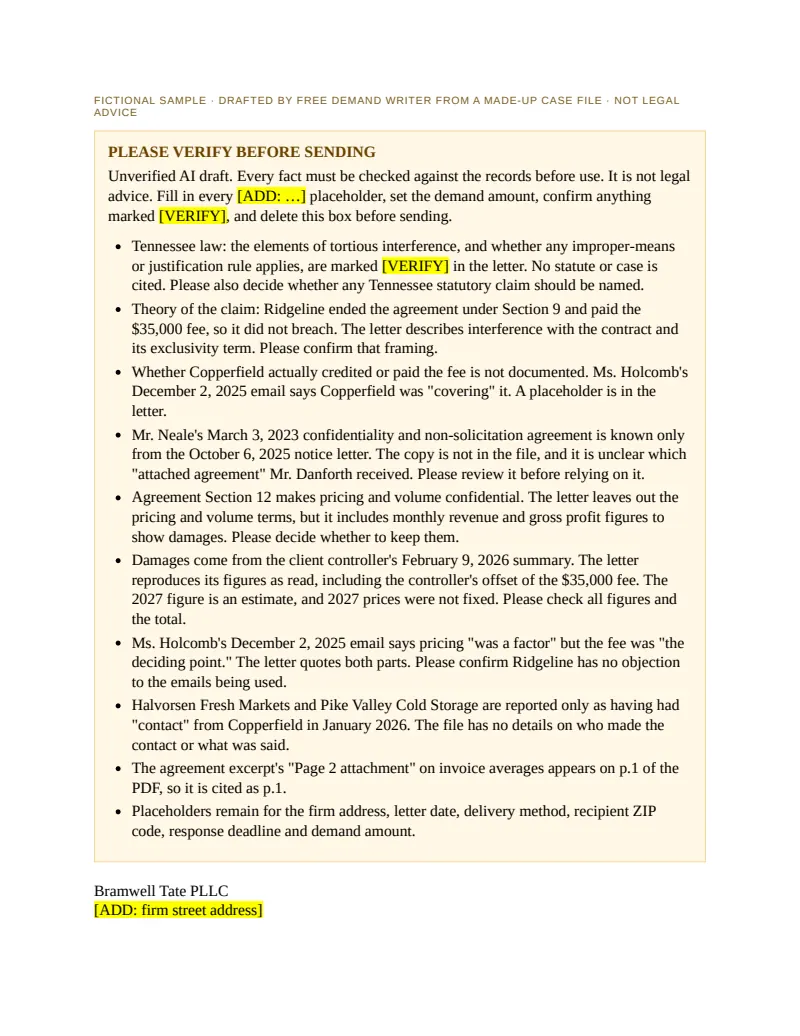
PLEASE VERIFY BEFORE SENDING
Unverified AI draft. Every fact must be checked against the records before use. It is not legal advice. Fill in every [ADD: …] placeholder, set the demand amount, confirm anything marked [VERIFY], and delete this box before sending.
- Tennessee law: the elements of tortious interference, and whether any improper-means or justification rule applies, are marked [VERIFY] in the letter. No statute or case is cited. Please also decide whether any Tennessee statutory claim should be named.
- Theory of the claim: Ridgeline ended the agreement under Section 9 and paid the $35,000 fee, so it did not breach. The letter describes interference with the contract and its exclusivity term. Please confirm that framing.
- Whether Copperfield actually credited or paid the fee is not documented. Ms. Holcomb's December 2, 2025 email says Copperfield was "covering" it. A placeholder is in the letter.
- Mr. Neale's March 3, 2023 confidentiality and non-solicitation agreement is known only from the October 6, 2025 notice letter. The copy is not in the file, and it is unclear which "attached agreement" Mr. Danforth received. Please review it before relying on it.
- Agreement Section 12 makes pricing and volume confidential. The letter leaves out the pricing and volume terms, but it includes monthly revenue and gross profit figures to show damages. Please decide whether to keep them.
- Damages come from the client controller's February 9, 2026 summary. The letter reproduces its figures as read, including the controller's offset of the $35,000 fee. The 2027 figure is an estimate, and 2027 prices were not fixed. Please check all figures and the total.
- Ms. Holcomb's December 2, 2025 email says pricing "was a factor" but the fee was "the deciding point." The letter quotes both parts. Please confirm Ridgeline has no objection to the emails being used.
- Halvorsen Fresh Markets and Pike Valley Cold Storage are reported only as having had "contact" from Copperfield in January 2026. The file has no details on who made the contact or what was said.
- The agreement excerpt's "Page 2 attachment" on invoice averages appears on p.1 of the PDF, so it is cited as p.1.
- Placeholders remain for the firm address, letter date, delivery method, recipient ZIP code, response deadline and demand amount.
Bramwell Tate PLLC
[ADD: firm street address]
[ADD: city, state ZIP]
[ADD: phone] · [ADD: email]
[ADD: date]
VIA [ADD: delivery method]
Lyle Danforth, President
Copperfield Packaging Solutions LLC
1170 Kettle Creek Parkway
Dunmore Falls, Tennessee [ADD: ZIP]
Re: Stonebridge Pallet & Crate Co. – Interference with Exclusive Supply Agreement with Ridgeline Grocers Distribution Inc. – Ridgeline Notice of Early Termination dated December 1, 2025 – Reference No. [ADD: reference number]
Dear Mr. Danforth:
Introduction
We represent Stonebridge Pallet & Crate Co. ("Stonebridge") regarding Copperfield Packaging Solutions LLC's ("Copperfield") interference with Stonebridge's Exclusive Supply Agreement with Ridgeline Grocers Distribution Inc. ("Ridgeline"). Based on the records described below, we believe Copperfield's conduct amounts to tortious interference with that contract and with Stonebridge's business relationships under Tennessee law [VERIFY: Tennessee elements of tortious interference, including any improper means or justification rules]. This letter asks Copperfield to stop that conduct, preserve relevant records, and compensate Stonebridge for its loss.
The relationship
Stonebridge and Ridgeline are parties to an Exclusive Supply Agreement effective January 1, 2025. Martin Okafor signed for Stonebridge and Renee Holcomb, Ridgeline's Vice President of Procurement, signed for Ridgeline, both on December 12, 2024 [supply_agreement_excerpt.pdf p.1]. The agreement has these relevant terms:
- The term runs from January 1, 2025 through December 31, 2027, unless ended earlier under Section 9 [supply_agreement_excerpt.pdf p.1].
- Under Section 3, Ridgeline must purchase all of its wooden pallet and crate requirements for its Carroll Bend and Hollis Junction warehouses from Stonebridge during the term [supply_agreement_excerpt.pdf p.1].
- Under Section 9, Ridgeline may end the agreement early only by written notice and payment of an early termination fee of $35,000 [supply_agreement_excerpt.pdf p.1].
- Under Section 12, each party must keep the pricing and volume terms confidential [supply_agreement_excerpt.pdf p.1].
Ridgeline was an active customer under this agreement. Stonebridge's invoices to Ridgeline for January through September 2025 averaged $66,850 per month [supply_agreement_excerpt.pdf p.1].
The recipient's knowledge
Copperfield knew of the Ridgeline relationship and of the exclusive agreement before the events described below.
- On October 6, 2025, Mr. Okafor wrote to you. The letter stated that Travis Neale, Stonebridge's former Regional Sales Manager, had begun working for Copperfield on September 22, 2025, and had managed Stonebridge's Ridgeline account. It stated that Ridgeline was under an exclusive supply agreement with Stonebridge running through December 31, 2027. It also referred to a confidentiality and non-solicitation agreement that Mr. Neale signed on March 3, 2023, and enclosed a copy. The letter asked that Copperfield not use Stonebridge's confidential pricing or solicit customers Mr. Neale handled, including Ridgeline [notice_letter_and_reply.pdf p.1].
- On October 9, 2025, you replied by email that Copperfield had received the letter and the attached agreement, and wrote: "We are aware Ridgeline buys from you." [notice_letter_and_reply.pdf p.1].
- Mr. Neale's own November 3, 2025 email, described below, shows he knew the early termination fee Ridgeline would owe to leave the agreement [ridgeline_emails.pdf p.1].
The interference
The records show the following, in date order:
- September 22, 2025. Mr. Neale began working for Copperfield [notice_letter_and_reply.pdf p.1].
- October 6 and 9, 2025. Stonebridge gave Copperfield written notice of the Ridgeline agreement and asked Copperfield not to solicit Ridgeline. Copperfield replied that it did not think further discussion was needed [notice_letter_and_reply.pdf p.1].
- November 3, 2025. After that exchange, Mr. Neale wrote to Ms. Holcomb from his Copperfield email account. He stated Ridgeline's current standard and export pallet prices, which match the prices in Section 4 of the agreement, and offered lower Copperfield prices. He noted that Ridgeline "would owe a $35,000 fee to leave your current contract." He wrote that Copperfield was "prepared to credit that full amount against your first orders if you move to us by January 1" [ridgeline_emails.pdf p.1; supply_agreement_excerpt.pdf p.1].
- November 10 and 14, 2025. According to Ms. Holcomb, Copperfield followed up by phone on both dates with the same offer. She also wrote that she "was surprised they had our exact prices" [ridgeline_emails.pdf p.1].
- December 1, 2025. Ridgeline gave written notice ending the agreement under Section 9, effective December 31, 2025, and enclosed the $35,000 early termination fee [ridgeline_emails.pdf p.1].
- December 2, 2025. Ms. Holcomb wrote to Mr. Okafor: "The pricing was a factor, but the deciding point was Copperfield covering the termination fee." [ridgeline_emails.pdf p.1]. [ADD: confirm whether Copperfield has credited or paid the $35,000 fee, and any supporting document].
- January 2026. Halvorsen Fresh Markets and Pike Valley Cold Storage, two other accounts Mr. Neale handled for Stonebridge, each reported contact from Copperfield. As of February 9, 2026, no orders had been lost from those accounts [lost_revenue_summary.pdf p.1]. [ADD: details of the January 2026 contacts, if available].
Harm to our client
Stonebridge's Controller, Dana Whitcombe, prepared a summary dated February 9, 2026 from Stonebridge's 2025 Ridgeline invoices and Sections 2 and 4 of the agreement. It reports average monthly Ridgeline revenue of $66,850.00 for January to September 2025, an average monthly gross margin of 21.4%, and an average monthly gross profit of $14,305.90 [lost_revenue_summary.pdf p.1]. It calculates the loss over the remaining term, January 1, 2026 through December 31, 2027, as follows:
| Item | Date | Amount | Source |
|---|
| Lost gross profit, 2026 (prices fixed under the agreement) | January 1, 2026 to December 31, 2026 | $171,670.80 | [lost_revenue_summary.pdf p.1] |
| Lost gross profit, 2027 (estimate at 2026 prices) | January 1, 2027 to December 31, 2027 | $171,670.80 | [lost_revenue_summary.pdf p.1] |
| Early termination fee received from Ridgeline (credit) | [ADD: date fee received] | ($35,000.00) | [lost_revenue_summary.pdf p.1] |
| Total (as read from the bills): net lost gross profit as calculated by Stonebridge's Controller | | $308,341.60 | [lost_revenue_summary.pdf p.1] |
The 2027 figure is an estimate, because the agreement did not fix 2027 prices [lost_revenue_summary.pdf p.1]. Stonebridge has not lost orders from Halvorsen Fresh Markets or Pike Valley Cold Storage as of the date of the summary, but both accounts have been contacted by Copperfield [lost_revenue_summary.pdf p.1]. [ADD: any other documented losses, such as costs incurred, and any records supporting the January 2026 contacts].
Demand
On behalf of Stonebridge, we demand that Copperfield:
- Stop all conduct that interferes with Stonebridge's contracts and business relationships. This includes stopping any solicitation of Stonebridge's remaining accounts, among them Halvorsen Fresh Markets and Pike Valley Cold Storage, and any use of Stonebridge's confidential pricing or terms.
- Confirm in writing by [ADD: response deadline] that it has stopped and will not resume this conduct.
- Preserve all documents, data and communications, in any form, relating to Ridgeline, Halvorsen Fresh Markets, Pike Valley Cold Storage, Mr. Neale's work for Copperfield, any pricing offered to those accounts, and any credit, payment or commitment concerning Ridgeline's early termination fee. This includes emails, text messages, call logs, proposals and internal communications.
- Pay Stonebridge [ADD: demand amount] for the loss of the Ridgeline contract.
Stonebridge reserves all rights, claims and remedies, and nothing in this letter waives any of them. Please direct all communications about this matter to me.
Sincerely,
Catherine L. Bramwell
Bramwell Tate PLLC