When to use this letter
Use this letter when your client conferred a benefit, expected to be paid, and has no signed agreement to point to. Typical cases:
- A contractor or consultant did work on a handshake deal and was never paid.
- Work went beyond the written scope at the owner's request, without a change order.
- A contract turned out to be unenforceable or was never signed, but the work was done.
- A business partner or family member kept money, property or services meant to be repaid.
- A customer accepted and used goods or services and then refused to pay a fair price.
If a written contract covers the same work, a breach of contract letter is often the better fit. Many states do not allow an unjust enrichment claim where an express contract governs the subject. Upload anything that looks like an agreement so the draft can flag it.
What to upload
Upload up to 5 PDFs, 500 pages in total. Without a contract, the paper trail carries the claim, so include every record of the request and the work.
- Requests and messages
- Emails, texts and letters (saved as PDF) where the recipient asked for the work or acknowledged it.
- Proof of what was provided
- Work logs, timesheets, delivery receipts, photos saved as PDF, or before-and-after records.
- Invoices and estimates
- Invoices sent, estimates or quotes given, and any reply disputing or accepting them.
- Value evidence
- Your client's usual rates, comparable quotes, or market prices for the same goods or services.
- Payment history
- Bank records or receipts showing any partial payment received.
What the draft includes
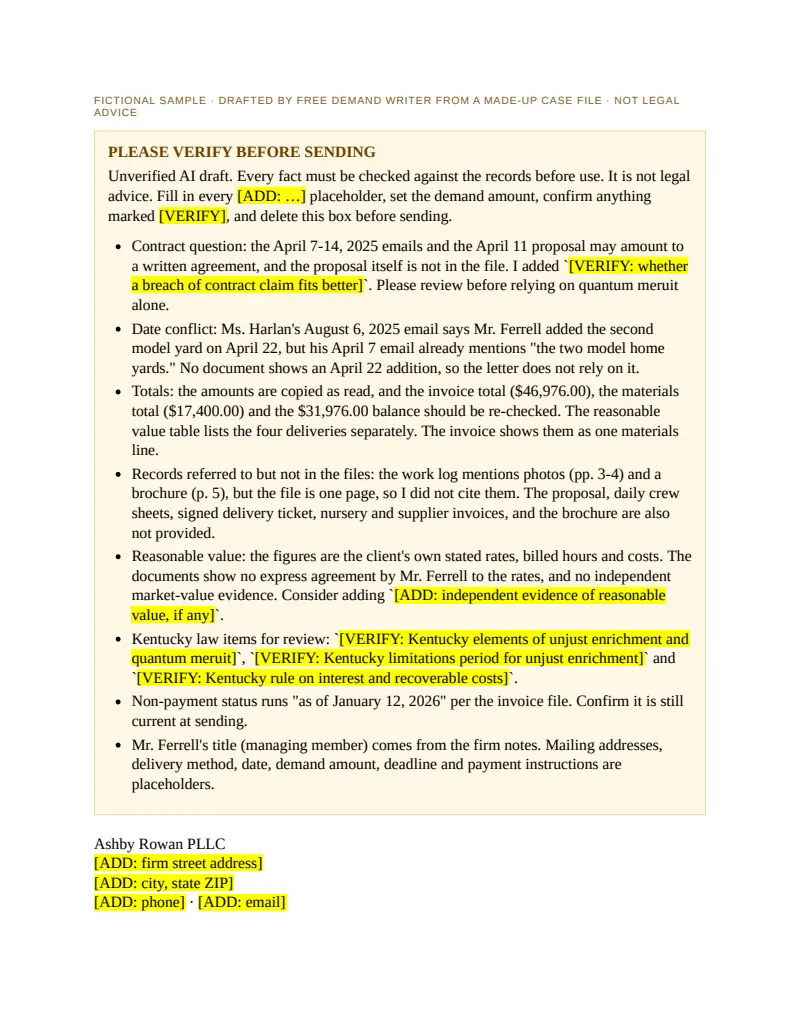
An editable Word letter built only from what your documents say. Missing facts become [ADD: …] placeholders, never guesses, and any law cited is marked [VERIFY].
- Please verify box. A short notice at the top reminding the reviewer that this is an unverified AI draft.
- What was provided. The work, goods or benefit, when it was provided and at whose request, in date order with citations.
- Knowledge and acceptance. The documents showing the recipient asked for, accepted or kept the benefit.
- Reasonable value. A table of the value shown in the invoices, estimates and rate records, with a total as read and any payments subtracted.
- Basis for the claim. Unjust enrichment and quantum meruit described in general terms, with the state's elements marked [VERIFY].
- Contract flag. A [VERIFY] note if the documents show a written contract that may govern the same work.
- The demand. Payment by a deadline, with the amount and deadline left as placeholders.
Before you send it
The result is an unverified AI draft for attorney review, not legal advice.
- Confirm that no written agreement covers the work, or decide whether to plead both theories.
- Check each value against its source, and decide whether to claim cost, market value or the benefit to the recipient.
- Check the state's elements and limitations period for unjust enrichment and quantum meruit.
- Set the amount and deadline, and remove the Please verify box.
Common mistakes
Claims without a contract are easy to dispute. These are the gaps the other side usually aims at.
- No proof of a request A benefit the recipient never asked for or knew about can look like a gift or a volunteer's work. Lead with the messages showing the request or acceptance.
- Inflated value Reasonable value is usually measured by what the work was worth, not what your client hoped to earn. Tie every figure to a rate record, quote or invoice.
- Ignoring an existing contract Where a written contract covers the subject, many states limit the claim to the contract. Address it directly.
- Forgetting partial payments Credit every payment received. An overstated balance undermines the rest of the letter.
- Waiting too long Limitations periods for these claims vary by state and may be shorter than for written contracts. Check the period before sending.
Free unjust enrichment / quantum meruit demand letter template
Prefer to write it yourself? Download a plain Word template with fields to fill in. No AI, no email needed. Sample template, not legal advice.
Questions
Is the unjust enrichment demand letter free?
Yes. No account and no payment.
What is the difference between unjust enrichment and quantum meruit?
Both seek payment for a benefit without a contract. Quantum meruit usually refers to the reasonable value of services, while unjust enrichment is broader. How each is defined and pleaded varies by state, so the draft marks it [VERIFY].
Can the tool work out what the work was worth?
No. It lists only the values your documents show and totals them where the numbers are clear. The demand figure is always yours to set.
What if there was a partial contract?
Upload it. The draft flags any written agreement it finds so you can decide whether a contract claim fits better.
What happens to the documents I upload?
They are deleted as soon as the draft is generated. The Word file is deleted after 48 hours or 3 downloads.