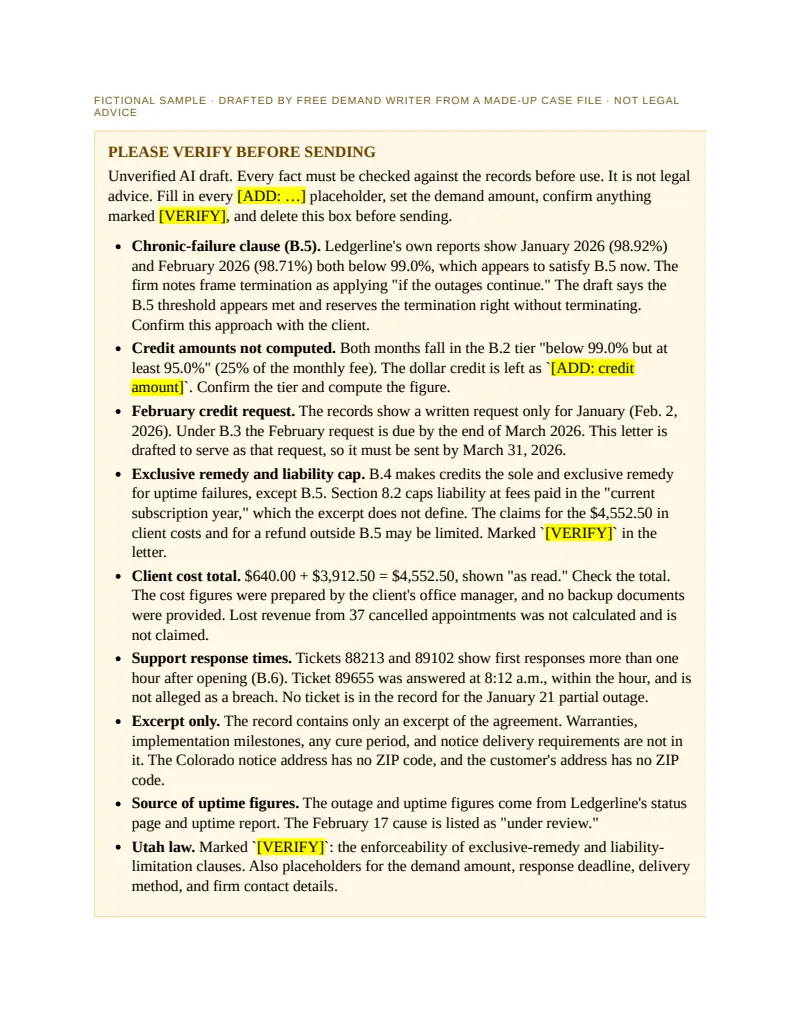
PLEASE VERIFY BEFORE SENDING
Unverified AI draft. Every fact must be checked against the records before use. It is not legal advice. Fill in every [ADD: …] placeholder, set the demand amount, confirm anything marked [VERIFY], and delete this box before sending.
- Chronic-failure clause (B.5). Ledgerline's own reports show January 2026 (98.92%) and February 2026 (98.71%) both below 99.0%, which appears to satisfy B.5 now. The firm notes frame termination as applying "if the outages continue." The draft says the B.5 threshold appears met and reserves the termination right without terminating. Confirm this approach with the client.
- Credit amounts not computed. Both months fall in the B.2 tier "below 99.0% but at least 95.0%" (25% of the monthly fee). The dollar credit is left as `[ADD: credit amount]`. Confirm the tier and compute the figure.
- February credit request. The records show a written request only for January (Feb. 2, 2026). Under B.3 the February request is due by the end of March 2026. This letter is drafted to serve as that request, so it must be sent by March 31, 2026.
- Exclusive remedy and liability cap. B.4 makes credits the sole and exclusive remedy for uptime failures, except B.5. Section 8.2 caps liability at fees paid in the "current subscription year," which the excerpt does not define. The claims for the $4,552.50 in client costs and for a refund outside B.5 may be limited. Marked `[VERIFY]` in the letter.
- Client cost total. $640.00 + $3,912.50 = $4,552.50, shown "as read." Check the total. The cost figures were prepared by the client's office manager, and no backup documents were provided. Lost revenue from 37 cancelled appointments was not calculated and is not claimed.
- Support response times. Tickets 88213 and 89102 show first responses more than one hour after opening (B.6). Ticket 89655 was answered at 8:12 a.m., within the hour, and is not alleged as a breach. No ticket is in the record for the January 21 partial outage.
- Excerpt only. The record contains only an excerpt of the agreement. Warranties, implementation milestones, any cure period, and notice delivery requirements are not in it. The Colorado notice address has no ZIP code, and the customer's address has no ZIP code.
- Source of uptime figures. The outage and uptime figures come from Ledgerline's status page and uptime report. The February 17 cause is listed as "under review."
- Utah law. Marked `[VERIFY]`: the enforceability of exclusive-remedy and liability-limitation clauses. Also placeholders for the demand amount, response deadline, delivery method, and firm contact details.
Halloran Pike PC
[ADD: firm street address]
[ADD: city, state ZIP]
[ADD: phone] · [ADD: email]
[ADD: date]
VIA [ADD: delivery method]
Legal Department
Ledgerline Health Systems Inc.
2750 Quarry Bend Way
Hollister Ridge, Colorado [ADD: ZIP] [subscription_agreement_excerpt.pdf p.1]
Re: Notice of SLA Breach, Request for Service Credits and Demand – Wasatch Peak Dental Partners PLLC – Master Subscription Agreement effective July 1, 2025 – Customer/Account No. [ADD: account number] – Outages of January 8 through February 17, 2026
Dear Legal Department:
Introduction
We represent Wasatch Peak Dental Partners PLLC ("Wasatch Peak") under the Master Subscription Agreement and Service Level Agreement (Exhibit B) with Ledgerline Health Systems Inc. ("Ledgerline"), effective July 1, 2025, for Ledgerline Practice Cloud (scheduling, charting and billing) at 9 office locations [subscription_agreement_excerpt.pdf p.1]. The subscription fee is $14,850.00 per month, billed monthly in advance [subscription_agreement_excerpt.pdf p.1]. Please direct all further communication about this matter to this office.
The agreement
The provisions relevant to this letter are as follows:
- Uptime commitment (Exhibit B, B.1). Ledgerline committed to make the Service available 99.9% of each calendar month ("Monthly Uptime"), measured by Ledgerline's monitoring. Only scheduled maintenance announced in advance and performed between 10 p.m. and 4 a.m. Mountain Time is excluded [subscription_agreement_excerpt.pdf p.1].
- Service credits (B.2). Monthly Uptime below 99.9% but at least 99.0% earns a credit of 10% of that month's fee. Below 99.0% but at least 95.0% earns 25%. Below 95.0% earns 50% [subscription_agreement_excerpt.pdf p.1].
- Claim process (B.3). Customer must request credits in writing by the end of the calendar month following the month of the outage [subscription_agreement_excerpt.pdf p.1].
- Chronic failure (B.5). "If Monthly Uptime is below 99.0% in any two consecutive calendar months, Customer may terminate this Agreement on written notice and receive a refund of prepaid fees for the unused period" [subscription_agreement_excerpt.pdf p.1].
- Support (B.6). Priority 1 (system down) tickets require a response within 1 hour, at all hours [subscription_agreement_excerpt.pdf p.1].
- Remedy and liability (B.4, Section 8.2). Service Credits are Customer's sole and exclusive remedy for failure to meet the Uptime Commitment, except as stated in B.5. Each party's total liability is limited to the fees paid by Customer during the current subscription year [subscription_agreement_excerpt.pdf p.1].
- Notices and governing law (Sections 11.1, 13.4). Notices to Ledgerline go to its Legal Department at the address above. The Agreement is governed by the laws of the State of Utah [subscription_agreement_excerpt.pdf p.1].
[ADD: any warranty or implementation-milestone provisions of the full agreement that the firm intends to rely on]
The failures
Ledgerline's own status page history, printed February 27, 2026, records the following incidents, all times Mountain Time [incident_reports.pdf p.1]:
- January 8, 2026, 7:52 a.m. to 1:14 p.m. Major outage. Practice Cloud was unavailable for all customers in the Mountain region. Cause: failed database upgrade. Duration: 5 hours 22 minutes [incident_reports.pdf p.1].
- January 21, 2026, 8:05 a.m. to 10:40 a.m. Partial outage. The scheduling module was unavailable. Duration: 2 hours 35 minutes [incident_reports.pdf p.1].
- February 3, 2026, 9:10 a.m. to 3:55 p.m. Major outage. Cause: expired security certificate. Duration: 6 hours 45 minutes [incident_reports.pdf p.1].
- February 17, 2026, 7:30 a.m. to 9:15 a.m. Major outage. Cause listed as "under review." Duration: 1 hour 45 minutes [incident_reports.pdf p.1].
Ledgerline's Monthly Uptime Report for Wasatch Peak states a January 2026 Monthly Uptime of 98.92% and a February 2026 Monthly Uptime of 98.71%, and states that neither month had scheduled maintenance during business hours [incident_reports.pdf p.1]. Both figures are below the 99.9% commitment in B.1 and below the 99.0% threshold in B.5.
In its February 5, 2026 incident summary, Ledgerline wrote of the February 3 outage: "A certificate renewal step was missed. We have added an automated reminder" [incident_reports.pdf p.1].
Ledgerline also did not meet the B.6 response commitment on at least two Priority 1 tickets [tickets_and_costs.pdf p.1]:
- Ticket 88213 was opened January 8, 2026 at 7:58 a.m. by Wasatch Peak's office manager, Tessa Morrow. Ledgerline's first response came at 10:31 a.m.
- Ticket 89102 was opened February 3, 2026 at 9:14 a.m. Ledgerline's first response came at 11:02 a.m.
A third Priority 1 ticket, 89655, was opened February 17, 2026 at 7:36 a.m. and received a first response at 8:12 a.m. [tickets_and_costs.pdf p.1].
Credits and losses
Wasatch Peak paid the January 2026 invoice (LHS-7710) of $14,850.00 on January 2, 2026, and the February 2026 invoice (LHS-7944) of $14,850.00 on February 2, 2026 [tickets_and_costs.pdf p.1]. On February 2, 2026, Ms. Morrow requested the January 2026 service credit in writing under Exhibit B. On February 25, 2026, Ledgerline Account Management replied only that the request "is under review by our finance team." No credit has been applied to the January or February invoices as of March 4, 2026 [tickets_and_costs.pdf p.1].
| Item | Period | Amount | Source |
|---|
| Service credit, 25% tier (B.2) | January 2026 | 25% of $14,850.00 monthly fee: [ADD: credit amount] | [subscription_agreement_excerpt.pdf p.1]; [incident_reports.pdf p.1] |
| Service credit, 25% tier (B.2) | February 2026 | 25% of $14,850.00 monthly fee: [ADD: credit amount] | [subscription_agreement_excerpt.pdf p.1]; [incident_reports.pdf p.1] |
| Paper backup forms and courier between offices | January 8 and February 3, 2026 | $640.00 | [tickets_and_costs.pdf p.1] |
| Staff overtime to re-enter appointments and claims | During the outages | $3,912.50 | [tickets_and_costs.pdf p.1] |
| Total client costs (as read from the records) | | $4,552.50 | [tickets_and_costs.pdf p.1] |
In addition, 37 patient appointments were cancelled during the outages [tickets_and_costs.pdf p.1]. Wasatch Peak has not calculated the associated revenue and does not include it above, but reserves the right to do so.
We recognize that B.4 makes Service Credits the exclusive remedy for uptime failures except as stated in B.5, and that Section 8.2 limits liability. [VERIFY: whether the exclusive-remedy clause or liability cap limits this claim] [VERIFY: Utah rule on enforceability of exclusive-remedy and limitation-of-liability clauses]. Wasatch Peak reserves all rights regarding the application of those provisions.
Notice
This letter is Wasatch Peak's written request for Service Credits under B.3 for January 2026 and February 2026. The January request was first made in writing on February 2, 2026. This letter also serves as written notice of Ledgerline's failure to meet the Uptime Commitment and the Priority 1 support commitment, and is sent to the notice address in Section 11.1.
Under B.5, Wasatch Peak may terminate on written notice and receive a refund of prepaid fees for the unused period if Monthly Uptime is below 99.0% in any two consecutive calendar months. Ledgerline's own reports show January 2026 at 98.92% and February 2026 at 98.71% [incident_reports.pdf p.1]. Wasatch Peak reserves its right to terminate under B.5 and does not waive it by sending this letter.
Demand
Wasatch Peak demands that Ledgerline, by [ADD: response deadline]:
- Apply the Service Credits due under B.2 for January 2026 and February 2026 and confirm the amounts in writing.
- Refund [ADD: demand amount] for the period of lost service. [ADD: remedy sought, if the attorney wishes to specify the basis for the refund]
- Reimburse the documented costs of $4,552.50 listed above, to the extent recoverable. [VERIFY: Utah rule on recovery of costs where a sole-and-exclusive-remedy clause applies]
- Confirm in writing that Wasatch Peak is entitled to terminate under B.5 and to receive a refund of prepaid fees for the unused period, including if outages continue.
- Provide a written root-cause report for the February 17, 2026 outage, which Ledgerline lists as "under review," and describe the steps taken to prevent recurrence.
Ledgerline must preserve all documents and data relating to Wasatch Peak's account and the incidents described above. This includes monitoring data and logs used to calculate Monthly Uptime, status page records, incident reports, support tickets and communications, and internal communications about the credit request.
This letter is not a complete statement of the facts or of Wasatch Peak's rights, and Wasatch Peak reserves all rights and remedies under the Agreement and Utah law, which governs under Section 13.4.
Sincerely,
Brooke E. Halloran
Halloran Pike PC