When to use this letter
Use this letter when a shipment your client sent or was due to receive arrived damaged, short or not at all. Typical cases:
- A truckload or LTL shipment arrived with visible damage noted on the delivery receipt.
- Concealed damage was found after delivery when the goods were unpacked.
- Part of a shipment was missing, or the entire load was lost or stolen in transit.
- Temperature-controlled goods spoiled because the carrier did not maintain the agreed temperature.
- A delay in delivery caused a documented loss, such as spoiled goods or a missed sale.
Claims against interstate carriers are generally governed by federal law, the Carmack Amendment. It and the bill of lading set a deadline to file a written claim and often a limit on the carrier's liability. The draft marks both [VERIFY]. Claims against brokers, forwarders and intrastate carriers may follow different rules.
What to upload
Upload up to 5 PDFs, 500 pages in total. The bill of lading and the delivery receipt matter most.
- Bill of lading
- The signed bill of lading, plus the rate confirmation or shipping contract and any tariff terms you have.
- Delivery receipt
- The proof of delivery, with any exceptions or damage notes the consignee wrote.
- Inspection and photos
- Inspection reports, surveyor findings and photos of the damage, saved as PDF.
- Commercial invoices
- Invoices that show the value of the goods, and freight bills that show the charges paid.
- Salvage and repair records
- Salvage offers, repair estimates or disposal records for damaged goods.
- Correspondence
- Emails with the carrier, broker or forwarder about the loss and any claim already filed.
What the draft includes
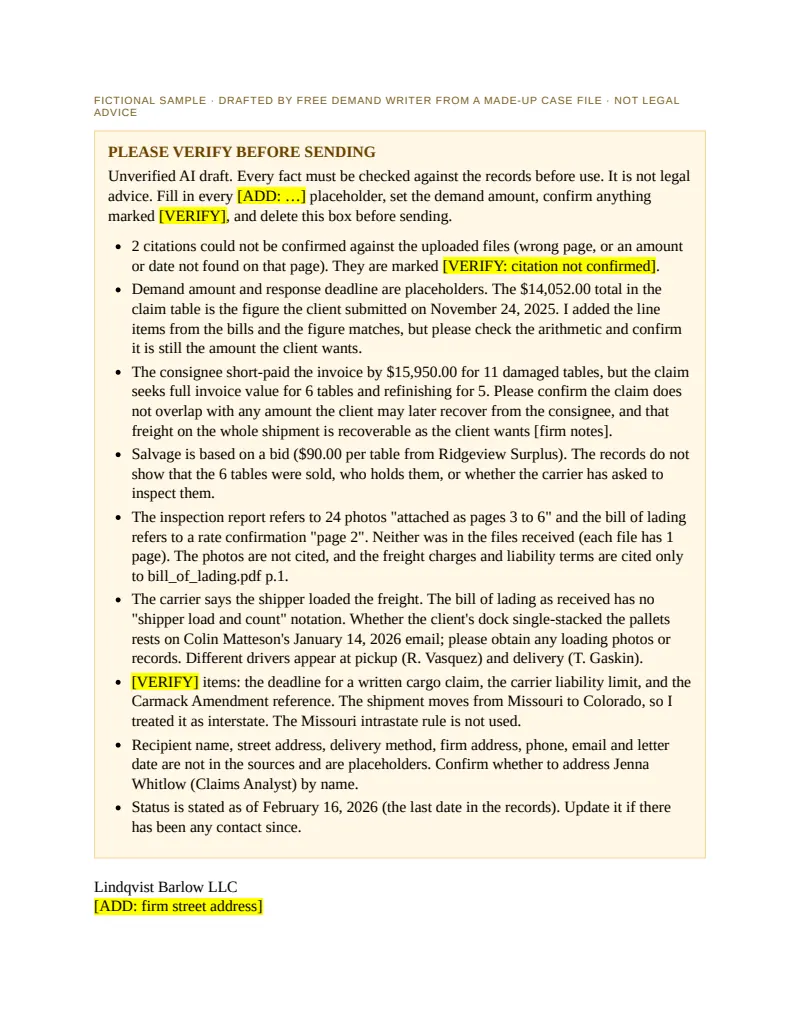
An editable Word letter built only from what your documents say. Missing facts become [ADD: …] placeholders, never guesses, and any law cited is marked [VERIFY].
- Please verify box. A short notice at the top reminding the reviewer that this is an unverified AI draft.
- Shipment details. PRO or bill of lading number, dates, origin, destination, goods and count, cited.
- Condition at pickup and delivery. What the bill of lading and delivery receipt show about the goods, including exceptions.
- The loss or damage. What was lost or damaged and when it was found, drawn only from the documents.
- Claim table. Invoice value, freight charges, inspection costs and any salvage credit, with the total as read.
- Liability limit and claim deadline. Any limit or claim terms in the bill of lading, quoted and marked [VERIFY].
- The demand. The amount and response deadline are always placeholders for you to set.
Before you send it
The result is an unverified AI draft for attorney review, not legal advice.
- Confirm the deadline to file a written claim, and file it in time.
- Check the bill of lading and tariff for a liability limit or declared value.
- Confirm who the right party is: carrier, broker or freight forwarder.
- Match every item and amount to the invoices and the delivery receipt.
- Set the amount and deadline, and remove the Please verify box.
Common mistakes
Carriers decline many cargo claims on technical grounds. These are the gaps they use most.
- Missing the claim deadline A late written claim can bar recovery entirely. Calendar the deadline as soon as the loss is known.
- A clean delivery receipt If the consignee signed without noting damage, the carrier will argue it happened later. Document concealed damage promptly.
- Claiming against the wrong party Brokers and forwarders are often not liable the way a carrier is. Name the party the documents show had the goods.
- No proof of value Carriers pay on documented value. Attach invoices, not price lists or estimates.
Free freight / cargo loss or damage demand letter template
Prefer to write it yourself? Download a plain Word template with fields to fill in. No AI, no email needed. Sample template, not legal advice.
Questions
Is the freight and cargo loss or damage demand letter free?
Yes. No account and no payment.
Does it name the Carmack Amendment?
It notes in general terms that federal law, the Carmack Amendment, usually governs claims against interstate carriers, and marks the claim deadline and liability limit [VERIFY].
Can it be used as the written claim to the carrier?
It can be a starting point. Carriers often have their own claim form and required content, so check those before relying on the letter alone.
Does it work for shipments by sea or air?
It drafts from the documents you upload, but ocean and air shipments are often governed by different rules. Your attorney must check which apply.
What happens to the documents I upload?
They are deleted as soon as the draft is generated. The Word file is deleted after 48 hours or 3 downloads.