Skip to content
Free Demand Writer
Menu
Free Demand Writer

Free Domain Name / Cybersquatting Demand Letter

A cybersquatting demand letter asks the registrant of a domain name that copies or mimics your client's trademark to stop using it and transfer it. Many disputes end at this stage, especially when the letter shows the mark came first and the registrant's conduct points to bad faith: offers to sell, look-alike pages or diverted customers.

Free Demand Writer reads the trademark records, registration lookups and screenshots you upload and drafts an editable Word letter. It sets out the mark, the domain and the evidence of bad faith with a citation to the file and page for each fact, and refers to federal anti-cybersquatting law and the UDRP dispute process only in general terms.

New to this kind of letter? Our guide explains what goes into a demand letter, when to send one and what happens next.

  • Free
  • No sign-up
  • Editable Word (.docx)
  • Files deleted after drafting

When to use this letter

Use this letter when someone has registered a domain name that matches or closely resembles your client's mark without a legitimate reason. Typical cases:

  • A domain that is the client's brand with a different ending or a common typo.
  • A registrant who offered to sell the domain to your client for a high price.
  • A look-alike site used to sell competing or counterfeit goods.
  • A domain used for phishing emails or fake login pages in your client's name.
  • A former partner, reseller or employee who registered the brand domain in their own name.

Federal law and the UDRP process offer different remedies, and the registrant may be outside the United States. A demand letter can also prompt the registrant to move the domain. Decide on the strategy before you send.

What to upload

Upload up to 5 PDFs, 500 pages in total. Proof that the mark came first and dated evidence of the domain's use matter most.

Trademark records
Registration certificates or applications, and proof of when your client started using the mark.
Domain registration records
Registration lookups showing the creation date, registrar and any registrant details.
Screenshots of the site
Dated screenshots of the domain's pages, including ads, listings or login pages.
Offers to sell
Emails or marketplace listings offering the domain for sale, especially to your client.
Customer confusion
Complaints, misdirected emails or messages from customers who mistook the site for your client's.

What the draft includes

An editable Word letter built only from what your documents say. Missing facts become [ADD: …] placeholders, never guesses, and any law cited is marked [VERIFY].

  1. Please verify box. A short notice at the top reminding the reviewer that this is an unverified AI draft.
  2. Our client's mark. The mark, its first use and any registrations, exactly as in the documents.
  3. The domain name. The domain, its registration date and how it is used, cited to the records and screenshots.
  4. Evidence of bad faith. Offers to sell, diverted customers, look-alike pages and false contact details, only as documented.
  5. Legal basis. Federal anti-cybersquatting law, trademark law and the UDRP process in general terms, marked [VERIFY].
  6. The demand. Stop use, do not sell or move the domain, and transfer it through the registrar, with the deadline as a placeholder.

Before you send it

The result is an unverified AI draft for attorney review, not legal advice.

  • Confirm the mark's registration and first-use dates against the records.
  • Compare the domain registration date with the dates your client's rights began.
  • Check each screenshot is dated and still matches the live site.
  • Decide between a letter, a UDRP complaint or court, and whether to lock the domain first.
  • Set the deadline and any amount, and remove the Please verify box.

Common mistakes

Registrants who receive these letters often reply by arguing legitimate use. These are the errors that make that argument easier.

  • Claiming rights that came later If the domain was registered before your client's mark existed, bad faith is hard to show. Check the dates first.
  • Assuming bad faith A matching domain alone may not be enough. Point to the documented facts, such as offers to sell or look-alike pages.
  • Ignoring fair uses Review sites, fan pages and generic words can be legitimate. Consider how the domain is actually used.
  • Offering to buy in the letter An offer to pay can undercut a later bad faith argument. Keep any negotiation separate and deliberate.
  • Tipping off a bad actor A letter can lead the registrant to transfer the domain to someone else. Consider a registrar lock or a dispute filing first.

Free domain name / cybersquatting demand letter template

Prefer to write it yourself? Download a plain Word template with fields to fill in. No AI, no email needed. Sample template, not legal advice.

Questions

Is the domain name and cybersquatting demand letter free?

Yes. No account and no payment.

Does it file a UDRP complaint?

No. It drafts a demand letter only. It mentions the UDRP dispute process in general terms so your attorney can decide on next steps.

Can it find the domain's owner?

No. It uses only the registration records and documents you upload. Missing registrant details are left as placeholders.

Does my client need a registered trademark?

Unregistered rights may also count in some cases. The draft states the rights your documents show and marks the legal points [VERIFY].

What happens to the documents I upload?

They are deleted as soon as the draft is generated. The Word file is deleted after 48 hours or 3 downloads.
Fictional sample

See a sample draft

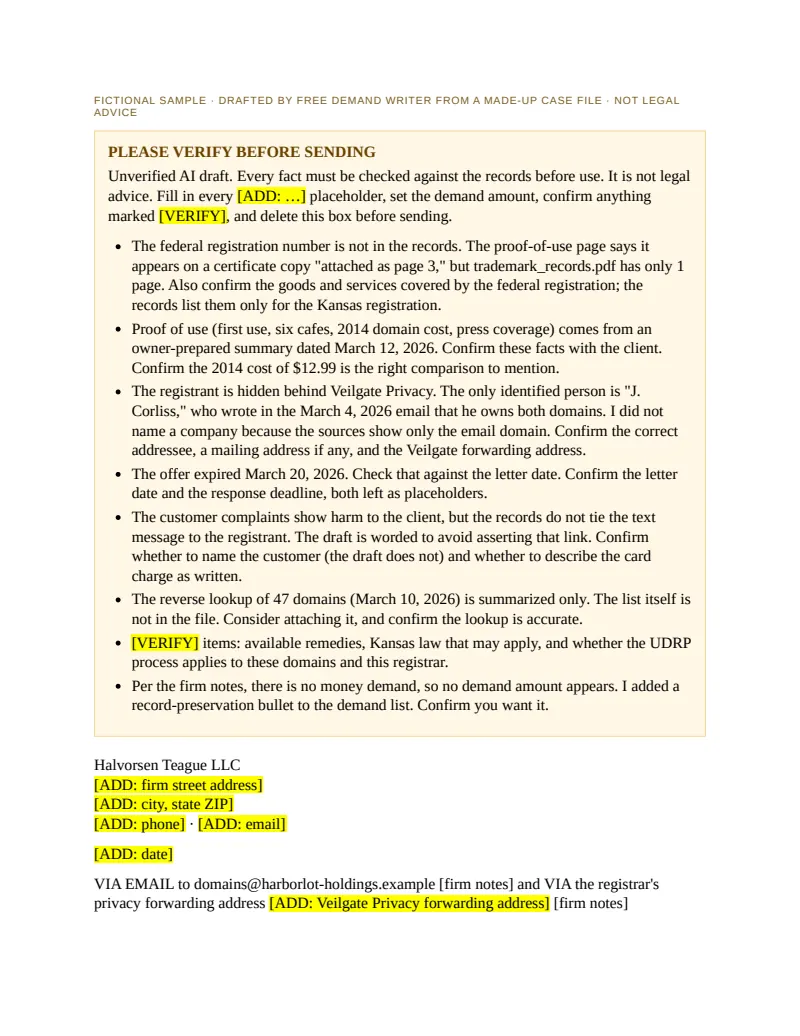
We made up a case file and ran it through Free Demand Writer, the same way your documents would be. This is the unedited draft. Everything in it is fictional: the people, the companies and the facts. A Kansas coffee roaster's mark was copied in two look-alike domains registered right after it announced an expansion, used for competitor ads and a fake gift card page, and offered back to it for sale.

Fictional case file: trademark_records.pdf, domain_records_and_screenshots.pdf, offer_email_and_customer_complaints.pdf · State: Kansas

Page 1 of a fictional sample domain name / cybersquatting demand letter drafted by Free Demand Writer Download sample PDF

Fictional sample. Not legal advice. Your draft is built from your own documents.

Fictional sample · letter text

PLEASE VERIFY BEFORE SENDING

Unverified AI draft. Every fact must be checked against the records before use. It is not legal advice. Fill in every [ADD: …] placeholder, set the demand amount, confirm anything marked [VERIFY], and delete this box before sending.

  • The federal registration number is not in the records. The proof-of-use page says it appears on a certificate copy "attached as page 3," but trademark_records.pdf has only 1 page. Also confirm the goods and services covered by the federal registration; the records list them only for the Kansas registration.
  • Proof of use (first use, six cafes, 2014 domain cost, press coverage) comes from an owner-prepared summary dated March 12, 2026. Confirm these facts with the client. Confirm the 2014 cost of $12.99 is the right comparison to mention.
  • The registrant is hidden behind Veilgate Privacy. The only identified person is "J. Corliss," who wrote in the March 4, 2026 email that he owns both domains. I did not name a company because the sources show only the email domain. Confirm the correct addressee, a mailing address if any, and the Veilgate forwarding address.
  • The offer expired March 20, 2026. Check that against the letter date. Confirm the letter date and the response deadline, both left as placeholders.
  • The customer complaints show harm to the client, but the records do not tie the text message to the registrant. The draft is worded to avoid asserting that link. Confirm whether to name the customer (the draft does not) and whether to describe the card charge as written.
  • The reverse lookup of 47 domains (March 10, 2026) is summarized only. The list itself is not in the file. Consider attaching it, and confirm the lookup is accurate.
  • [VERIFY] items: available remedies, Kansas law that may apply, and whether the UDRP process applies to these domains and this registrar.
  • Per the firm notes, there is no money demand, so no demand amount appears. I added a record-preservation bullet to the demand list. Confirm you want it.

Halvorsen Teague LLC
[ADD: firm street address]
[ADD: city, state ZIP]
[ADD: phone] · [ADD: email]

[ADD: date]

VIA EMAIL to domains@harborlot-holdings.example [firm notes] and VIA the registrar's privacy forwarding address [ADD: Veilgate Privacy forwarding address] [firm notes]

Registrant of prairielantern-coffee.example and prairielanternroasters.example
c/o J. Corliss
domains@harborlot-holdings.example
[ADD: registrant mailing address, if known]

Re: Demand to Cease Use and Transfer Domain Names prairielantern-coffee.example and prairielanternroasters.example; Our Client: Prairie Lantern Coffee Roasters LLC; Mark: PRAIRIE LANTERN

Dear J. Corliss and Registrant:

Introduction

This firm represents Prairie Lantern Coffee Roasters LLC ("Prairie Lantern"), the owner of the PRAIRIE LANTERN mark [trademark_records.pdf p.1]. We write about two domain names: prairielantern-coffee.example and prairielanternroasters.example. Both were created on February 26, 2026 through the registrar Bluehaven Names Inc., and both list as registrant a privacy service, "Registrant Protected by Veilgate Privacy" [domain_records_and_screenshots.pdf p.1]. In a March 4, 2026 email sent from domains@harborlot-holdings.example, J. Corliss wrote to our client, "I own prairielantern-coffee and prairielanternroasters" [offer_email_and_customer_complaints.pdf p.1]. We therefore direct this letter to the registrant and to Mr. or Ms. Corliss.

Our client's mark

Prairie Lantern opened its first cafe under the PRAIRIE LANTERN name on May 3, 2014, and now operates six cafes in Kansas and western Missouri [trademark_records.pdf p.1]. The mark appears on its bags, cups, signs and delivery vans [trademark_records.pdf p.1]. Our client has sold coffee online through its website, prairielantern.example, since 2015 [trademark_records.pdf p.1].

Our client's rights are registered:

  • Kansas state registration of PRAIRIE LANTERN, Certificate no. KS-TM-18-03316, issued by the Kansas Secretary of State on August 17, 2018, for roasted coffee beans, coffee shop and cafe services, and online retail store services featuring coffee. The registration lists May 3, 2014 as the date of first use [trademark_records.pdf p.1].
  • Federal registration of PRAIRIE LANTERN in standard characters, registered November 5, 2019, Registration no. [ADD: federal registration number] [trademark_records.pdf p.1].

On February 24, 2026, our client publicly announced a franchise program, with the first franchise cafes planned for Oklahoma and Nebraska in 2027 [trademark_records.pdf p.1].

The domain names

Both domain names were created on February 26, 2026, two days after our client's franchise announcement [domain_records_and_screenshots.pdf p.1; trademark_records.pdf p.1]. Each incorporates our client's PRAIRIE LANTERN mark in full. One adds "-coffee" and the other adds "roasters," terms that describe our client's goods and services [domain_records_and_screenshots.pdf p.1; trademark_records.pdf p.1].

prairielantern-coffee.example. The name servers are park1.adhaven-parking.example and park2.adhaven-parking.example [domain_records_and_screenshots.pdf p.1]. On March 9, 2026, the site displayed the banner "Prairie Lantern Coffee: Shop Coffee Deals." It also showed sponsored links for other coffee sellers, including "Ridgeway Roast Co. Coffee, 20% Off," "Best Kansas Coffee Subscription," and "Fresh Roasted Beans Delivered." The footer read, "This domain may be for sale. Inquire: domains@harborlot-holdings.example" [domain_records_and_screenshots.pdf p.1]. On March 8, 2026, a user wrote on our client's social media page that they went to prairielantern-coffee to order beans and found "just ads for other coffee companies" [offer_email_and_customer_complaints.pdf p.1].

prairielanternroasters.example. Mail server records for this domain are active [domain_records_and_screenshots.pdf p.1]. On March 9, 2026, the page was titled "Prairie Lantern Rewards, Claim Your Free $50 Gift Card." It used the Prairie Lantern lantern logo copied from our client's website. It also presented a form asking for name, email, phone, and "card number to cover $1.99 shipping" [domain_records_and_screenshots.pdf p.1]. Our client is not running a gift card promotion [offer_email_and_customer_complaints.pdf p.1]. Our client received the following communications:

  • On March 6, 2026, a customer wrote that she had received a text about a free $50 Prairie Lantern gift card and entered her card number on the "rewards site" to pay shipping. She then found a $79.00 charge from a company she did not know, and she asked whether the site was our client's [offer_email_and_customer_complaints.pdf p.1].
  • On March 7, 2026, the manager of our client's Flint Ridge cafe reported that two regular customers had asked about the gift card promotion that day [offer_email_and_customer_complaints.pdf p.1].

On March 11, 2026, our client posted a warning on its website and social pages that it has no rewards gift card promotion and that prairielanternroasters is not its site [offer_email_and_customer_complaints.pdf p.1].

Bad faith

The documents show the following facts, which we believe indicate bad faith:

  • The domains were created on February 26, 2026, two days after our client's February 24, 2026 franchise announcement [domain_records_and_screenshots.pdf p.1; trademark_records.pdf p.1].
  • On March 4, 2026, the registrant's email congratulated our client on "the franchise news," said the domains "would be perfect for your franchise sites," and offered both to our client for $18,500. The email said the offer was good until March 20, 2026 because "other buyers are interested" [offer_email_and_customer_complaints.pdf p.1]. For context, our client paid $12.99 to register its own domain in 2014 [offer_email_and_customer_complaints.pdf p.1].
  • The prairielantern-coffee.example site carries sponsored links to other coffee sellers and a notice that the domain may be for sale [domain_records_and_screenshots.pdf p.1].
  • The prairielanternroasters.example site uses our client's logo and the PRAIRIE LANTERN name to solicit personal information and a card number for a gift card promotion our client does not offer [domain_records_and_screenshots.pdf p.1; offer_email_and_customer_complaints.pdf p.1].
  • A reverse lookup of domains@harborlot-holdings.example, run March 10, 2026, lists 47 domains. These include names that combine other regional cafe and bakery brands with "-coffee" or "roasters" [domain_records_and_screenshots.pdf p.1].

Legal basis

The registration and use of these domain names may violate federal anti-cybersquatting law and federal and state trademark law, including our client's rights in its registered PRAIRIE LANTERN mark [VERIFY: available remedies] [VERIFY: Kansas law that may apply]. In addition, the domains may be subject to the Uniform Domain-Name Dispute-Resolution Policy (UDRP) process through the registrar [VERIFY: whether the UDRP applies to these domains and registrar]. Our client reserves all rights and remedies, whether or not mentioned in this letter.

Demand

On behalf of Prairie Lantern, we demand that you:

  • Immediately stop using prairielantern-coffee.example and prairielanternroasters.example, including any page that uses the PRAIRIE LANTERN name or logo or collects personal or payment information.
  • Do not sell, offer to sell, or transfer either domain name to anyone other than our client.
  • Transfer both domain names to our client through the registrar, Bluehaven Names Inc. We will provide the transfer details on request.
  • Preserve all records relating to the registration and use of both domains, including registration, hosting, and email records and any information collected through either site.
  • Confirm in writing, by [ADD: response deadline], that you will comply with each of the above.

If we do not receive your written confirmation by that date, our client may pursue the remedies available to it without further notice.

Sincerely,

Bradley N. Halvorsen
Halvorsen Teague LLC