Skip to content
Free Demand Writer
Menu
Free Demand Writer

Free Patent Infringement Demand Letter

A patent infringement demand letter tells a company that a product or process it makes, sells or uses appears to infringe your client's patent, and asks it to stop or take a license. Because these letters are regulated in many states and can prompt a lawsuit from the recipient, they need to be precise: the patent, the owner, the specific products and the specific claims, and nothing vaguer.

Free Demand Writer reads the patent, assignment records, claim charts and product evidence you upload and drafts an editable Word letter. It states the patent details exactly as they appear, ties each accused product to the documents with file and page citations, and leaves the claims and demand as placeholders where the documents do not support them.

Required form. This letter often has a legally required form, content and notice period that vary by state. Check your state's rules before sending; the draft lists them to verify.

New to this kind of letter? Our guide explains what goes into a demand letter, when to send one and what happens next.

  • Free
  • No sign-up
  • Editable Word (.docx)
  • Files deleted after drafting

When to use this letter

Use this letter when a patent owner or exclusive licensee has evidence that a specific product or process infringes and wants to open licensing talks or stop sales. Typical cases:

  • A competitor launched a product that matches the claims of your client's patent.
  • A former licensee kept selling a patented product after the license ended.
  • A manufacturer's product manual or teardown report shows the patented feature.
  • Your client wants to give formal notice of the patent before seeking damages.
  • A company ignored earlier informal notice of the patent.

This letter often has a legally required form, content and notice period that vary by state. Many states regulate the content of patent demand letters, and a letter that is vague about the patent or the products can expose your client to liability. Check the rules before sending.

What to upload

Upload up to 5 PDFs, 500 pages in total. The patent itself and a claim chart matter most.

The patent
The issued patent, including the claims, plus any certificate of correction or reexamination certificate.
Ownership records
Assignments, licenses or other documents showing your client owns or has exclusive rights in the patent.
Claim chart
A chart comparing each asserted claim element to the accused product, if one has been prepared.
Product evidence
Product listings, manuals, data sheets, test results or teardown reports saved as PDF.
Prior correspondence
Any earlier letters, emails or license discussions with the recipient.

What the draft includes

An editable Word letter built only from what your documents say. Missing facts become [ADD: …] placeholders, never guesses, and any law cited is marked [VERIFY].

  1. Please verify box. A short notice at the top reminding the reviewer that this is an unverified AI draft, with the state patent letter rules flagged.
  2. The patent. Number, title, issue date and owner exactly as in the documents, with the source page.
  3. Your client's rights. The assignment or license that gives your client standing, cited.
  4. The accused products. Each product, model or process, and where it is sold or offered, from the documents.
  5. Infringement. The asserted claims and a claim-to-product comparison drawn only from your documents, or a placeholder for the claim chart.
  6. The demand. Stop sales or take a license, preserve documents, with the amount and deadline left as placeholders.

Before you send it

The result is an unverified AI draft for attorney review, not legal advice.

  • Check the patent number, owner and status against the official record.
  • Confirm each asserted claim against the claim chart and the product evidence.
  • Check your state's rules on the content and delivery of patent demand letters.
  • Consider whether the letter could lead the recipient to file first, and where.
  • Set the terms and deadline, and remove the Please verify box.

Common mistakes

Patent demand letters are read by experienced litigators and, in many states, by regulators. These are the errors most worth fixing.

  • Vague identification A letter that does not name the patent, the owner and the specific products and claims may violate state rules and is easy to dismiss.
  • No claim analysis Saying a product infringes without showing how each claim element is met invites a flat denial. Include or attach a claim chart.
  • Wrong owner If the assignment chain is incomplete, the letter may be sent by a party without standing. Check the recorded assignments.
  • Expired or limited patents Check the term, maintenance fee status and any disclaimers before asserting a patent.
  • Overstated threats Threatening suit without a basis can create liability and invite a declaratory judgment action. Keep the tone measured.

Free patent infringement demand letter template

Prefer to write it yourself? Download a plain Word template with fields to fill in. No AI, no email needed. Sample template, not legal advice.

Questions

Is the patent infringement demand letter free?

Yes. No account and no payment.

Will it decide whether the product infringes?

No. It states the comparison your documents make, such as a claim chart. Infringement is for your attorney to assess.

Can it look up the patent for me?

No. It works only from the documents you upload. Upload the issued patent and the ownership records.

Does it follow my state's patent letter rules?

It flags that the required content, notice period and delivery method must be checked for your state. It does not state those rules.

What happens to the documents I upload?

They are deleted as soon as the draft is generated. The Word file is deleted after 48 hours or 3 downloads.
Fictional sample

See a sample draft

We made up a case file and ran it through Free Demand Writer, the same way your documents would be. This is the unedited draft. Everything in it is fictional: the people, the companies and the facts. An Indiana agricultural technology company that owns a patent on a grain bin moisture and temperature sensing cable finds a competitor selling cables that match each element of its main claim.

Fictional case file: patent_excerpt.pdf, assignment_record.pdf, claim_chart_and_product_evidence.pdf · State: Indiana

Page 1 of a fictional sample patent infringement demand letter drafted by Free Demand Writer Download sample PDF

Fictional sample. Not legal advice. Your draft is built from your own documents.

Fictional sample · letter text

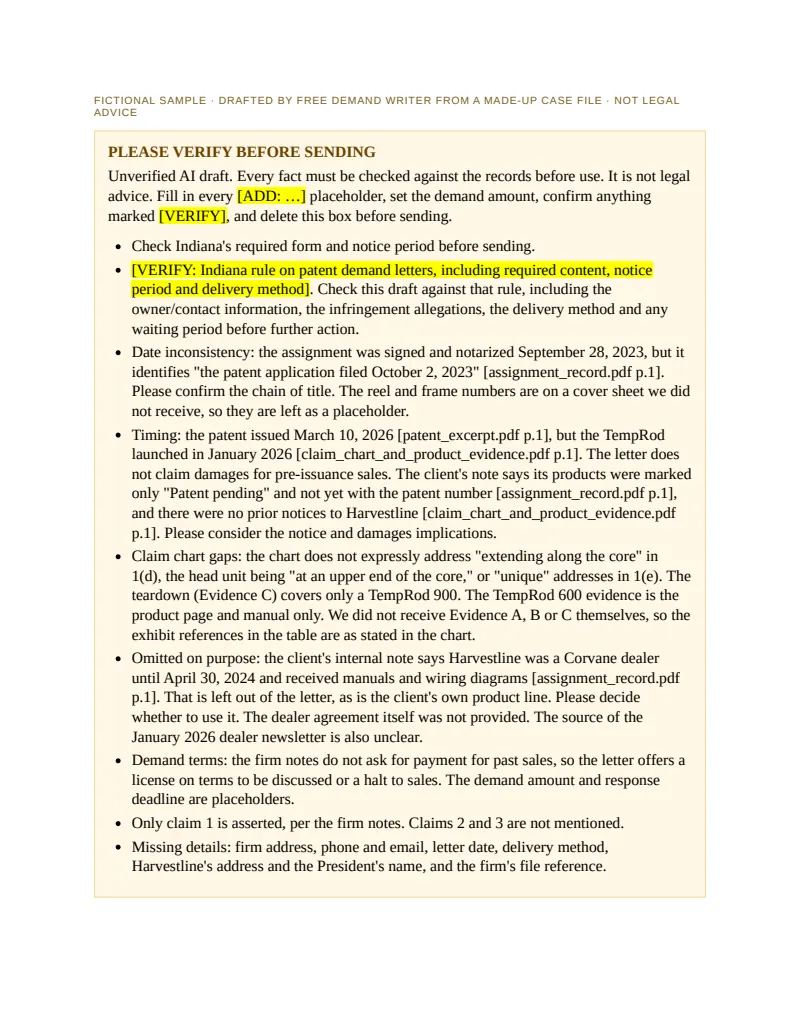
PLEASE VERIFY BEFORE SENDING

Unverified AI draft. Every fact must be checked against the records before use. It is not legal advice. Fill in every [ADD: …] placeholder, set the demand amount, confirm anything marked [VERIFY], and delete this box before sending.

  • Check Indiana's required form and notice period before sending.
  • [VERIFY: Indiana rule on patent demand letters, including required content, notice period and delivery method]. Check this draft against that rule, including the owner/contact information, the infringement allegations, the delivery method and any waiting period before further action.
  • Date inconsistency: the assignment was signed and notarized September 28, 2023, but it identifies "the patent application filed October 2, 2023" [assignment_record.pdf p.1]. Please confirm the chain of title. The reel and frame numbers are on a cover sheet we did not receive, so they are left as a placeholder.
  • Timing: the patent issued March 10, 2026 [patent_excerpt.pdf p.1], but the TempRod launched in January 2026 [claim_chart_and_product_evidence.pdf p.1]. The letter does not claim damages for pre-issuance sales. The client's note says its products were marked only "Patent pending" and not yet with the patent number [assignment_record.pdf p.1], and there were no prior notices to Harvestline [claim_chart_and_product_evidence.pdf p.1]. Please consider the notice and damages implications.
  • Claim chart gaps: the chart does not expressly address "extending along the core" in 1(d), the head unit being "at an upper end of the core," or "unique" addresses in 1(e). The teardown (Evidence C) covers only a TempRod 900. The TempRod 600 evidence is the product page and manual only. We did not receive Evidence A, B or C themselves, so the exhibit references in the table are as stated in the chart.
  • Omitted on purpose: the client's internal note says Harvestline was a Corvane dealer until April 30, 2024 and received manuals and wiring diagrams [assignment_record.pdf p.1]. That is left out of the letter, as is the client's own product line. Please decide whether to use it. The dealer agreement itself was not provided. The source of the January 2026 dealer newsletter is also unclear.
  • Demand terms: the firm notes do not ask for payment for past sales, so the letter offers a license on terms to be discussed or a halt to sales. The demand amount and response deadline are placeholders.
  • Only claim 1 is asserted, per the firm notes. Claims 2 and 3 are not mentioned.
  • Missing details: firm address, phone and email, letter date, delivery method, Harvestline's address and the President's name, and the firm's file reference.

Kettering Shaw LLP
[ADD: firm street address]
[ADD: city, state ZIP]
[ADD: phone] · [ADD: email]

[ADD: date]

VIA [ADD: delivery method]

[ADD: recipient name], President
Harvestline Grain Systems Inc.
[ADD: street address]
[ADD: city, state ZIP]

Re: Notice of Infringement of U.S. Patent No. 12,987,416 – Harvestline TempRod 600 and TempRod 900 Sensing Cables; Our Client: Corvane Agritech LLC; Our File: [ADD: firm file number]

Dear [ADD: recipient name]:

Introduction

This firm represents Corvane Agritech LLC ("Corvane"), the owner of U.S. Patent No. 12,987,416 (the "'416 Patent") [patent_excerpt.pdf p.1; assignment_record.pdf p.1]. Corvane is located at 2200 Elevator Road, Wabash Bend, Indiana [assignment_record.pdf p.1]. We write to notify Harvestline Grain Systems Inc. ("Harvestline") that Corvane believes the Harvestline TempRod 600 and TempRod 900 sensing cables infringe claim 1 of the '416 Patent. We also write to propose a way to resolve the matter. Corvane is open to discussing a license [firm notes].

The patent

The '416 Patent is described below.

ItemDetailSource
Patent number12,987,416[patent_excerpt.pdf p.1]
TitleMulti-Point Moisture and Temperature Sensing Cable for Stored Grain[patent_excerpt.pdf p.1]
Issue dateMarch 10, 2026[patent_excerpt.pdf p.1]
Application filedOctober 2, 2023[patent_excerpt.pdf p.1]
InventorDale R. Ruppert[patent_excerpt.pdf p.1]
Owner (assignee)Corvane Agritech LLC[patent_excerpt.pdf p.1]

The inventor assigned to Corvane the entire right, title and interest in the invention, the application and any patent issuing from it. That assignment includes the right to sue for and collect damages for past, present and future infringement [assignment_record.pdf p.1]. The assignment was recorded with the United States Patent and Trademark Office on October 19, 2023, at reel and frame [ADD: reel and frame number] [assignment_record.pdf p.1].

The accused products

Corvane's investigation identified the following Harvestline products:

ProductLengthSensor nodesListed priceSource
TempRod 60060 ft15$1,795.00[claim_chart_and_product_evidence.pdf p.1]
TempRod 90090 ft22$2,385.00[claim_chart_and_product_evidence.pdf p.1]

Harvestline's product page, saved March 16, 2026, states that the TempRod is "Now shipping, launched January 2026." It states that the TempRod is sold through dealers in Indiana, Illinois and Ohio and online [claim_chart_and_product_evidence.pdf p.1]. A Harvestline dealer newsletter from January 2026 states: "Over 1,400 TempRod cables pre-sold for the 2026 harvest" [claim_chart_and_product_evidence.pdf p.1]. A TempRod 900 was purchased from Prairie Fork Co-op in Lafontaine Creek, Indiana, on an invoice dated February 27, 2026, and examined [claim_chart_and_product_evidence.pdf p.1].

Infringement

Corvane asserts claim 1 of the '416 Patent. Claim 1 recites a grain sensing cable with five elements, (a) through (e) [patent_excerpt.pdf p.1]. A claim chart prepared for Corvane by Owen Bakshi, P.E., dated March 24, 2026, compares claim 1 to the TempRod 600 and TempRod 900. The chart relies on Harvestline's product page (Evidence A), the TempRod Installation and Wiring Manual, Rev. 2, dated November 2025 (Evidence B), and the teardown of a TempRod 900 (Evidence C) [claim_chart_and_product_evidence.pdf p.1]. The comparison is summarized below.

ClaimClaim elementWhere found in the TempRodSource
1(a)A flexible load-bearing core configured to hang vertically within a grain storage binProduct page: "Aircraft-grade steel cable core, hangs from the bin roof" (Ex. A p.1; Ex. C photo 2)[claim_chart_and_product_evidence.pdf p.1]
1(b)A plurality of sensor nodes spaced along the core, each with a capacitive moisture sensor and a temperature sensor15 nodes (TempRod 600) or 22 nodes (TempRod 900), each said to "measure moisture and temperature." Teardown found a capacitive moisture sensing plate and a temperature chip in each node (Ex. A p.1; Ex. C photos 4-6)[claim_chart_and_product_evidence.pdf p.1]
1(c)A vented housing around each node with openings that let air reach the moisture sensor while blocking grain kernelsProduct page: "Slotted node shell lets air in, keeps grain out." Teardown: slotted polymer shell with fine mesh liner (Ex. A p.2; Ex. C photo 7)[claim_chart_and_product_evidence.pdf p.1]
1(d)A two-wire bus connected to each node, carrying both electrical power and digital dataManual: "All nodes share a single 2-conductor bus for power and data." (Ex. B p.9)[claim_chart_and_product_evidence.pdf p.1]
1(e)A head unit at an upper end of the core that assigns each node a unique address on the busManual: "On startup, the head unit assigns each node an address." (Ex. B p.11)[claim_chart_and_product_evidence.pdf p.1]

Based on this comparison, Corvane believes the TempRod 600 and TempRod 900 include each element of claim 1. We are prepared to provide the chart and supporting evidence on request. [ADD: confirm whether the claim chart and exhibits are to be enclosed]

Demand

On behalf of Corvane, we ask that Harvestline do the following:

  • Stop making, offering for sale and selling the TempRod 600 and TempRod 900, or contact us to discuss a license to the '416 Patent on terms to be agreed [firm notes]. Any license discussion would address past sales, and Corvane's position on that is [ADD: demand amount, if the firm wishes to demand payment for past sales].
  • Preserve all documents and electronic data relating to the design, development, manufacture, sourcing, marketing, sale and pricing of the TempRod 600 and TempRod 900, including sales and pre-order records, the manual, product page and dealer communications.
  • Respond to us in writing by [ADD: response deadline].

This letter is intended to give Harvestline the notice and information required for a patent demand letter [VERIFY: Indiana rule on patent demand letters, including required content, notice period and delivery method]. Please direct all communications about this matter to the undersigned at [ADD: attorney phone] or [ADD: attorney email]. This letter is not a complete statement of the facts or of Corvane's rights, claims or remedies. Corvane reserves all of its rights and remedies under the '416 Patent and applicable law.

Sincerely,

Philip A. Kettering
Kettering Shaw LLP