When to use this letter
Use this letter when the driver who caused the crash cannot pay the full claim and your client's own policy carries UM or UIM coverage. Typical cases:
- The at-fault driver had no liability insurance at the time of the crash.
- A hit and run driver was never identified, and the crash was reported to police.
- The at-fault driver's liability limits have been paid or offered and do not cover the full claim.
- Your client was a passenger, pedestrian or cyclist covered as a household member under a family auto policy.
UM/UIM rules vary a lot by state, including how liability payments are credited, whether coverages can be stacked, and whether the insurer must consent before your client settles with the at-fault driver. The draft marks each of these [VERIFY]. If the insurer has already unreasonably delayed or denied the claim, the insurance bad faith letter may fit better.
What to upload
Upload up to 5 PDFs, 500 pages in total. The declarations page and the policy matter as much as the medical file.
- Declarations page and policy
- The declarations page showing UM/UIM limits, plus the policy form and endorsements with the consent, offset and arbitration clauses.
- Crash report
- The police report and any witness statements, so the draft can show the other driver was at fault.
- Liability carrier letters
- Denial letters, limits tenders or settlement offers from the at-fault driver's insurer, or proof there was no coverage.
- Medical records and bills
- Records and itemized bills from each provider, for the treatment narrative and the specials table.
- Wage loss proof
- An employer letter or pay stubs, if your client missed work.
- Claim correspondence
- Letters with your client's insurer, so the draft can pick up the claim number and adjuster name.
What the draft includes
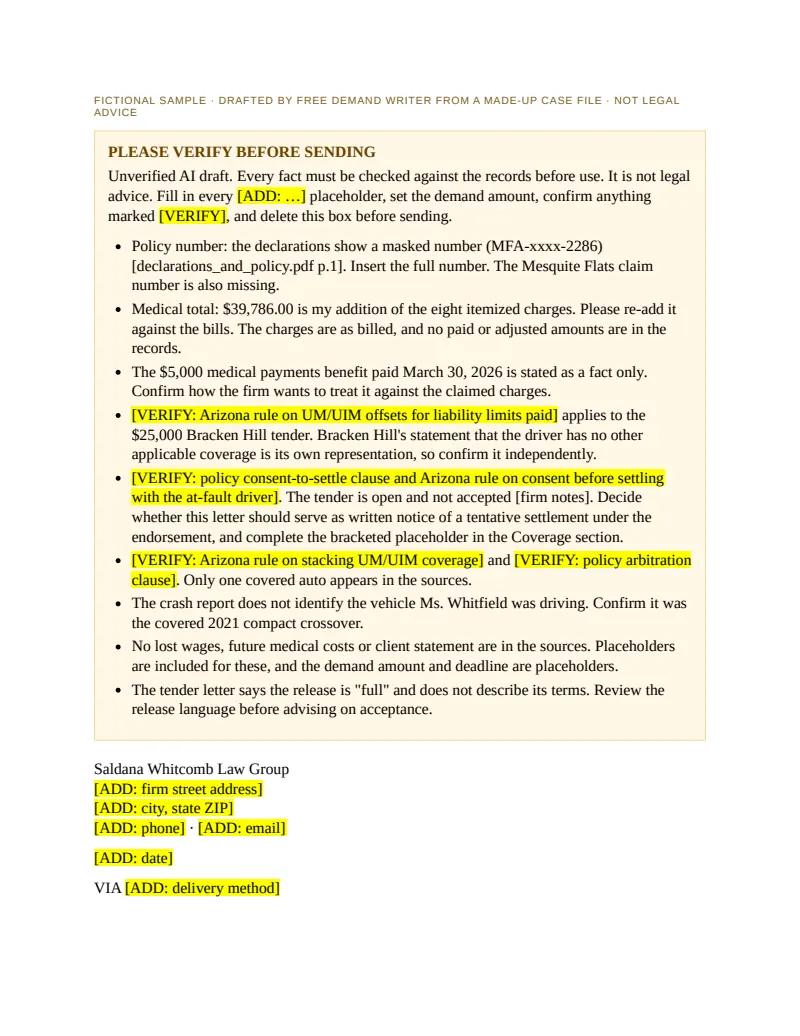
An editable Word letter built only from what your documents say. Missing facts become [ADD: …] placeholders, never guesses, and any law cited is marked [VERIFY].
- Please verify box. A short list at the top of the specific items your reviewer must check in this unverified AI draft.
- Coverage section. UM/UIM limits and the key policy clauses, quoted and cited to the policy pages.
- Fault and the other driver's coverage. Why the other driver is at fault, and whether they were uninsured, underinsured or unidentified, cited.
- Treatment narrative. Each provider and visit in date order, with diagnoses and treatment as recorded.
- Damages table. Medical bills and other losses as read from the documents, with a total for you to confirm.
- State rule flags. Offsets, stacking, consent to settle and arbitration marked [VERIFY] for the governing state.
- The demand. The amount and response deadline are always placeholders. The tool never suggests a number.
Before you send it
The result is an unverified AI draft for attorney review, not legal advice.
- Confirm the UM/UIM limits and endorsements against the full certified policy.
- Check the consent-to-settle clause before your client accepts any liability settlement.
- Confirm how your state credits liability payments and whether stacking applies.
- Match every date, provider and amount to the page cited in brackets.
- Set the demand amount and deadline, and remove the Please verify box.
Common mistakes
UM/UIM claims often go wrong on the policy, not the injuries. These are the problems that come up most.
- Settling with the at-fault driver without consent Many policies require the insurer's written consent before your client releases the at-fault driver. Settling first can put the UM/UIM claim at risk. Read the clause and give notice early.
- Reading only the declarations page Endorsements and exclusions can change who is covered and how much is owed. Get the full policy, not just the summary.
- Ignoring offsets Liability payments, medical payments coverage and other benefits may reduce what the insurer owes. How these credits work varies by state.
- Missing the arbitration or suit deadline The policy may require arbitration or set its own time to sue or demand arbitration. Calendar it when the claim opens.
- Thin proof that the other driver was uninsured Insurers often ask for proof of no coverage. For a hit and run, show the crash was reported promptly.
Free uninsured / underinsured motorist (um/uim) demand letter template
Prefer to write it yourself? Download a plain Word template with fields to fill in. No AI, no email needed. Sample template, not legal advice.
Questions
Is the uninsured or underinsured motorist (UM/UIM) demand letter free?
Yes. No account and no payment.
Who is the letter addressed to?
Your client's own auto insurer, not the at-fault driver's. The draft takes the insurer, adjuster and claim number from the documents where they appear.
Does it work for hit and run claims?
Yes. Upload the police report and any notice to the insurer. The draft marks the policy and state rules on reporting a hit and run [VERIFY].
Will it calculate the offset for the liability payment?
No. It lists any liability payment the documents show and marks the offset rule [VERIFY]. The amount demanded is always left to the attorney.
What happens to the documents I upload?
They are deleted as soon as the draft is generated. The Word file is deleted after 48 hours or 3 downloads.