When to use this letter
Use this letter when a neighbor's conduct or tree has harmed your client's property and your client wants it stopped or paid for. Typical cases:
- Repeated loud noise, barking, music or machinery at night.
- Water runoff from regrading, gutters or a new structure that floods your client's yard or basement.
- A dead or leaning tree the neighbor was warned about fell and damaged a home, fence or car.
- Roots or overhanging branches damaged a foundation, driveway, roof or sewer line.
- A neighbor or their contractor cut or damaged trees on your client's land.
Nuisance and tree damage rules come from state law and local ordinances, and they vary. Some states allow increased damages for cutting another person's trees. The draft never applies a multiplier; check the rules before relying on one.
What to upload
Upload up to 5 PDFs, 500 pages in total. Dated records of the problem and the cost of fixing it matter most.
- Logs and complaints
- Your client's log of dates and times, and any complaints to the neighbor, a homeowners association, police or a code office.
- Photos and video stills
- Photos saved as PDF of the tree, the damage, the runoff or the source of the nuisance, with dates.
- Arborist or expert reports
- An arborist's report on the tree's condition, or an engineer's or drainage report on runoff.
- Prior warnings
- Letters, emails or texts telling the neighbor the tree was dead, diseased or leaning, or asking them to stop the conduct.
- Estimates and invoices
- Tree removal, roof or fence repair, cleanup, replacement tree and landscaping bills or quotes.
- Insurance papers
- Claim letters or denials, if your client or the neighbor reported the loss to an insurer.
What the draft includes
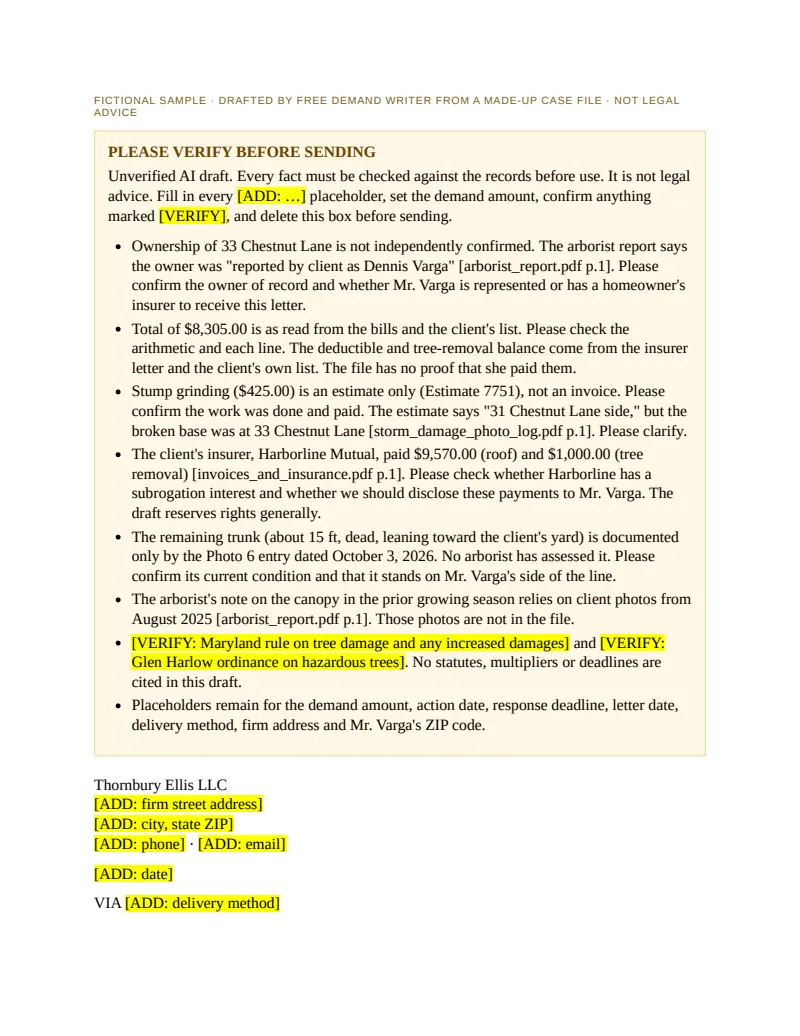
An editable Word letter built only from what your documents say. Missing facts become [ADD: …] placeholders, never guesses, and any law cited is marked [VERIFY].
- Please verify box. A short notice at the top reminding the reviewer that this is an unverified AI draft.
- The properties and parties. Your client's property, the neighbor's property, and how they relate, as the records show.
- What happened. The conduct or the tree event in date order, including any prior warning, each fact cited.
- Harm to your client. How the nuisance affects use of the property, drawn only from the records and logs.
- Damages table. Item, date, amount and source for each documented cost, with the total as read.
- Legal position. Nuisance, trespass or negligence in general terms, with state and local rules marked [VERIFY].
- The demand. Stop the conduct, remove the tree or pay. The action date, amount and deadline are placeholders.
Before you send it
The result is an unverified AI draft for attorney review, not legal advice.
- Confirm each date and cost against the logs, photos and estimates.
- Check the state's tree damage rules and any local noise, tree or drainage ordinance.
- Decide whether the letter should go to the neighbor, their insurer, or both.
- Set the action date, amount and deadline, and remove the Please verify box.
Common mistakes
Neighbor disputes are personal, and a letter that overreaches can harden positions. These errors are the most common.
- No proof of prior notice For a fallen tree, the neighbor's knowledge of its condition often matters. Include warnings and arborist reports, or note that none exist.
- Vague nuisance claims Saying the noise is constant is weaker than a dated log. Tie each claim to a record.
- Assuming increased damages Some states allow more than actual damages for tree cutting, others do not, and conditions apply. Check before you mention it.
- Missing local rules Noise limits, tree permits and drainage rules are often local. Look them up for the property's city or county.
- Emotional language Keep the tone factual. The letter may be read by an insurer, a mediator or a judge.
Free nuisance / tree damage demand letter template
Prefer to write it yourself? Download a plain Word template with fields to fill in. No AI, no email needed. Sample template, not legal advice.
Questions
Is the nuisance and tree damage demand letter free?
Yes. No account and no payment.
Can it send the claim to the neighbor's insurer?
Yes, if your notes or documents say so. Otherwise the draft is addressed to the neighbor, and you can change the recipient in Word.
Will it claim increased damages for tree cutting?
No. It marks state tree damage rules [VERIFY] for your attorney and never applies a multiplier.
Does it work for ongoing noise or runoff?
Yes. Upload dated logs, photos and complaints, and the draft asks the neighbor to stop by a date you set.
What happens to the documents I upload?
They are deleted as soon as the draft is generated. The Word file is deleted after 48 hours or 3 downloads.