Skip to content
Free Demand Writer
Menu
Free Demand Writer

Free Real Estate Failure to Disclose Demand Letter

A real estate failure to disclose demand letter is sent on behalf of a buyer to the seller, and sometimes the seller's agent, after the buyer finds a defect the seller knew about and did not disclose. It sets out what the seller said, what the seller knew, and what the defect costs to fix, and it demands payment of those costs or, in some cases, rescission of the sale.

Free Demand Writer reads the purchase contract, the seller's disclosure statement, the inspection report and the repair records you upload and drafts the letter in Word. It quotes the disclosures with the page they appear on, lays out the evidence of prior knowledge in date order, tables the repair costs, and leaves the demand and deadline to you.

New to this kind of letter? Our guide explains what goes into a demand letter, when to send one and what happens next.

  • Free
  • No sign-up
  • Editable Word (.docx)
  • Files deleted after drafting

When to use this letter

Use this letter when your client bought property and found a defect that the records show the seller knew about before closing. Typical cases:

  • Water intrusion, mold or roof leaks that the seller had repaired before and did not disclose.
  • Foundation, drainage or structural problems painted over or hidden behind new finishes.
  • Unpermitted additions or work the seller marked as permitted or left off the disclosure.
  • Pest damage, septic failures or plumbing problems the seller knew about from earlier service calls.
  • Flooding, insurance claims or neighbor disputes the disclosure form asked about and the seller denied.

Seller disclosure duties, the effect of as-is clauses and inspection contingencies, and claims against agents vary by state. Many purchase contracts also require mediation or arbitration before suit. Check them before the letter goes out.

What to upload

Upload up to 5 PDFs, 500 pages in total. The seller's disclosure statement and the evidence of prior knowledge matter most.

The purchase contract
The signed contract with addenda, counteroffers and any as-is or inspection terms.
The seller's disclosure statement
The completed disclosure form and any supplements, so the draft can quote what the seller said.
The inspection report
The buyer's pre-closing inspection, to show what was and was not visible.
Evidence of prior knowledge
Earlier repair invoices, insurance claims, permits, contractor records, listing photos or statements from neighbors.
Repair estimates and invoices
Contractor bids, invoices and expert reports on the defect and its cost.

What the draft includes

An editable Word letter built only from what your documents say. Missing facts become [ADD: …] placeholders, never guesses, and any law cited is marked [VERIFY].

  1. Please verify box. A short notice at the top reminding the reviewer that this is an unverified AI draft.
  2. The purchase. Property, parties, contract date, price and closing date, cited to file and page.
  3. What the seller disclosed. The relevant answers on the disclosure form, quoted with the page they appear on.
  4. The defect and the seller's knowledge. What was found, when, and the documents that show the seller knew, in date order. The draft never infers knowledge the records don't show.
  5. Damages table. Item, date, amount and source for each repair estimate and cost, with the total as read.
  6. State law points. Disclosure duties, as-is clauses and agent claims are flagged [VERIFY]. The tool never invents legal authority.
  7. The demand. The amount, any rescission request and the deadline are placeholders for you to set.

Before you send it

The result is an unverified AI draft for attorney review, not legal advice.

  • Compare each quoted disclosure answer to the signed form.
  • Confirm the evidence of the seller's prior knowledge and its dates.
  • Check the contract for as-is, inspection, mediation, arbitration and fee clauses.
  • Check the state's rules on seller disclosure and on claims against agents.
  • Set the amount and deadline, and remove the Please verify box.

Common mistakes

Sellers usually answer that the buyer inspected the property and bought it as-is. These are the gaps that answer exploits.

  • No proof the seller knew A defect found after closing is not enough. Tie the claim to records that show the seller's knowledge before closing.
  • Ignoring the inspection report If the buyer's inspector noted the problem, the seller will say the buyer knew. Address what the inspection did and did not reveal.
  • Overlooking the dispute clause Many purchase contracts require mediation or arbitration first. Make sure the letter's next steps fit the contract.
  • Inflated repair figures Upgrades and unrelated work weaken the demand. Limit the table to costs tied to the undisclosed defect.
  • Leaving out the agents Listing agents and sometimes the buyer's own agent may have known. Decide who should receive the letter.

Free real estate failure to disclose demand letter template

Prefer to write it yourself? Download a plain Word template with fields to fill in. No AI, no email needed. Sample template, not legal advice.

Questions

Is the real estate failure to disclose demand letter free?

Yes. No account and no payment.

Does an as-is clause defeat the claim?

Not always, but it matters, and the rules vary by state. The draft quotes the clause and flags it [VERIFY] for your attorney.

Can the letter demand rescission?

Yes, if your notes ask for it. The draft states the request and leaves the terms to you.

Will it decide whether the agent is liable?

No. It notes any agent involvement the records show and flags claims against agents [VERIFY].

What happens to the documents I upload?

They are deleted as soon as the draft is generated. The Word file is deleted after 48 hours or 3 downloads.
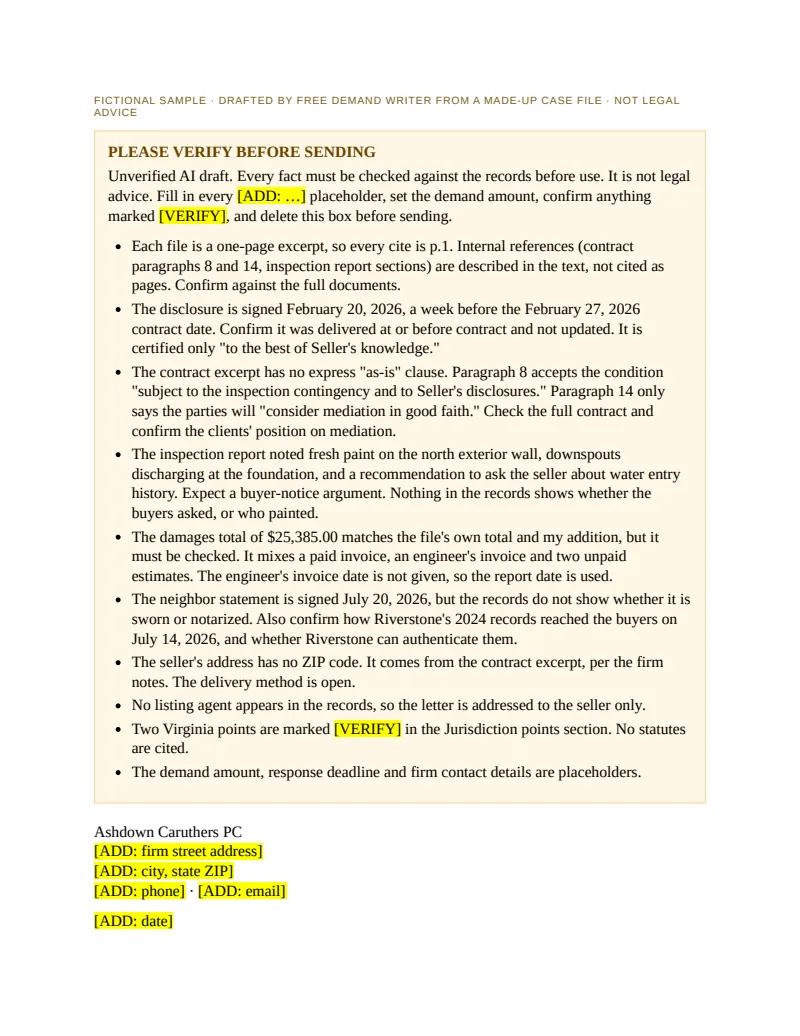
Fictional sample

See a sample draft

We made up a case file and ran it through Free Demand Writer, the same way your documents would be. This is the unedited draft. Everything in it is fictional: the people, the companies and the facts. Virginia home buyers find recurring basement water and a foundation crack behind new paneling after closing, and learn the seller had received a waterproofing estimate for the same problem before listing the house.

Fictional case file: purchase_contract_and_disclosure.pdf, home_inspection_report.pdf, prior_waterproofing_records.pdf, repair_estimates.pdf · State: Virginia

Page 1 of a fictional sample real estate failure to disclose demand letter drafted by Free Demand Writer Download sample PDF

Fictional sample. Not legal advice. Your draft is built from your own documents.

Fictional sample · letter text

PLEASE VERIFY BEFORE SENDING

Unverified AI draft. Every fact must be checked against the records before use. It is not legal advice. Fill in every [ADD: …] placeholder, set the demand amount, confirm anything marked [VERIFY], and delete this box before sending.

  • Each file is a one-page excerpt, so every cite is p.1. Internal references (contract paragraphs 8 and 14, inspection report sections) are described in the text, not cited as pages. Confirm against the full documents.
  • The disclosure is signed February 20, 2026, a week before the February 27, 2026 contract date. Confirm it was delivered at or before contract and not updated. It is certified only "to the best of Seller's knowledge."
  • The contract excerpt has no express "as-is" clause. Paragraph 8 accepts the condition "subject to the inspection contingency and to Seller's disclosures." Paragraph 14 only says the parties will "consider mediation in good faith." Check the full contract and confirm the clients' position on mediation.
  • The inspection report noted fresh paint on the north exterior wall, downspouts discharging at the foundation, and a recommendation to ask the seller about water entry history. Expect a buyer-notice argument. Nothing in the records shows whether the buyers asked, or who painted.
  • The damages total of $25,385.00 matches the file's own total and my addition, but it must be checked. It mixes a paid invoice, an engineer's invoice and two unpaid estimates. The engineer's invoice date is not given, so the report date is used.
  • The neighbor statement is signed July 20, 2026, but the records do not show whether it is sworn or notarized. Also confirm how Riverstone's 2024 records reached the buyers on July 14, 2026, and whether Riverstone can authenticate them.
  • The seller's address has no ZIP code. It comes from the contract excerpt, per the firm notes. The delivery method is open.
  • No listing agent appears in the records, so the letter is addressed to the seller only.
  • Two Virginia points are marked [VERIFY] in the Jurisdiction points section. No statutes are cited.
  • The demand amount, response deadline and firm contact details are placeholders.

Ashdown Caruthers PC
[ADD: firm street address]
[ADD: city, state ZIP]
[ADD: phone] · [ADD: email]

[ADD: date]

VIA [ADD: delivery method]

Gerald Pruitt
18 Tidewell Court, Unit 4
Marlin Shoals, Virginia [ADD: ZIP] [purchase_contract_and_disclosure.pdf p.1]

Re: Demand for Repair Costs – Failure to Disclose Water Entry and Foundation Defects; Andrew and Lena Kowalczyk; 2207 Saddle Creek Road, Bramford, Virginia; Closing April 17, 2026

Dear Mr. Pruitt:

Introduction

We represent Andrew and Lena Kowalczyk [firm notes]. They bought 2207 Saddle Creek Road, Bramford, Virginia, from you under a Residential Purchase Agreement dated February 27, 2026, for $412,000.00. Closing was held on April 17, 2026 [purchase_contract_and_disclosure.pdf p.1].

After closing, our clients found water entry and a cracked foundation wall in the basement. The records described below show that you had received a written waterproofing estimate for these same conditions before you signed your disclosure statement. This letter demands payment of the resulting repair costs.

The purchase and the disclosures

Paragraph 8 of the contract provides that the buyers "accept the Property in its condition as of the contract date, subject to the inspection contingency and to Seller's disclosures" [purchase_contract_and_disclosure.pdf p.1].

On February 20, 2026, you signed the Seller's Property Condition Disclosure. You answered as follows [purchase_contract_and_disclosure.pdf p.1]:

  • Question 6, "Are you aware of any water leakage or dampness in the basement or crawlspace?" You checked: No.
  • Question 7, "Are you aware of any cracks or defects in the foundation?" You checked: No.
  • Question 8, "Have you had any repairs or estimates for water or foundation problems?" You checked: No.

Under additional comments you wrote: "Basement finished in 2025 with new wall paneling and carpet." You certified that "[t]he information above is true and correct to the best of Seller's knowledge" [purchase_contract_and_disclosure.pdf p.1].

Our clients had a pre-closing inspection performed by Blue Ridge Home Inspections on March 6, 2026. The inspector reported that the basement was fully finished, with paneling over furring strips on all perimeter walls and carpet on the floor. He reported that the foundation walls were not visible. He observed no active moisture, found moisture meter readings at the base of the paneling within normal range, and noted a dehumidifier running in the utility closet. The report states that "[c]onditions concealed behind finished surfaces cannot be evaluated" [home_inspection_report.pdf p.1]. The report also notes that no sump pump was present and that fresh paint was visible on the north exterior wall at grade. Its summary recommended asking the seller about any history of water entry [home_inspection_report.pdf p.1].

The defect and what the seller knew

The records show the following, in date order:

  • April 3, 2024. Riverstone Basement Systems visited the property at your request and prepared Estimate No. 24-0417 for you. The technician, Shawn Belcourt, recorded: "Active water entry along north foundation wall after rain. Vertical crack in north wall, approx. 6 ft long, with efflorescence. Standing water at base of wall." Riverstone recommended interior drain tile along the north and east walls, a sump pump, and crack injection, at an estimate of $8,900.00 [prior_waterproofing_records.pdf p.1].
  • April 22, 2024. Riverstone's file notes: "Customer declined, said he would finish the basement instead" [prior_waterproofing_records.pdf p.1].
  • Spring 2024. Your next-door neighbor, Pauline Odum, states that you told her your basement "flooded every time it rained hard" and that you "had to run a shop vacuum" [prior_waterproofing_records.pdf p.1].
  • 2025. Ms. Odum states that she watched contractors put up paneling in the basement and that you said "it would make the house easier to sell." Your disclosure statement likewise says the basement was finished in 2025 with new paneling and carpet [prior_waterproofing_records.pdf p.1; purchase_contract_and_disclosure.pdf p.1].
  • February 20, 2026. You signed the disclosure answering "No" to Questions 6, 7 and 8 [purchase_contract_and_disclosure.pdf p.1].
  • April 17, 2026. Closing was held [purchase_contract_and_disclosure.pdf p.1].
  • June 9, 2026. After heavy rain, water entered the basement along the north wall and soaked the carpet [repair_estimates.pdf p.1].
  • June 11, 2026. Our clients removed a section of paneling and found a vertical crack, staining and old water lines behind it. They photographed the area that day [repair_estimates.pdf p.1].
  • June 30, 2026. Priyanka Sethi, PE, of Hollis & Drake Engineering reported: "The north foundation wall has a vertical crack with mineral deposits and long-term water staining. The staining pattern shows water entry over an extended period before the paneling was installed. The paneling was fastened over the stained areas without repair" [repair_estimates.pdf p.1].
  • July 14, 2026. Riverstone produced its 2024 records to our clients [prior_waterproofing_records.pdf p.1].
  • July 20, 2026. Ms. Odum signed her statement [prior_waterproofing_records.pdf p.1].

Riverstone's 2024 findings describe water entry and a vertical crack in the north foundation wall. The engineer found the same conditions in June 2026. Those findings and the 2024 estimate made out in your name cannot be reconciled with your "No" answers to Questions 6, 7 and 8. The paneling and carpet you installed covered the foundation walls, and our clients' inspector was unable to evaluate what was behind them [home_inspection_report.pdf p.1].

Damages

ItemDateAmountSource
Water cleanup, DryFast Restoration, Invoice 0610-B (paid by buyers)June 10, 2026$1,385.00repair_estimates.pdf p.1
Structural engineer report, Hollis & Drake Engineering (invoice)June 30, 2026$1,150.00repair_estimates.pdf p.1
Riverstone Basement Systems, Estimate 26-0712: interior drain tile, sump pump, crack injection, north and east wallsJuly 12, 2026$18,650.00repair_estimates.pdf p.1
Bramford Interiors, Estimate 4471: remove and replace wet paneling, insulation and carpet in basementJuly 18, 2026$4,200.00repair_estimates.pdf p.1
[ADD: other documented costs, if any][ADD: date][ADD: amount][ADD: source]
Total (as read from the bills)$25,385.00repair_estimates.pdf p.1

Our clients are seeking payment of these repair costs. They are not seeking rescission [firm notes].

Demand

We demand that you pay our clients [ADD: demand amount] to cover the costs of investigating and repairing the water entry and foundation conditions. Payment is to be made by [ADD: response deadline]. Please direct your response, or that of your counsel, to the undersigned.

We note that paragraph 14 of the contract provides that "[t]he parties agree to consider mediation in good faith before filing suit" [purchase_contract_and_disclosure.pdf p.1]. If this matter is not resolved by the deadline above, we are prepared to discuss mediation in accordance with that paragraph.

Our clients reserve all rights, claims and remedies, including the right to supplement the damages above as repairs proceed and further costs are incurred. Nothing in this letter waives any right or remedy.

Jurisdiction points

The contract concerns real property in Virginia, and we expect Virginia law to govern. Our clients' position is that your disclosure answers were false when made and that the conditions were concealed behind finished surfaces. The effect of your disclosure duties and of the contract's acceptance-of-condition language on that position is addressed by Virginia law. [VERIFY: Virginia rule on seller disclosure duties and as-is clauses]

Our clients also reserve any claims against others involved in the sale. [VERIFY: Virginia rule on claims against the listing agent]

Sincerely,

Lydia M. Ashdown
Ashdown Caruthers PC