When to use this letter
Use this letter when your client holds an easement and the owner of the land it crosses is blocking or limiting its use. Typical cases:
- A neighbor installed a locked gate across a recorded right of way.
- A shared driveway is blocked by parked vehicles, equipment or planters.
- A fence, building or grading narrowed an access road below its recorded width.
- An owner is refusing a utility or access easement holder entry for repairs.
- A neighbor denies that a long-used path or drive is an easement at all.
Easements created by long use or by necessity, rather than by a written grant, follow state rules that vary. The scope of a written easement can also be disputed. Check the rules for the property's state before the letter asserts rights in strong terms.
What to upload
Upload up to 5 PDFs, 500 pages in total. The recorded easement is the most important document, so include the full recorded copy.
- The easement
- The recorded easement, right of way grant, or shared driveway or road maintenance agreement, with all exhibits.
- Deeds and plats
- Deeds for both properties and the recorded plat or survey showing where the easement runs.
- Title documents
- A title commitment or policy listing the easement, and any later amendments or releases.
- Photos
- Photos saved as PDF of gates, fences, vehicles or other obstructions, with dates.
- Correspondence
- Requests to restore access and the owner's replies, and any notes from calls or meetings.
- Cost records
- Invoices or estimates for alternative access, repairs, towing, lost rent or other costs the blockage caused.
What the draft includes
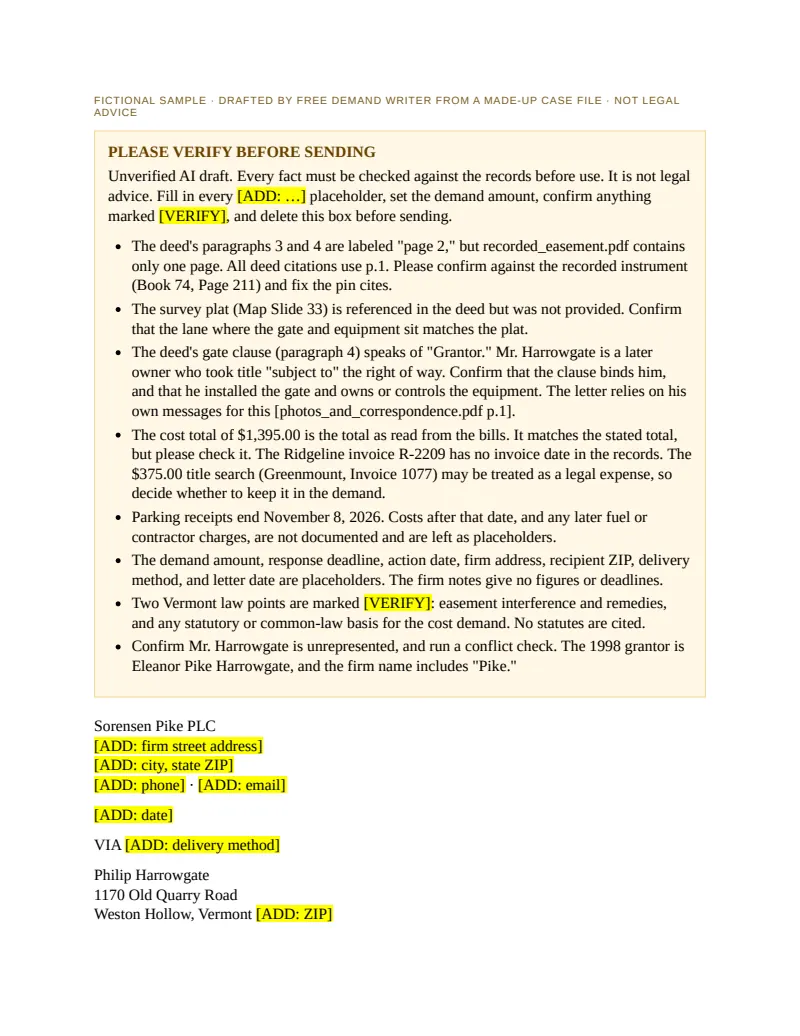
An editable Word letter built only from what your documents say. Missing facts become [ADD: …] placeholders, never guesses, and any law cited is marked [VERIFY].
- Please verify box. A short notice at the top reminding the reviewer that this is an unverified AI draft.
- The easement terms. Location, width, purpose, users and maintenance, quoted briefly with the page cited.
- The interference. Each obstruction, where and since when, in date order, from photos and correspondence.
- Prior requests. When your client asked for access to be restored and what the owner said.
- Costs table. Each documented cost with its date and source, and the total as read.
- Legal position. The duty not to unreasonably interfere, in general terms, with state rules marked [VERIFY].
- The demand. Removal of the obstruction and restored access. The dates and any amount are placeholders.
Before you send it
The result is an unverified AI draft for attorney review, not legal advice.
- Read the quoted terms against the recorded easement, including any amendments.
- Confirm the easement's location and width on the plat or survey.
- If the easement is unwritten, check the state's rules on prescriptive easements and easements by necessity.
- Set the action date, deadline and any amount, and remove the Please verify box.
Common mistakes
Easement letters are read closely by the other side and often by a title insurer. These errors weaken them most.
- Claiming more than the easement grants If the grant is for access only, it may not cover parking or utilities. Stay within the recorded purpose and width.
- Ignoring maintenance terms Many shared driveway agreements split upkeep. A letter that skips them invites a counterclaim.
- Assuming an unwritten easement Long use does not always create a right. Check the state's rules before calling a path an easement.
- Treating every gate as interference Some easements allow a gate if access stays open. Read the terms before demanding removal.
- No dated proof Photos and messages with dates show the obstruction is ongoing. Without them, the letter is easy to deny.
Free easement interference demand letter template
Prefer to write it yourself? Download a plain Word template with fields to fill in. No AI, no email needed. Sample template, not legal advice.
Questions
Is the easement interference demand letter free?
Yes. No account and no payment.
Does it work for a shared driveway with no recorded easement?
Yes, but the draft says plainly that the right rests on use or necessity, and marks the state rules [VERIFY]. It never claims a recorded grant that is not in your documents.
Can a utility or business use it?
Yes. It works for any easement holder, including a utility or a business with an access easement.
Will it demand money?
Only if you want it to. It lists documented costs, and any amount is a placeholder for you to set.
What happens to the documents I upload?
They are deleted as soon as the draft is generated. The Word file is deleted after 48 hours or 3 downloads.